
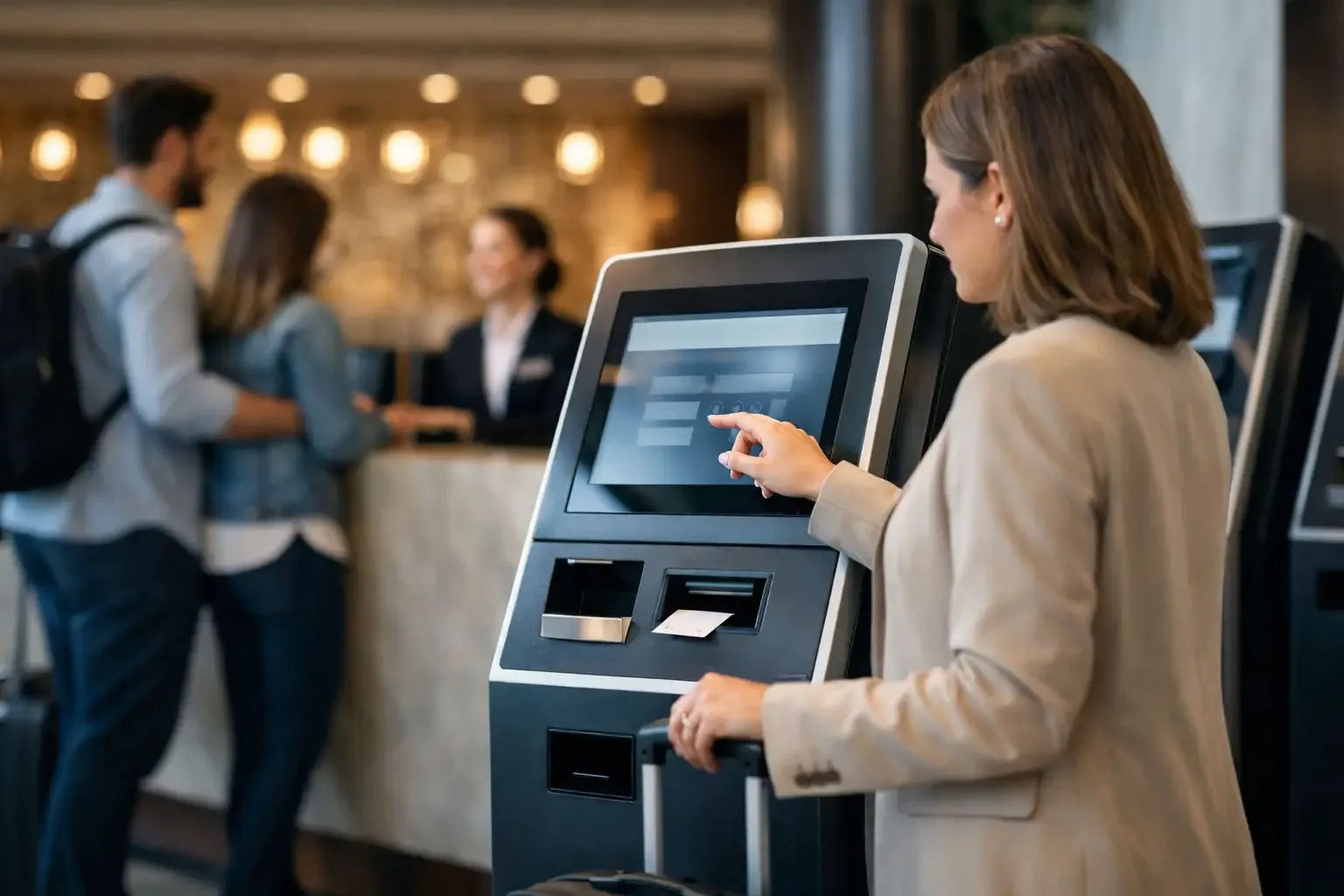
In some hotels, the first impression still begins with a queue. At times of high occupancy, a few simultaneous check-ins are enough for reception to lose its rhythm, for pressure to build on the team and for guests to start their stay with unnecessary friction. This is where automated hotel check-in stops being just a technology option and becomes an operational decision with a direct impact on service, control and profitability.
For hotels with lean teams, extended hours or concentrated arrival peaks, automating the reception process means relying less on repetitive tasks and freeing up resources for higher-value roles. It is not just about modernising the guest experience. It is about reorganising the front desk so that it works better.
What changes with automated hotel check-in
In a traditional model, reception handles booking validation, data collection, document scanning, room allocation, issuing keys or access codes and, in many cases, payment management. Each of these steps demands time, attention and staff availability. As volume rises, so does the risk of error.
With an automated check-in system, a significant part of this flow moves to a kiosk, a dedicated terminal or an integrated digital process. Guests can identify themselves, confirm their details, pay when necessary and receive access instructions without relying solely on reception staff. The result is a more predictable operation that is less prone to bottlenecks.
In practice, automation delivers three immediate gains. The first is speed of service. The second is a standardised process, because every check-in follows a defined logic. The third is availability, especially for properties that need to respond outside conventional hours or with fewer staff on site.
Where the impact is most visible
Not every hotel faces the same challenges, but there are contexts in which automating reception shows its value more quickly. City hotels with high turnover, properties with late arrivals, tourist accommodation with small teams and more self-service concepts benefit particularly from this model.
In highly seasonal destinations, for example, pressure on reception rises within very short windows. Temporarily adding staff does not always solve the problem efficiently. It requires recruitment, training and coordination, with results that are not always consistent. An automated system helps absorb these peaks more steadily.
In small properties too, where the same employee combines operational and front-of-house duties, automation reduces interruptions and allows more focused management. The aim is not to remove human presence where it makes a difference. It is to stop the team being tied up with tasks that can be carried out autonomously and in a controlled way.
Greater efficiency without losing service quality
A frequent objection to automated check-in relates to hospitality. There is a perception that automating arrival reduces closeness and makes the experience more impersonal. In some contexts, that concern is valid. But the issue is not the technology itself. It is how it is integrated into the operation.
If automation is used to eliminate waiting, simplify procedures and give guests autonomy, the effect tends to be positive. Many guests value speed, especially after a long journey, a late arrival or a business trip. In these cases, a clear, self-service process can be more convenient than a slow check-in at the desk.
On the other hand, there are segments where a personal welcome still carries strategic weight. Boutique hotels, upscale properties or concepts with a strong relational component may prefer a hybrid model. There, automated check-in does not fully replace reception. It acts as operational support, cuts queues and offers an alternative for guests who prefer autonomy.
Security, control and operational integration
One of the most important aspects of this type of solution is less visible to guests and more present in day-to-day management: control. When the arrival process relies on manual records, scattered checks and multiple interventions, the likelihood of operational slip-ups grows. This affects compliance, traceability and the quality of the information collected.
Well-implemented automation solutions make it possible to standardise procedures, record every step and reduce reliance on informal practices. Data collection follows a consistent flow, with greater capacity to integrate with property management systems, access control and payment modules.
The payment component is particularly sensitive. In many properties, check-in involves pre-authorisations, settling bookings or charging additional fees. Building this moment into an automated process helps reduce errors, speeds up arrival and improves financial control. For operations managers, this point is decisive, because front-desk efficiency and financial rigour must go hand in hand.
What to assess before going ahead
Adopting automation without analysing the property’s context is a common mistake. The right technology depends on the type of operation, team size, guest profile and the level of integration already in place. A hotel with a 24-hour reception and a large volume of groups will have different needs from a holiday rental with remote access and a lean operation.
Before investing, it is important to understand where the current friction lies. Is the main problem waiting time? Lack of out-of-hours cover? Staffing costs? Registration errors? Scattered payments? The clearer the diagnosis, the more objective the choice of solution will be.
It is also worth assessing the user experience. A system can be technically complete and still create barriers if the interface is not intuitive, if the screen does not guide the process well or if the operation requires too many steps. In hospitality, speed and simplicity are not details. They are central to effectiveness.
Implementation: success lies in the detail
The decision to install a check-in kiosk or platform does not settle the matter. The return depends heavily on implementation. This is where many projects scale up or lose impact. If the solution is not aligned with reception workflows, existing systems and the real profile of guests, the result falls short of expectations.
Integration with the PMS, key systems, document control and payments should be treated as a priority. The fewer breaks there are between platforms, the smoother the process. In addition, the team needs to know how to step in when necessary. Automation does not eliminate human operation. It redefines its role.
Another important point is communication with guests. If the property starts offering automated check-in, this option should be explained clearly before arrival and on site. Signage, simple instructions and quick help in case of doubt make a difference. Autonomy works best when users understand the process effortlessly.
Automated hotel check-in and operational return
When the decision is well framed, the return shows on several fronts. There are visible gains in shorter queues, out-of-hours responsiveness and an optimised reception workload. But there are also less immediate yet equally relevant benefits, such as more consistent procedures and better use of the team.
Instead of concentrating resources on repetitive tasks, the property can direct face-to-face service to situations that are more critical or more commercially valuable. This includes personalised assistance, incident management, selling additional services and monitoring the guest experience.
On the management side, operational predictability improves. More standardised processes make analysis, fixing problems and scaling easier. For hotel groups or multi-property operations, this factor carries even more weight, because it simplifies replicating best practice.
That is also why the topic is no longer limited to large hotels or highly digitalised concepts. Today, the question is no longer whether automation makes sense in hospitality. The question is in what format and with what objective it should be implemented.
A strategic decision, not just a technological one
Seeing automated check-in merely as equipment oversimplifies the subject. What is at stake is the ability to redesign a critical stage of the operation to gain efficiency, control and availability. In a market where the experience counts but so does the margin, this balance is increasingly relevant.
For decision-makers looking to improve reception without adding complexity, automation can be a very concrete step, provided it is tailored to the property, with a focus on the process and not just on technological novelty. SelfPay works precisely along these lines: specialised solutions, implemented with an operational vision and aligned with the real requirements of each business.
In hospitality, reception remains a key point of the experience. But that does not mean it has to keep working the way it always has. When the operation evolves, the service also has room to become faster, more consistent and more profitable.


