
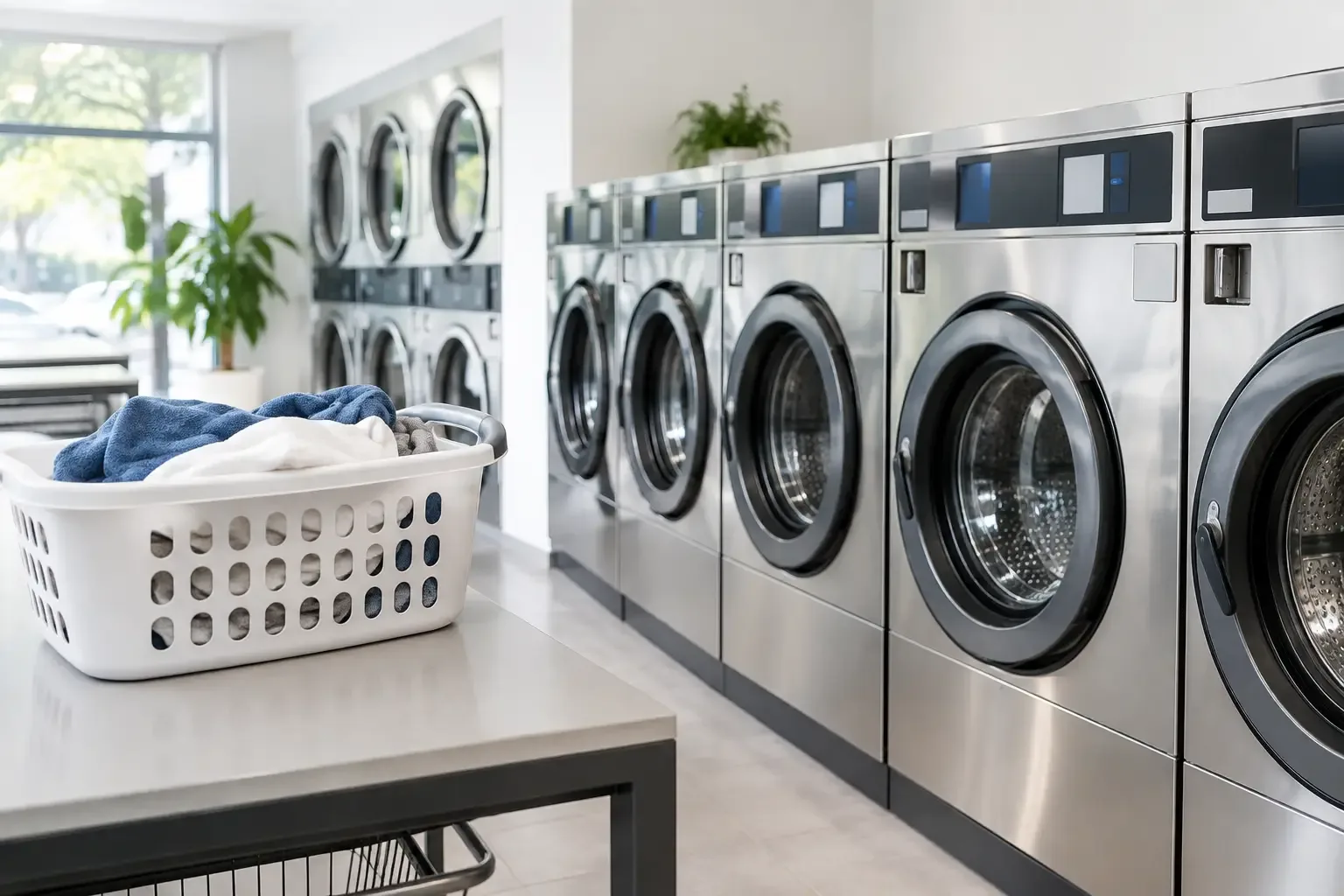
A self-service laundrette can have excellent washing machines and still lose customers and margin through payment failures, unavailable machines or a lack of operational control. Choosing the best equipment for a self-service laundrette is not just about finding the largest capacity or the lowest purchase price. It means designing an autonomous, secure and easy-to-use operation that can run consistently for many hours a day.
For the operator, every technical decision has a direct impact on profitability: well-sized cycles increase turnover, automated payments reduce cash-handling tasks and monitoring systems avoid unnecessary site visits. For the customer, the difference shows in how quickly they can come in, pay, wash and leave. This combination of operational efficiency and user experience should guide the investment.
Best equipment for a self-service laundrette: what to assess
The right configuration depends on the location, the customer profile and the expected volume. A laundrette in a city centre, used by students and residents without a washing machine at home, will have different patterns from one in a tourist area, where short stays and bulkier items dominate. There is therefore no universal list of ideal equipment. There is a solution that suits the business model.
The first criterion is real service capacity. Counting the number of machines is not enough: you need to consider kilos per cycle, the balance between washers and dryers, the space available and peak demand periods. An operation with large-capacity washers but too few dryers creates queues at the final stage of the service and lowers customer satisfaction.
The second criterion is reliability. In an operation without permanent staff, a breakdown can mean an immediate loss of revenue and damage the site’s reputation. Equipment designed for heavy use, with planned technical support and easy access to maintenance components, tends to deliver a more predictable total cost of ownership than alternatives that are cheaper at first.
Finally, integration must be assessed. Machines, payment system, cash management, telemetry and customer communication should work as a whole. When each component is bought without operational compatibility, the manager ends up relying on manual processes and several contacts to solve a simple problem.
Professional washers: capacity, consumption and durability
Washers are the core of the laundrette and should be sized for the most frequent uses. A balanced range usually includes medium-capacity machines for everyday clothes and larger machines for duvets, bed linen, curtains or large family loads. This mix lets you serve several customer profiles without filling the whole space with high-capacity machines that turn over more slowly.
Water and energy efficiency deserve a concrete analysis. An efficient machine may require a higher initial investment but cut costs on every cycle throughout its working life. Even so, you should not rely only on the figures published by the manufacturer. Consumption, programme length, actual load and selling price need to be considered together. A short programme with good washing quality and controlled consumption can significantly increase the number of daily cycles.
Programming matters just as much. Customers expect clear options, not a confusing panel. Programmes for whites, colours, quick washes or bulky items should be labelled intuitively. Where applicable, automatic dosing of detergent and softener improves consistency, reduces waste and removes the need for customers to bring their own products.
The importance of G-force and installation
The G-force of the spin affects how much moisture remains in the clothes at the end of the wash. The more effective the extraction, the less time is usually needed in the dryer. This improves the customer experience and can reduce the overall energy use of the service.
However, the choice must take the site conditions into account. Flooring, drainage, ventilation and available electrical power all affect installation. A technical survey before purchase avoids extra building work, delays to opening or under-used equipment.
Dryers: the equipment that sets the turnover
Many operators focus on washers and underestimate dryers. In practice, drying is often what determines how fast the operation runs. If the dryers cannot keep up with washing capacity, customers pile up waiting, even when washing machines are free.
The ratio between washers and dryers should be calculated from capacity and expected customer behaviour. Not everyone uses the dryers, but those who do expect a fast, even result. Professional machines with temperature control, drum reversal and programmes suited to different fabrics help reduce unnecessary cycles and protect garments.
The energy source is an operating decision. Depending on infrastructure and local costs, electric, gas or another available option may be more advantageous. What matters is comparing operating costs, installation requirements, maintenance and drying time, rather than deciding on purchase price alone.
Payment systems: less friction, more control
In a self-service laundrette, payment is as critical as the machine. A customer who cannot pay easily does not start a cycle. An operator who collects and manages cash manually takes on the risk of errors, theft, running out of change and administrative time.
An automated payment system should accept the methods most relevant to the local customer base, such as coins, notes, cards and digital payments. The wider the range of options, the lower the chance of losing a sale because a specific payment method is missing. The interface should show prices, instructions and confirmation clearly on a readable screen.
Automated cash management adds security and accuracy to the process. Specialist solutions validate notes and coins, give the correct change and reduce staff exposure to cash handling. As well as reducing cash discrepancies, this automation simplifies reconciliation and lets the operator spend time managing the business rather than counting by hand.
SelfPay Portugal works precisely in this area, with automated payment solutions for in-person operations that want to gain control, security and autonomy in customer service.
Remote monitoring and operational management
Self-service should not mean lack of oversight. Remote monitoring lets you track machine status, check cycles in progress, spot unavailable machines and analyse usage patterns. This data is particularly useful for planning maintenance, adjusting cleaning schedules and understanding whether installed capacity is correctly sized.
A laundrette with higher demand in the evening may benefit from off-peak pricing or promotions. A site where large-capacity machines are heavily used may justify buying another machine of that type. Without data, these decisions rest on impressions; with data, they gain an operational basis.
Remote management also reduces reactive call-outs. Receiving a fault alert before a visit means you can bring the right part or call technical support with more precise information. The result is less downtime and less impact on the customer.
Complementary equipment that adds value to the service
The essentials are washing, drying and paying without difficulty. But some complementary equipment can increase perceived value and create extra revenue. Folding tables, seating, trolleys, automatic detergent dispensers, bag dispensers and vending machines for useful products make the experience more complete.
These items should be chosen carefully. In a small space, adding too much equipment can hinder movement and look disorganised. On the other hand, in a laundrette in a residential area, a comfortable folding area and a convenience vending machine can meet real needs and encourage repeat visits.
Physical security is also part of the equation. CCTV, good lighting, clear signage and materials built for heavy use help protect the investment and inspire confidence. In unstaffed spaces, these details directly influence the perception of quality.
How to make a safer investment decision
Before settling on a configuration, start by mapping the customer journey: how they come in, choose a machine, pay, wait, dry and leave. Then analyse the operational side: who restocks consumables, collects cash when needed, cleans the space, responds to breakdowns and monitors performance indicators.
It is also worth calculating the investment with a long-term view. Purchase price, installation, consumption, maintenance, downtime and payment methods are all part of the real cost. A machine that is cheaper to buy can end up more expensive if it needs frequent repairs or gives the customer a slow experience.
The best self-service laundrette is one that makes the process predictable for everyone: the customer finds available machines and simple payment; the operator gains visibility over revenue, usage and incidents; and the operation stays efficient even without a constant presence on site. When equipment is chosen as an integrated system, automation stops being just a technical feature and becomes a daily business advantage.


