
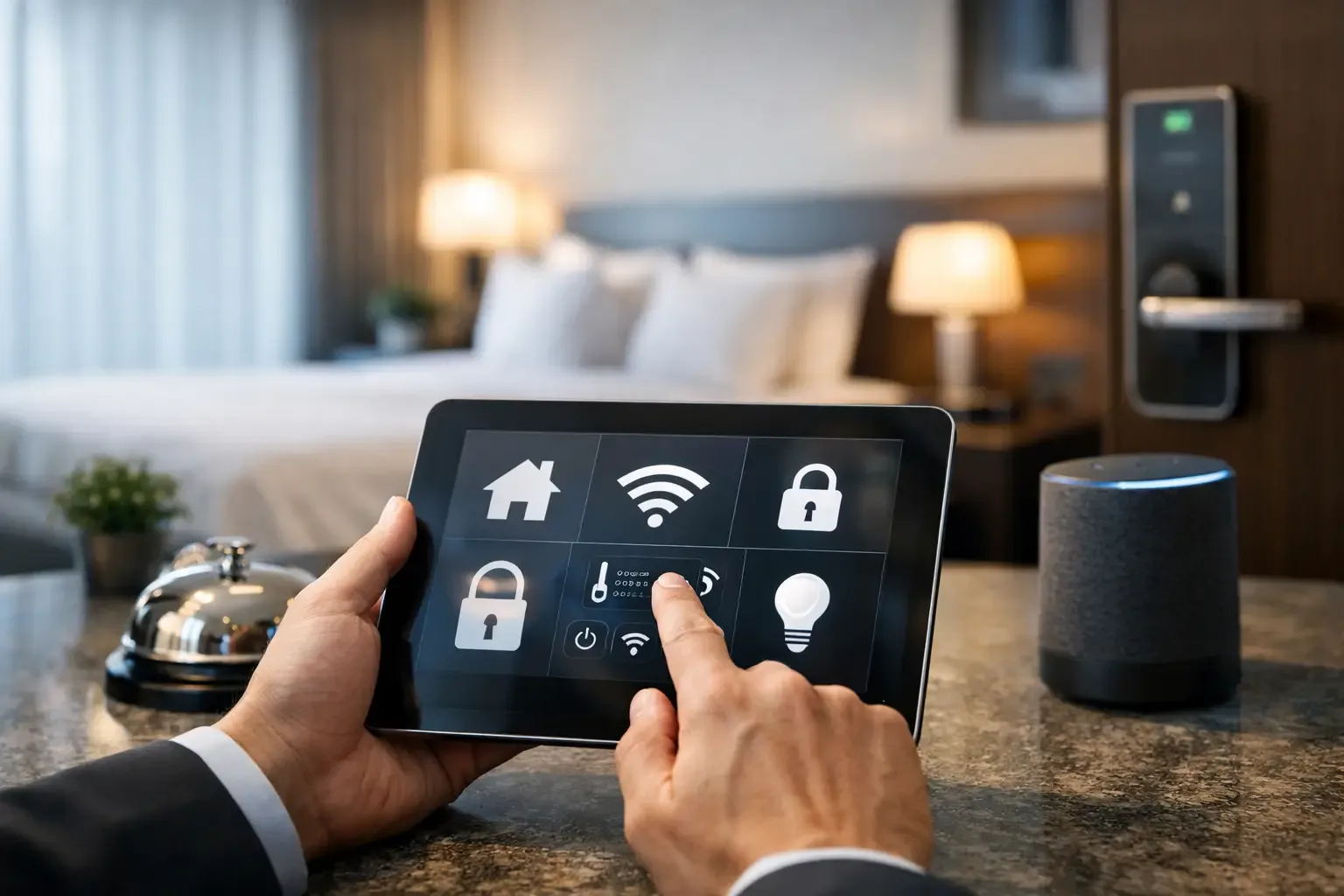
A front desk with guests waiting to check in, phones ringing and a team switching between in-person requests and admin tasks quickly loses service capacity. This guide to hospitality automation starts from that concrete problem: automating does not mean replacing hospitality, but removing from the front desk the repetitive tasks that consume time, create errors and delay the guest’s arrival in the room.
For a hotel, the decision should be operational before it is technological. The goal is not to install standalone equipment, but to create a faster, safer and more controlled journey, from booking through to check-out and payment.
Where automation has the greatest impact in a hotel
Automation delivers the greatest return when it targets high-volume, low-complexity processes with well-defined rules. In hospitality, check-in, key issuing, data collection, payment of fees and extras, and check-out are the most obvious examples.
A check-in kiosk allows the guest to validate the booking, identify themselves, settle outstanding payments and receive the key without relying on the front desk at all times. This is especially relevant in city hotels, airport properties, accommodation with late arrivals and operations with occupancy peaks concentrated at certain times.
The benefit is not limited to shorter queues. A team under less pressure from transactional tasks can focus on situations that require human intervention: welcoming families, answering questions about the stay, handling booking changes or supporting a guest with specific needs. Technology handles the predictable process; the team handles the relationship.
Payment management is another decisive area. Where there are cash payments, deposits, extra charges or till discrepancies, manual control exposes the operation to errors and reduces traceability. Suitable payment automation systems help standardise procedures, limit cash handling and ensure every movement is recorded.
How to set priorities before investing
There is no single solution for every hotel. A 15-room property with a limited front desk faces different challenges from a 150-room hotel, an aparthotel or a chain with several service points. Before choosing technology, you need to map how the operation really works.
Start by analysing the moments of greatest pressure. How many guests arrive at the same time? How long does each check-in take on average? What percentage of arrivals happen outside the hours when most staff are present? How many requests are repetitive? And where do communication failures, outstanding payments or data entry errors arise?
This analysis lets you distinguish a capacity problem from a process problem. If the front desk is overloaded only at specific times, a check-in kiosk can absorb a significant share of the flow. If the difficulty lies in cash control or end-of-day reconciliation, the priority may be payment automation. If the biggest cost comes from out-of-hours service, a self check-in solution becomes more relevant.
The guest profile also matters. Guests used to digital processes tend to value independence and speed. However, some segments prefer in-person support, especially on longer stays, group trips or when the booking has special conditions. The best operation does not force every guest to use the same channel: it offers independence to those who want it and assisted service to those who need it.
Hospitality automation guide: essential components
An effective strategy starts by integrating the elements that directly affect the guest journey and internal management. The first is the property management system, or PMS, which holds bookings, availability, guest data and room status. Any automation solution must communicate reliably with this system to avoid duplicated work or outdated information.
The second component is the check-in kiosk. Equipment such as Roommatik solutions makes it possible to automate check-in and check-out, with features adapted to the hotel environment. Depending on the configuration and the property’s needs, the kiosk can validate bookings, collect documents, process payments, issue key cards and provide information to the guest.
The third is the payment infrastructure. The equipment must accept the payment methods relevant to the property’s guests and fit into existing financial processes. Where cash is involved, automating cash management becomes particularly important to reduce discrepancies, strengthen security and simplify reconciliation at the end of each shift.
Finally, there is the operational layer: exception rules, alerts, access permissions, remote support procedures and staff training. This is where many projects fail. A piece of equipment may be technically advanced, but it will not deliver results if the team does not know how to step in when a booking cannot be found, a document is not validated or a guest needs assistance.
Integration is not a technical detail
The quality of the integration determines the final experience. When the PMS, payments, access control and kiosk work as separate systems, the front desk still has to correct data manually. This reduces efficiency and frustrates both guests and staff.
Before implementation, confirm that critical flows are defined: direct and platform bookings, early check-ins, group arrivals, upgrades, tourist taxes, partial payments, rooms not yet ready and the issuing of second keys. You do not need to automate every exception from day one, but you must know how each will be handled.
The balance between independence and human service
An automated front desk should not feel impersonal. Guests judge the experience by how long it takes to complete a task, how clear the instructions are and how easy it is to get help when something does not go as planned. An intuitive screen, instructions in several languages and an immediate way to contact the team make a difference.
Independence is valued most when it is optional and well presented. A guest arriving late appreciates completing check-in in a few minutes. Another may prefer to speak to someone for recommendations about the area, to ask for a cot or to clarify the terms of the stay. The hybrid model responds better to both scenarios.
For management, this requires a change of mindset. The front desk team is no longer judged only by the number of check-ins processed and has more time for service quality, handling exceptions and selling additional services. Automation creates capacity, but it is the organisation that turns that capacity into value.
Security, compliance and operational control
In hospitality, automation involves handling personal data, access credentials and financial transactions. That is why security must be considered from the outset when choosing a solution. Access to systems should be controlled by user profiles, logs should allow auditing and procedures must comply with applicable data protection obligations.
When it comes to payments, reducing cash handling lowers exposure to errors, losses and till discrepancies. It does not remove the need for control, but it makes that control more objective. Instead of relying on manual counts and scattered records, management works with identified transactions and standardised processes.
It is also advisable to define who monitors alerts, who can intervene remotely and what the plan is if the network goes down or equipment fails. Automation must include business continuity, not just normal operation.
Phased implementation reduces risk
Rather than changing every process at once, a phased implementation lets you measure results and adjust procedures. A property might start by automating check-in during hours with less staff cover, monitor guest uptake and gradually extend the service. In another case, the first step might be modernising payment control before moving on to self-service kiosks.
Define concrete indicators before launch: average check-in time, percentage of self-service transactions, number of front desk interventions, till discrepancies, guest reviews and the cost of out-of-hours service. This data lets you assess the return based on the operation, not just on a perception of modernity.
Training should accompany each phase. Staff need to understand the process from the guest’s point of view, be able to answer the most common questions and know when to refer a case to specialist support. Internal communication is as important as the choice of equipment.
SelfPay works with specialist solutions to automate payments and in-person service, including Roommatik kiosks designed for the needs of the hospitality sector. The right choice will always depend on the type of property, the integration required and the operational objectives set.
Automating a front desk is not about taking people out of the service. It is about ensuring that, when a guest really needs a person, they find a team that is available, informed and able to respond with quality.