
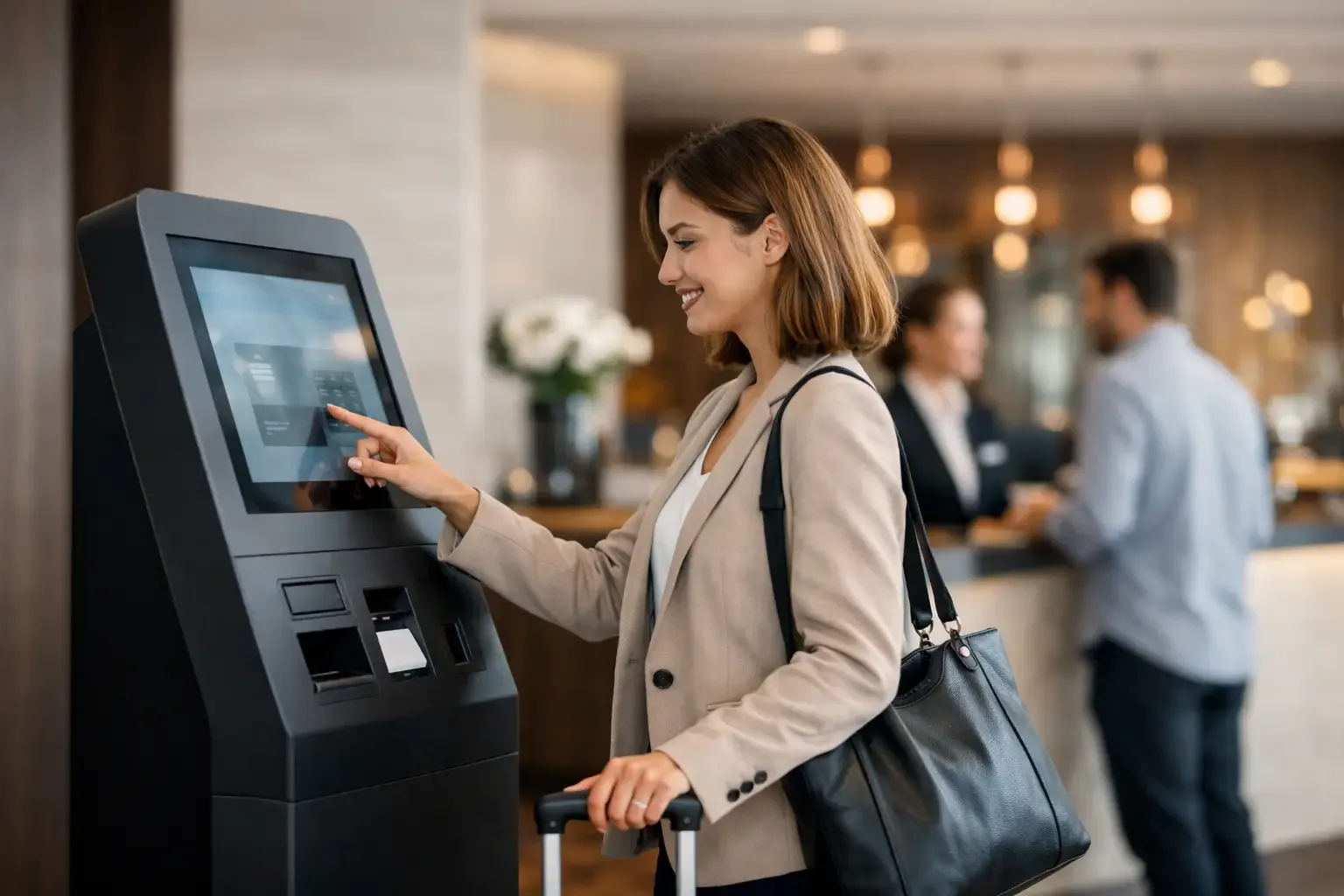
At the busiest time at the front desk, the problem is not just the queue. It is the sum of repetitive tasks, document checks, key issuing, operational questions and time lost on processes that add little to the service. This is where a hotel check-in kiosk stops being just a modern piece of equipment and becomes a concrete tool for operational efficiency.
For hotels with arrival peaks, small teams or a need for 24/7 service, automating check-in can mean less friction at arrival, greater responsiveness and better control of the process. But not every hotel gets the same value from the solution. The return depends on the type of operation, the guest profile and how the technology is integrated into the front desk.
What is a hotel check-in kiosk
A hotel check-in kiosk is a self-service unit that allows guests to complete stages of the arrival process on their own. Depending on the configuration, it can handle identification, data collection, digital signatures, payment of fees or extras and the issuing of a room key card or access code.
In practice, this type of solution moves tasks that traditionally require constant front desk involvement to an automated point. The aim is not to eliminate human service in every context. It is to reduce the operational load where automation is most effective and free the team for higher-value situations, such as personalised support, handling exceptions and looking after the customer experience.
In city hotels, professionally managed holiday lets, aparthotels and high-turnover properties, this logic makes even more sense. When the arrival process is predictable, standardised and repeated dozens of times a day, automation tends to deliver results faster.
Why the traditional front desk no longer responds in the same way
The classic front desk model still works in many properties. Even so, market expectations have clearly changed. Guests value speed, independence and availability outside peak hours. Waiting to complete a simple administrative process is less and less acceptable, especially in competitive tourist markets.
At the same time, hotels face pressure on operating costs, difficulty in reinforcing teams and the need to keep service consistent. When everything depends on manual intervention, the risk of error grows. A wrongly recorded document, a forgotten charge or a long queue directly affects the operation and the perception of the service.
The kiosk does not solve everything on its own, but it tackles a critical part of the problem well: repetitive work that depends on the team being immediately available.
The most relevant operational benefits
The most visible gain is shorter check-in times. When guests can complete simple steps on their own, the front desk is no longer a bottleneck. Instead of a single queue for every case, the operation can split the flow.
There is also an important productivity benefit. The team no longer has to focus on basic administrative tasks and can step in where it makes the most difference. This is particularly useful on night shifts, during periods of high occupancy and in operations with lean teams.
Another relevant point is standardisation. An automated process follows defined rules, reduces variation in service and helps ensure that certain steps are always completed. Where compliance and consistency matter, this stability has value.
Round-the-clock availability is another strong argument. A hotel that wants to give guests more independence or guarantee out-of-hours arrivals without adding staff will find a practical answer in this model. It does not always mean a front desk without people, but it allows more flexible operations to be designed.
Where a hotel check-in kiosk makes the most sense
Not every hotel has the same operational profile. A boutique hotel strongly focused on a personal welcome may prefer to keep a greater human presence at first contact. A property with a high volume of arrivals concentrated in a few hours, on the other hand, tends to benefit much more from automation.
A hotel check-in kiosk makes sense above all when one or more of these factors apply: a need to reduce queues, frequent late check-ins, staffing constraints, high international demand, many simultaneous arrivals or a focus on more self-service processes.
It can also be a relevant solution for hotel groups looking to scale procedures and maintain standards across several properties. When the operation can be replicated, automation stops being a mere convenience and becomes a method.
What to assess before implementing
The decision should not be based solely on an image of innovation. A successful project starts by assessing how the property really operates. How many check-ins are there per day, in which time slots, with what guest profile and with what level of staff involvement? Without this analysis, the risk is installing technology that goes underused.
Integration with the hotel’s systems is one of the most critical points. The kiosk must communicate reliably with the PMS, with access control solutions and, where applicable, with payment methods. If the experience at the kiosk is simple but the back end remains fragmented, efficiency suffers.
Another essential aspect is usability. Guests need to understand quickly what to do on screen, in several languages if necessary, without relying on constant support. A confusing interface shifts the problem instead of solving it.
It is also worth looking at the physical layout of the front desk. The kiosk should be placed somewhere visible, intuitive and in line with how guests move through the space. The right technology in the wrong place loses its effectiveness.
Automation does not mean dehumanisation
This is one of the most common fears among hotel managers. The concern is legitimate, but it depends a great deal on how the solution is implemented. A kiosk does not replace hospitality. It replaces repetitive tasks that take up the team’s time.
In practice, many hotels manage to improve the experience precisely because they no longer require staff to act as a permanent administrative counter. With less operational pressure, the team can give more attention to special requests, questions and moments when human contact is truly valued.
The central question is not choosing between people and technology. It is deciding which part of the process should be automated so that human service becomes more available and better qualified.
Challenges and limits to consider
There are always trade-offs. A property with older guests less used to digital interfaces may need closer support at first. Hotels with a strong relational focus may opt for a hybrid model, in which the kiosk speeds up certain steps but does not take over the whole process.
It is also important to plan for exception handling. Bookings with issues, groups, last-minute changes or incomplete documents require human intervention. That is why the kiosk should be seen as part of the operation, not as a standalone solution for every scenario.
Another point is maintenance and monitoring. Like any front-office technology, the kiosk needs to be stable, up to date and properly configured. When the equipment or the digital flow fails, the impact on the guest’s perception is immediate.
The role of implementation in the return on investment
The return does not depend on the equipment alone. It depends on the quality of the implementation. When the solution is adapted to the property’s flow, connected to existing systems and supported by a consultative approach, results tend to appear more quickly.
The gains can come on several fronts: less administrative work, greater operational independence, less need for extra staff at critical times and a faster arrival experience. In some contexts, this also means a greater ability to operate extended hours without a proportional rise in front desk costs.
This is where a specialist approach makes a difference. In hospitality, automating is not just about installing equipment. It is about redesigning a critical point of the operation with a direct impact on service, productivity and brand perception.
How to approach the decision pragmatically
The best question is not whether the technology is fashionable. It is whether it solves a concrete operational problem for the property. If the front desk faces peaks, pressure on the team and a need for more independence, the investment can make a lot of sense. If the current process already suits the hotel and its guests, a partial or phased implementation may be the way forward.
For many operators, the most effective scenario is the hybrid model. Guests gain speed and independence when they want it, while the team retains the ability to step in personally. This balance usually brings better internal acceptance and a smoother transition.
In an increasingly demanding hotel market, front desk efficiency is no longer an operational detail. It is part of the experience and of profitability. A well-planned check-in kiosk can be a very concrete step in that evolution, especially when the decision focuses on the process and not just on the equipment. It is this practical approach that turns automation into results.


