
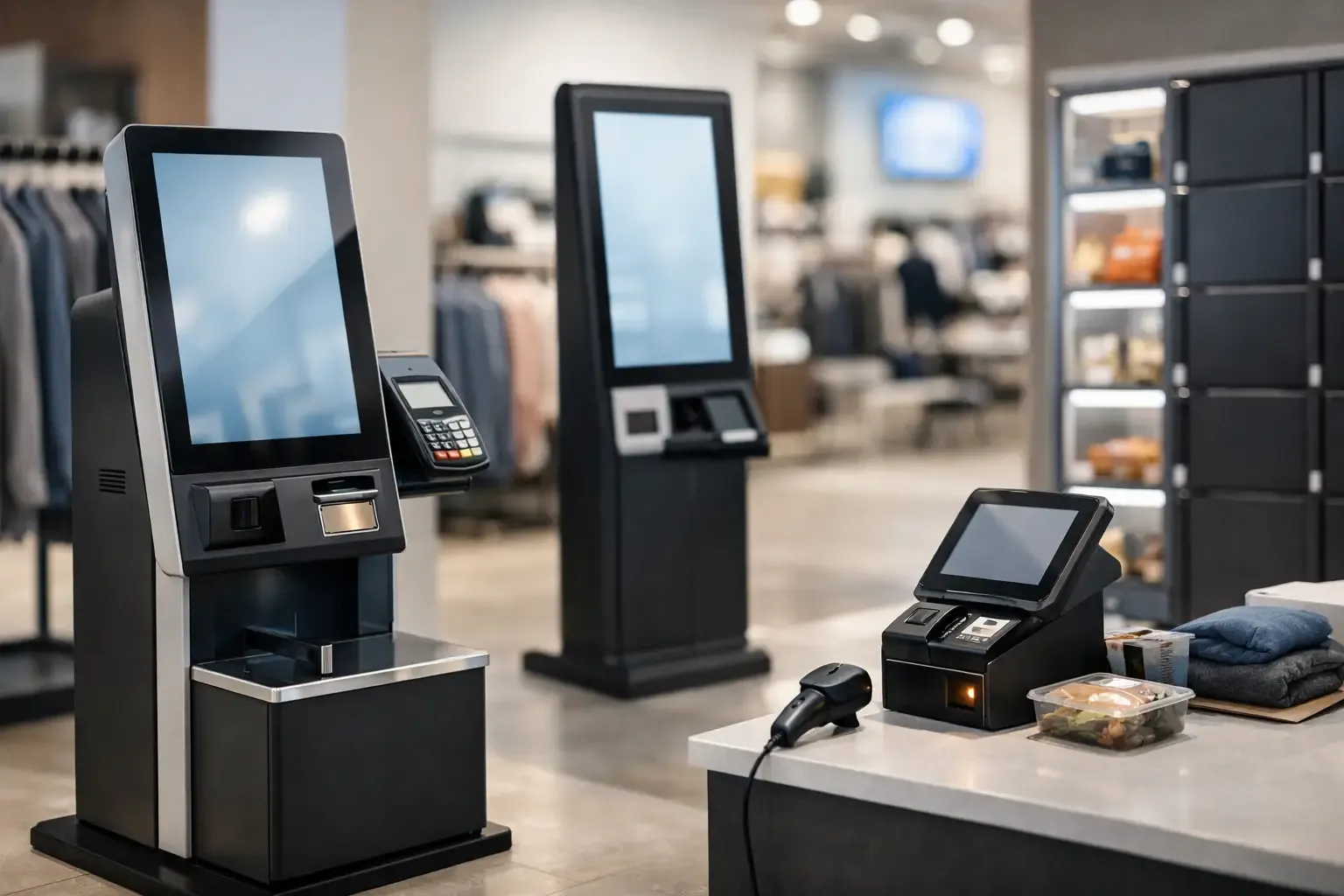
In a shop with peaks in footfall, a single badly managed queue is enough to lose sales, cause frustration and put pressure on the team. This is exactly where self-service equipment for shops stops being just a technology option and becomes an operational decision. When properly implemented, it cuts waiting times, improves control over the point of sale and makes the payment process faster, safer and more predictable.
The real question is not just installing a kiosk or automating a till. It is understanding what type of equipment makes sense for your store format, your customer profile and the way the business runs every day. In retail, effective automation is the kind that removes real friction, without complicating service or creating reliance on parallel processes.
Which self-service equipment makes most sense for shops
When people talk about self-service equipment for shops, they often think only of stand-alone payment terminals. But the reality is broader. Depending on the sector and the format of the operation, the solution may involve ordering kiosks, automated cash management systems, assisted payment points or hybrid equipment that keeps staff support at critical moments.
In a shop with a high volume of transactions and cash payments, till automation can have an immediate impact. By eliminating direct cash handling by staff, the risk of change errors falls, security improves and cashing up becomes simpler. This type of solution is particularly relevant in operations where speed and reliability of service directly affect profitability.
In venues where customers value independence, such as convenience stores, self-service launderettes or outlets with a simple, recurring offer, self-service kiosks can absorb a large share of the service flow. The benefit here is not only speed. It is also the ability to keep the service available more consistently and with less need for constant staff intervention.
What changes in a shop’s operation
The main gain from automation is neither aesthetic nor purely technological. It is operational. A shop that integrates self-service equipment in the right way can reorganise tasks, free up resources for higher-value roles and remove several points of failure that used to be treated as inevitable.
In customer service, the most visible improvement is response time. Less waiting means smoother flow, fewer walkouts and a better customer experience. In urban settings and areas of heavy footfall, this difference can be decisive. A slow payment process does not just affect satisfaction. It affects the real capacity to serve more people in the same period.
In internal management, the impact is also significant. Automated cash solutions strengthen control over money coming in and going out, reduce discrepancies and make auditing easier. For managers and owners, this means more visibility over the operation and less exposure to manual errors. It does not eliminate every risk, but it removes a significant share of recurring till problems.
There is also a third, often underestimated effect: reorganising the team. When staff are no longer tied up with repetitive payment tasks, they can devote more attention to restocking, customer support, assisted selling or store control. In many cases, the return comes precisely from this redistribution of work.
How to choose the right solution
Not every shop needs the same level of automation. The right decision depends less on the category of equipment and more on four factors: transaction volume, payment mix, customer profile and the complexity of the service.
If the operation takes a lot of cash payments, the priority may be automating cash handling. If the aim is to reduce queues at peak times, it makes more sense to look at self-checkout points or fast payment kiosks. If the store experience requires advice and guidance, the best answer may not be to replace human contact but to create a mixed model.
It is also important to assess how independent your customers are. In some shops, users quickly adapt to a self-service process. In others, especially where products need more explanation, technology should support the service rather than try to replicate it entirely. This is decisive in avoiding investments that look modern on paper but see little take-up in practice.
Integration with existing systems is another essential criterion. The equipment must work together with the invoicing software, payment methods and the store’s control processes. If the solution creates extra reconciliation, supervision or support work, the operational gain may fall short of expectations.
Where the return usually shows first
The return on investment in self-service equipment for shops tends to appear in very specific areas. The first is productivity. When a point of sale serves more customers with fewer interruptions, the impact is felt quickly. The second is fewer errors, especially in cash operations. The third is security, both through lower exposure of cash and through less manual handling.
But one point deserves a realistic view: the return does not always come solely from cutting direct costs. In many businesses, the value lies in increasing operational capacity without proportionally expanding the service structure. This is especially relevant for shops with tight margins, long opening hours or staff shortages.
There can also be a return in service consistency. An automated process tends to be carried out the same way, with less variation between shifts, teams and periods of greater pressure. For those managing several locations, this matters because it helps standardise the operation and makes expansion easier.
Automating does not mean dehumanising
One of the most common objections to self-service is the fear of losing closeness with the customer. That risk exists, but it depends on how the solution is designed. When technology is introduced to replace useful interaction, the experience gets worse. When it is used to remove low-value tasks, service improves.
In a retail shop, customers do not always want to talk to someone to complete a simple payment. What they want is speed, clarity and independence. In situations involving questions, exchanges or more complex decisions, however, they still value human support. The most effective solution is often one that combines automation of the transaction with staff presence where it really makes a difference.
This means the implementation should be supported by flow design, clear signage and team preparation. Equipment alone does not fix a poorly defined process. And a simple interface does not remove the need for initial guidance, especially in the first weeks of use.
Practical criteria before investing
Before going ahead, it is worth answering a few objective questions. Where are the main delays in the shop today? Is the problem in ordering, payment, cash handling or lack of control? Are customers ready to use a self-service point? Can the team adapt to a new workflow? Is there suitable physical space for installation without hampering circulation and product display?
Another important issue is scalability. A solution may work in a pilot shop and not perform the same way in other locations with different profiles. That is why it makes sense to work with technology suited to the sector and with professional implementation that can accommodate operational differences.
This is where a specialist approach is worth more than a generic offer. Rather than choosing equipment purely on technical specifications, the most effective approach is to assess the business context, the operational objectives and the type of experience you want to offer. For many companies in Portugal, this analysis is what separates an equipment purchase from a genuine point-of-sale modernisation project.
The role of sector specialisation
In retail, restaurants, hotels or self-service launderettes, the logic of automation is similar, but its practical application varies a great deal. That is why solutions designed for each vertical tend to deliver better results. A convenience store has different needs from a specialist shop. An operation with high cash turnover does not face the same challenges as a venue where payments are almost entirely digital.
A company such as SelfPay positions itself precisely here: not as a supplier of undifferentiated technology, but as an implementation partner for operations that need automation with real impact. That difference matters to those looking for more than equipment. They are looking for a solution suited to their business, their sector and their efficiency goals.
Self-service equipment for shops makes sense when it solves concrete problems, improves control and helps serve customers better. The right technology does not complicate the operation. It removes friction, makes service more predictable and gives the shop room to grow more safely and efficiently.