
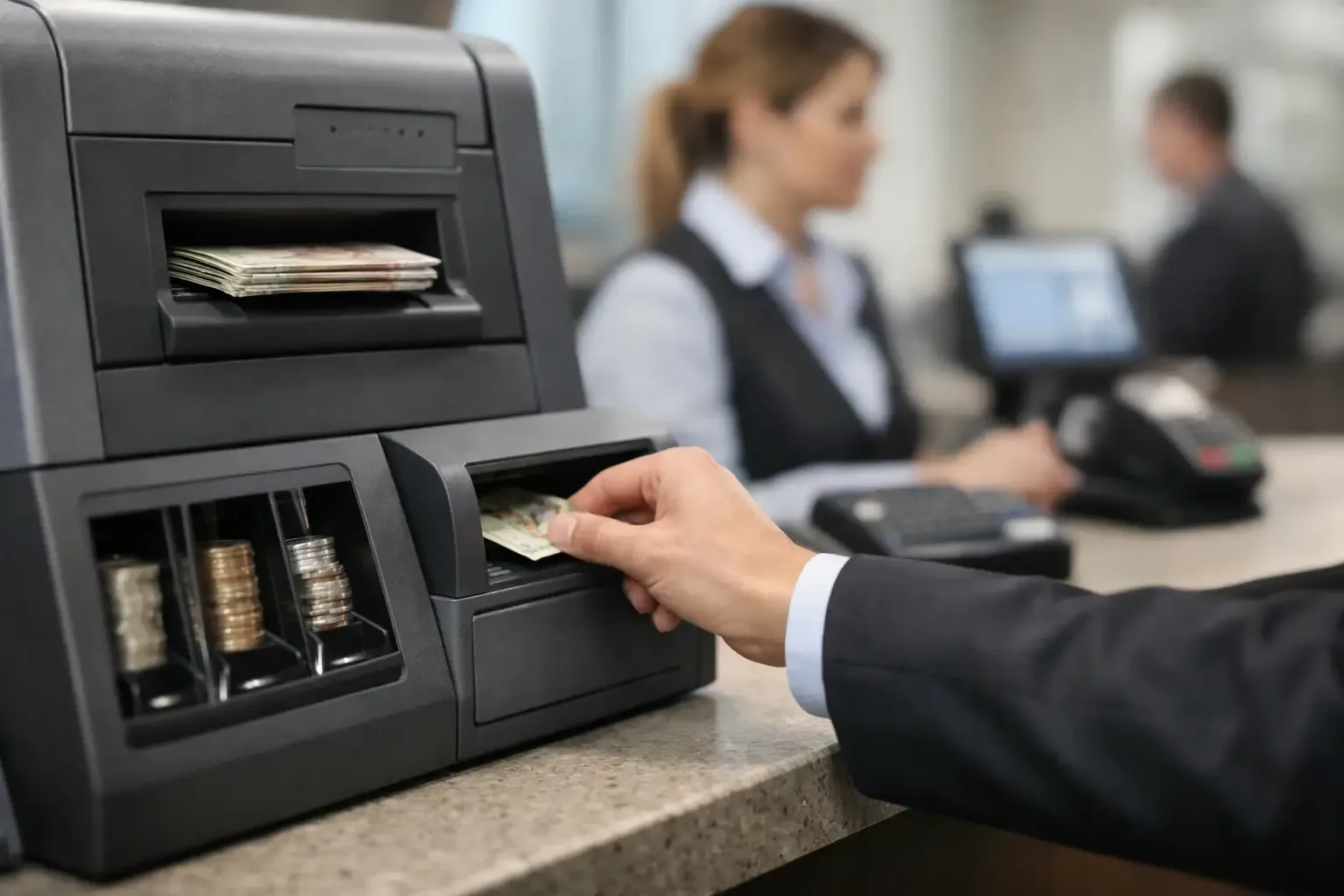
A miscounted change, an unrecorded note or a cash drawer left open seem like minor incidents. By the end of a shift, however, they add up to till discrepancies, administrative time, exposure to risk and queues that affect the customer experience. Automated cash handling tackles this problem with a simple approach: take cash out of the manual loop without taking control away from the operation.
For businesses that still receive a significant share of payments in cash, automating cash does not mean keeping old processes with new equipment. It means redesigning the point of payment so that the team can focus on serving customers, while technology validates, accepts, dispenses and counts notes and coins.
What is automated cash handling?
Automated cash handling is a physical cash management system integrated into the point of sale. The customer inserts notes and coins into a dedicated machine, the system validates each amount, calculates the change and dispenses it automatically. The member of staff records the sale in the POS software but no longer handles the cash directly.
In practice, a solution of this kind acts as a smart till. It accepts cash, identifies invalid or suspicious notes and coins, keeps the money securely stored and provides reliable information on the amounts held. Depending on the configuration, it can also support till opening, closing and cash collection.
This change affects a critical point of the operation: cash no longer passes between customers, counter, drawer and several members of staff. It follows a controlled, traceable flow inside the machine.
Why a manual till creates hidden costs
The cost of handling cash is not just counting notes at the end of the day. Time is spent preparing change floats, checking sales, investigating discrepancies, transporting cash and correcting errors. There is also the less visible cost of interrupting service whenever a coin is missing, a question arises about a payment or the amount handed over needs to be confirmed.
In restaurants, this problem becomes especially clear at the busiest times. A team taking orders, settling bills, giving change and answering customers all at once is more prone to slips. In retail, the variety of shifts and staff can make it hard to assign responsibility when till discrepancies arise.
Automation does not remove every cash-related task. Collection, deposit and reconciliation procedures still need to be defined. But it significantly reduces the moments when human error can affect the final till balance.
Security without slowing down service
One of the most important benefits is reduced direct access to cash. When notes and coins are secured inside the machine, exposure to internal theft, accidental losses and conflicts at the counter goes down.
It also improves the handling of suspicious notes. Instead of relying solely on each employee’s visual check, the system validates the money at the moment of the transaction. This makes the process more consistent, especially in operations with rotating teams or periods of high footfall.
Security, however, should be assessed as part of a complete process. An automated cash machine requires clear rules on access profiles, collections, cash transport and incident handling. Technology reduces operational risk, but procedures still determine the quality of control.
Operational benefits you can measure every day
The most immediate gain is fewer change errors. The machine receives the amount and calculates the correct change, avoiding discrepancies caused by haste, distraction or mental arithmetic. For the customer, this means a clearer, more predictable payment.
The second improvement is closing speed. Instead of counting a drawer by hand, managers can check the amounts recorded in the system and prepare the collection with greater confidence. This benefit is particularly relevant in shops, restaurants and self-service launderettes, where closing time means administrative work outside opening hours.
There is also a positive effect on team productivity. A member of staff who does not need to count coins, check change or manage a shared drawer can pay more attention to selling, table service or dealing with customer requests. This is not about replacing service with machines. It is about removing repetitive, sensitive and low-value tasks from customer service.
Where automated cash handling makes most sense
The decision depends on the volume of cash payments, the intensity of the operation and the cost of errors. Not every business has the same needs, but there are sectors where the operational return tends to be clearer.
Retail with a constant flow of customers
In convenience stores, local supermarkets, specialist shops or venues with several tills, automated cash handling helps standardise the payment process. Fewer till discrepancies and the availability of change can have a direct impact on how smoothly service runs.
It is especially useful when there are several shifts. Every transaction is linked to the system, and the team has less need to swap floats or take responsibility for a drawer used by different people.
Restaurants at peak times
In a restaurant, café or quick-service outlet, payment competes with many other tasks. Staff need to take orders, communicate with the kitchen, hand out products and keep the queue moving. Automated cash management frees up capacity at a time when every second counts.
In this context, POS integration is decisive. The solution should follow the venue’s real workflow, without adding extra steps that delay payment. Good operational design takes into account where the machine is placed, how the team moves around and the type of service provided at the counter or at the table.
Hotels and receptions with extended hours
Hotels, holiday lets and other reception-based businesses often deal with long hours, small teams and guests of many nationalities. A more controlled payment process helps keep reception organised and reduces reliance on manual cash handling.
When combined with automated check-in solutions, automated cash handling can be part of a broader strategy: creating arrival and payment flows that are available for longer, with consistent control and less administrative work for reception.
What to assess before implementing a solution
Buying a machine solely for its ability to accept notes is a common mistake. The choice should start with the business process. How many cash transactions are made each day? What is the average value? Are there peak hours? Is there one till or several? How much time is spent closing and resolving discrepancies?
Then it is worth assessing four practical criteria:
- Compatibility with the POS and the payment methods already in use.
- Note and coin capacity suited to the real volume of the operation.
- Ease of use for customers and staff, including initial training.
- The technical support, maintenance and service continuity model.
Capacity is one area where it is unwise to generalise. A machine sized below requirements may need frequent collections and limit efficiency gains. An oversized model may increase the investment without adding proportional value. The right solution comes from analysing the flow, not just the number of customers served.
Planning the implementation is also essential. The team needs to understand the new procedure, from recording the sale to what to do when a note is rejected or a payment is interrupted. A well-prepared transition reduces internal resistance and ensures the operation sees benefits in the very first weeks.
Automated cash handling as a management decision
Automated cash management should be seen as an operational control tool, not just as till equipment. Its results show in reduced losses, better reconciliation, more time available to the team and the confidence with which managers oversee each point of sale.
For companies with a significant physical presence, automation also creates the conditions to grow more consistently. Opening a new site, extending opening hours or bringing in new staff becomes simpler when payment processes follow clear, repeatable rules.
SelfPay approaches this kind of transformation from the needs of each sector, with specialist solutions for face-to-face operations. The aim is not to put technology on the counter for its own sake, but to create a safer, faster and more controlled payment process.
The best time to assess automated cash handling is before till discrepancies, queues and closing tasks come to be seen as inevitable. When cash no longer depends on manual routines, the till starts supporting business growth instead of holding it back.