
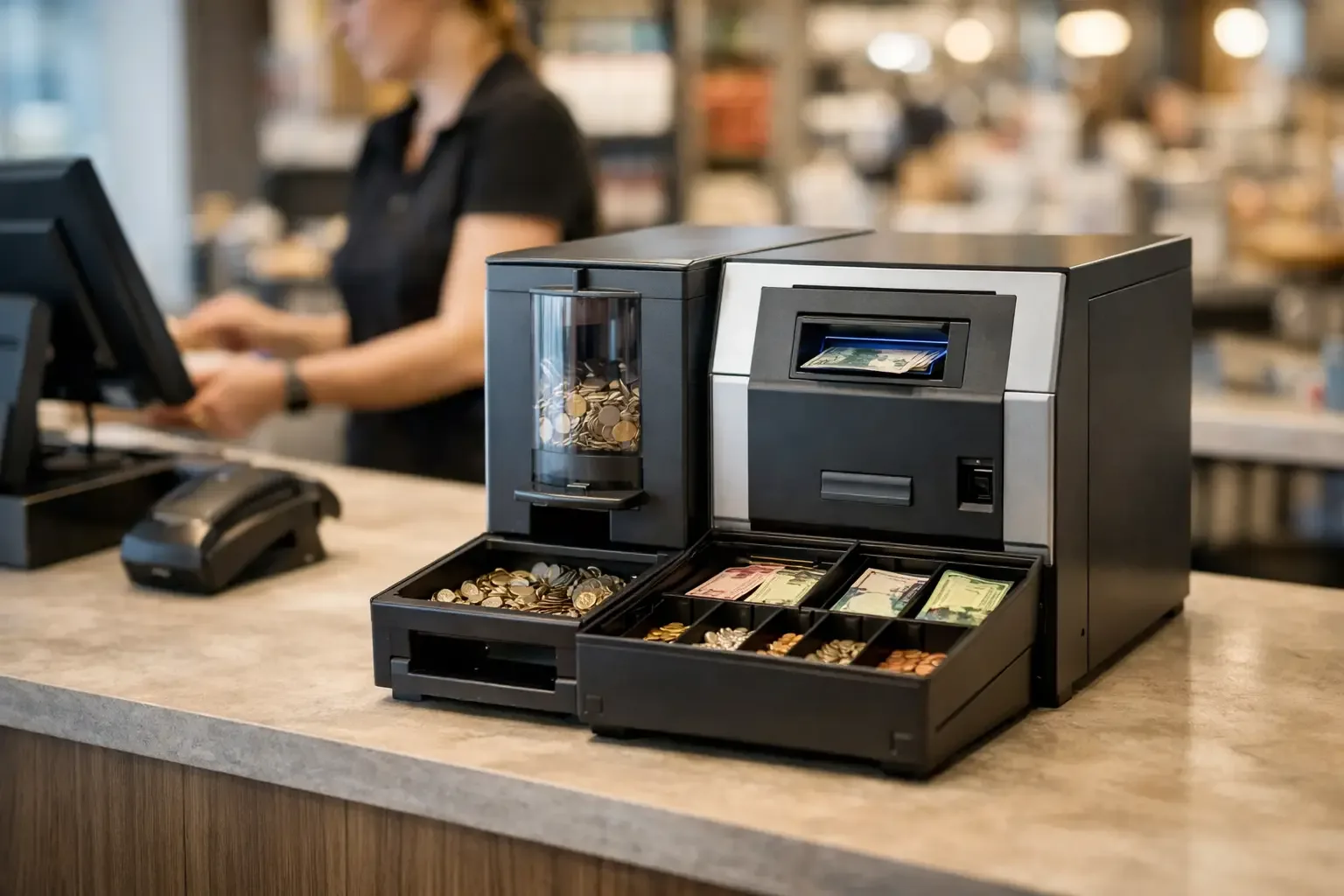
A review of Cashmatic for retail should start where the operation feels the most pressure: when there is a queue, cash passing between staff and the need to close tills without room for error. For shops that still take a significant share of their sales in cash, automating cash management can go from being a one-off improvement to an operational decision with a daily impact.
Cashmatic is not just a machine for accepting coins and notes. It is a solution designed to automate cash payment at the point of sale, reduce direct handling of cash, support till control and make service more consistent. Its value, however, depends on the shop’s context, the volume of transactions and the quality of integration with existing processes.
What is a Cashmatic system in retail?
A Cashmatic system is an automated payment device that accepts, validates, stores and dispenses change in cash. In practice, the customer inserts the cash into the machine and receives their change without staff having to count notes or coins. The payment is linked to the sale recorded in the point-of-sale software, provided the integration is correctly configured.
In retail, this model addresses a very specific problem: physical cash requires counting, change, checks, deposits and individual responsibility at the till. Each of these tasks takes time and creates opportunities for operational slips. Incorrect change may seem like a minor incident, but repeated over weeks it hurts margins, customer trust and the team’s available time.
Automation does not remove the need for supervision. The shop still needs rules for opening, closing, cash collection and handling exceptions. The difference is that validation and the mechanical management of cash are handed over to the system, creating a more controlled process.
Cashmatic for retail review: where the return is felt
The main advantage of a Cashmatic solution is less manual intervention in payment. In shops with frequent footfall, this change can speed up service and allow staff to focus on tasks with greater commercial value, such as advising customers, restocking products or managing orders.
Speed should not be judged only by the number of seconds per transaction. It should take the whole till cycle into account. When there is less need to check change and fewer discrepancies at the end of the shift, the time saved adds up. It also reduces reliance on more experienced staff to resolve till discrepancies or approve transactions at busy times.
Security is another decisive factor. With cash stored inside the machine, direct access to notes and coins is reduced during normal operation. This helps limit the risks of losses, internal theft and counting errors. For businesses with long opening hours, high staff turnover or several payment points, this layer of control is particularly relevant.
There is also a benefit for the customer experience. Many consumers still prefer to pay in cash, especially for smaller purchases. An automated payment system makes it possible to accept that preference without turning the till into a slow point or one that depends on change being available. The experience becomes more predictable, provided the interface is clear and the equipment well positioned.
Integration with the point of sale is decisive
The performance of a Cashmatic does not depend only on the hardware. Integration with the invoicing or POS software is one of the most important conditions for ensuring the process works as expected. Ideally, the purchase amount is sent automatically to the machine and the payment status returns to the system, avoiding manual entries and unnecessary reconciliation.
Before implementation, it is important to confirm compatibility with the existing point-of-sale solution, the type of connection required and how part payments, refunds, cancellations and suspended sales are handled. These scenarios may seem secondary in the initial demonstration, but they are precisely the ones that reveal whether the solution fits how the shop really works.
It is also important to understand how data will be managed. Transaction reports, amounts by denomination, incidents and closings should be easily accessible to shop managers. Automation only delivers control when operational information is readable and useful for decision-making.
Which shops benefit most from this solution?
A Cashmatic tends to pay for itself more quickly in operations with a steady flow of cash payments and teams that rotate between tills or shifts. Local supermarkets, convenience stores, pharmacies, tobacconists, specialist shops, service stations and businesses in tourist areas are examples where pressure on service can be high.
It can also be a good option for shops where the owner combines management and operational roles. In these cases, reducing the time spent checking the till frees up time to keep track of sales, suppliers and staff. It is not just about cutting direct costs, but about removing repetitive tasks from the heart of the operation.
On the other hand, a shop with a low volume of cash, few daily transactions or a strong predominance of digital payments may see a slower return. The decision should not be made simply because automation looks modern. It should be based on an analysis of the number of cash payments, till discrepancies, the cost of staff time and the business’s growth goals.
Points to assess before going ahead
Choosing a model should take into account the capacity needed for the volume of transactions and the type of cash usually handled. A shop with many low-value sales and a lot of coins in circulation has different needs from an operation that mainly takes notes. Getting the size of the equipment wrong can create limitations precisely at the busiest times.
Space on the counter or in the payment area deserves equal attention. The equipment should be accessible to the customer without obstructing circulation, the passing of products or interaction with staff. In compact shops, the design of the till point can determine whether the experience is intuitive or confusing.
Maintenance and technical support also carry weight in the assessment. Like any critical piece of point-of-sale equipment, a cash management system should have professional support, clear service procedures and suitable training for the team. Technology is most effective when users know how to resolve simple situations and when specialist support is available for issues that require intervention.
Finally, it is worth analysing the investment from an operational perspective, not just as a purchase cost. Compare the investment with the time spent on closing, losses from change errors, the exposure of cash at the till and the extra service capacity. This approach gives a more realistic estimate of the return, tailored to the reality of the shop.
Limitations and situations that require planning
A serious review should not present Cashmatic as an automatic answer to every retail challenge. The equipment improves cash management, but it does not fix poorly defined sales processes, POS failures or a lack of training. If staff do not know how to act when faced with a refund, a rejected note or a communication interruption, the operation may continue to suffer friction.
There is also an adjustment period. Staff need to understand that their role at the till changes: they no longer count and store cash with every transaction, but they remain responsible for assisting the customer and making sure the sale goes through correctly. Communicating this change from the outset avoids resistance and helps make the most of the investment.
For businesses looking for a sector-focused implementation, SelfPay Portugal works with automated payment solutions and specialist support to assess how well the system suits each operation. The choice should take into account customer flow, available space, technology integration and the specific goals of the point of sale.
The best decision starts by observing a normal day in the shop, but also its busiest period. If cash is causing queues, till discrepancies or too much administrative work, a Cashmatic solution can turn a critical point into a controlled, fast and more secure process.


