
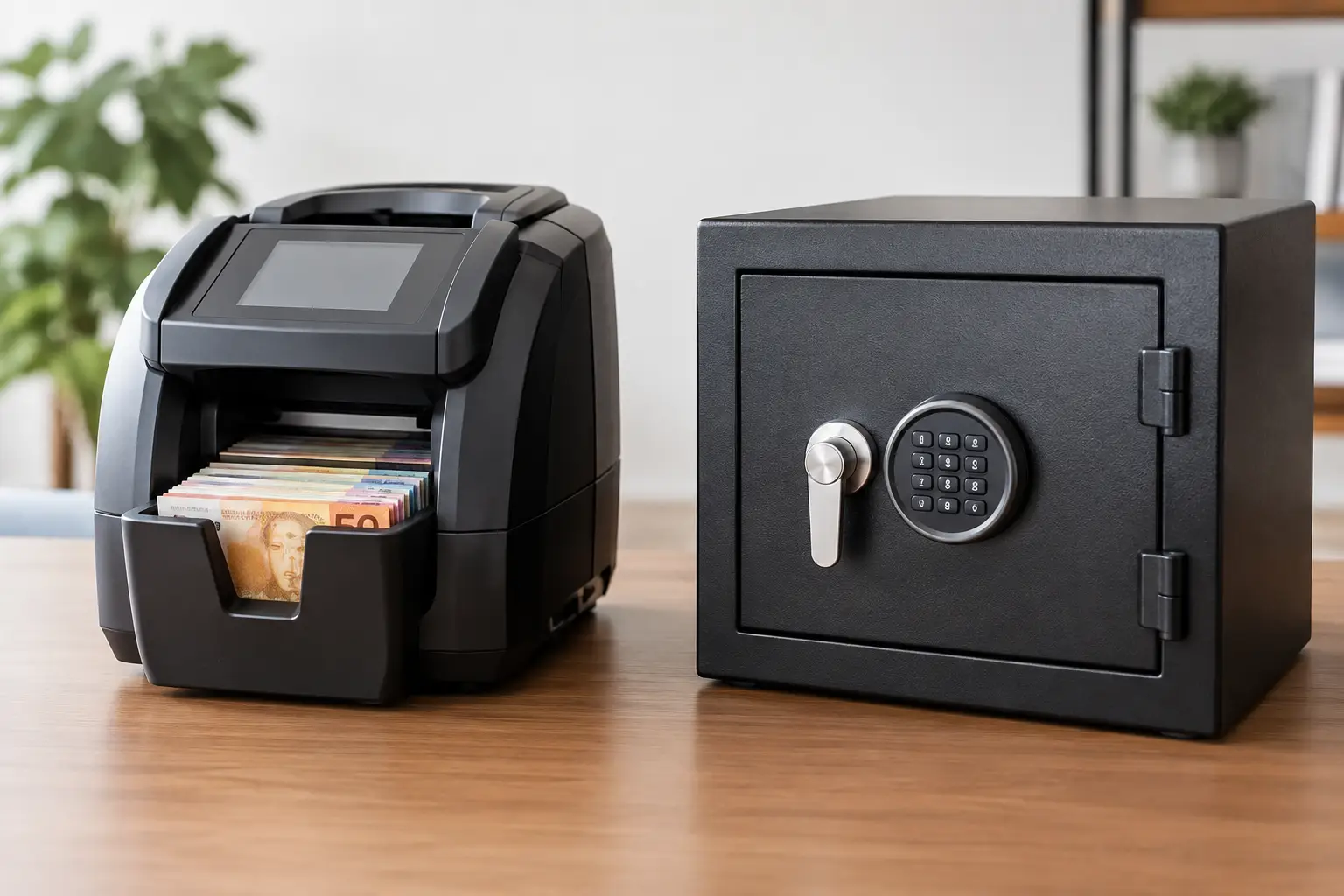
When cashing up depends on counting notes, checking change and carrying money to the safe, the problem is not just security. It is staff time, till discrepancies and the ability to keep service flowing at the busiest times. This is where the comparison of Cashmatic versus a safe stops being a question of equipment and becomes an operational decision.
A traditional safe protects cash after it has been received and handled. An automated cash management system, such as Cashmatic, steps in during the payment itself: it accepts, validates, counts, stores and, depending on the configuration, dispenses the correct change. The difference matters for businesses where the till is a daily, repetitive task, not just a place to deposit money.
Cashmatic versus a safe: the difference is in the process
A safe is a physical security solution. Its main function is to restrict access to money and reduce the risk of theft after deposit. It can be suitable for operations with a low volume of cash payments, few shifts and simple till processes. However, it does not remove the manual steps that happen before the deposit: taking payment, checking notes and coins, calculating change, checking the float and identifying differences at the end of the day.
Cashmatic was designed to automate these steps at the point of sale. The customer inserts the money into the machine and the system takes care of validation, storage and change. Staff no longer have direct access to cash during the transaction and can stay focused on service, preparing orders or other higher-value tasks for the operation.
In practice, a safe answers the question “where do we keep the money?”. Cashmatic answers a broader one: “how do we manage the money from the moment the customer pays until cash-up?”. For a quick-service restaurant, a convenience store or a high-turnover launderette, this difference has an immediate impact on productivity.
Security: protecting money or limiting handling
A safe reduces the exposure of money once it has been deposited, but it does not prevent handling at the counter. During the shift, there are still notes in the drawer, change prepared in a hurry and interim collection procedures. The greater the flow of cash, the greater the need for operational discipline to avoid errors, losses or unauthorised access.
With a Cashmatic system, cash goes straight into the machine after payment. This reduces staff’s physical contact with notes and coins and the need to keep large sums in a till drawer. It also creates a more controlled process, because each payment is linked to a transaction and an automated count.
This does not mean that Cashmatic removes the need for all security measures. The business still needs access policies, opening and closing procedures, preventive maintenance and correct integration with the point of sale software. The advantage lies in reducing the points where human error or unauthorised access can occur.
Till control and fewer discrepancies
Till discrepancies rarely have a single cause. They can result from incorrect change, recording errors, miscounted notes, voided payments or simple slips during a long shift. With a conventional safe, these situations are often only checked at the end of the day, when it is harder to identify the source of a difference.
Automated cash management improves the traceability of the process. By validating and recording the money received and dispensed, the machine provides a more consistent view of the amount in the till. When integrated with the POS, control becomes even more effective, as sales data and cash movements can be compared more quickly.
For managers with several shops or shifts, this capability is not just administrative. It helps detect patterns: a point of sale with recurring differences, a time of day with more voids or a need to adjust team procedures. The safe protects the stored value; automation helps you understand what happened before that value reached the deposit.
Service efficiency: the factor a safe does not solve
At peak times, every second at payment counts. In a café, restaurant or retail space, staff may be taking money, looking for coins, checking change and responding to the next customer all at once. Even an experienced team becomes more prone to errors as the queue grows.
With Cashmatic, the cash handling stage is taken over by the system. The customer pays directly at the machine and receives the calculated change. Staff can move on to preparing the order, giving sales advice or serving the next customer. This gain is particularly relevant in operations where speed has a direct impact on revenue and customer satisfaction.
There is, however, one essential criterion: the solution must be sized to the volume and type of operation. A machine that does not suit the number of transactions, the most used denominations or the space available on the counter may not deliver the expected return. The assessment should consider the venue’s real flow, including peak hours, number of tills and customers’ payment habits.
The investment should be assessed by the cost of the process
Comparing only the purchase price of a safe with that of a Cashmatic system leads to an incomplete analysis. A safe tends to have a lower initial investment, but it keeps the operating costs associated with handling: counting time, shift checks, managing differences, internal collections and the impact of change errors.
Cashmatic requires a higher investment and, depending on the project, may involve installation, POS integration and staff training. In return, it aims to reduce recurring costs and free up operational time. The return depends on how intensively cash is used. In an operation with few cash transactions, a well-implemented safe may be enough. In a business with high daily volumes, the cost of maintaining manual processes can quickly exceed the initial difference in investment.
The right question is not just “how much does the equipment cost?”. It is “how much does it cost, every day, to manage cash manually?”. This calculation should include working hours, till discrepancies, losses, service delays and the need for supervision.
Which solution makes sense for each business?
A safe may be the right choice for businesses with low cash volumes, mostly digital payments and a simple till operation. It can also complement other security processes in offices, warehouses or premises where money is not handled continuously in front of customers.
Cashmatic makes more sense when cash is a significant part of revenue and the point of sale needs to gain control, speed and consistency. Restaurants, bakeries, retail shops, pharmacies, service stations, self-service launderettes and other face-to-face businesses are settings where automation can deliver clear gains.
Before deciding, it is worth answering four operational questions:
- How many cash transactions are made per day and at peak times?
- How much time is spent on change, counting, cashing up and resolving discrepancies?
- How many people have access to cash during a shift?
- Can the current POS integrate an automated cash management solution?
These answers help avoid two common decisions: buying a safe when the real problem is the till process, or adopting automation without making sure the configuration matches the venue’s needs.
Implementation: technology with a defined process
Installing equipment does not, on its own, fix a poorly defined process. Implementation should include an analysis of the counter, customer flows, the POS connection and the procedures for opening, closing and staff intervention. It is also essential to explain to staff how to act in the event of incomplete payments, rejected notes or refund requests.
SelfPay carries out this assessment by sector and by operation, because a system suited to a quick-service restaurant will not necessarily have the same configuration as a retail shop or a launderette. The choice should start from the workflow you want to improve, not just from the technical features of the equipment.
A safe will still be valuable as a physical security measure. But when the goal is to reduce errors, speed up payments and improve daily cash control, automation turns the till from a vulnerable task into a more predictable and efficient process.