
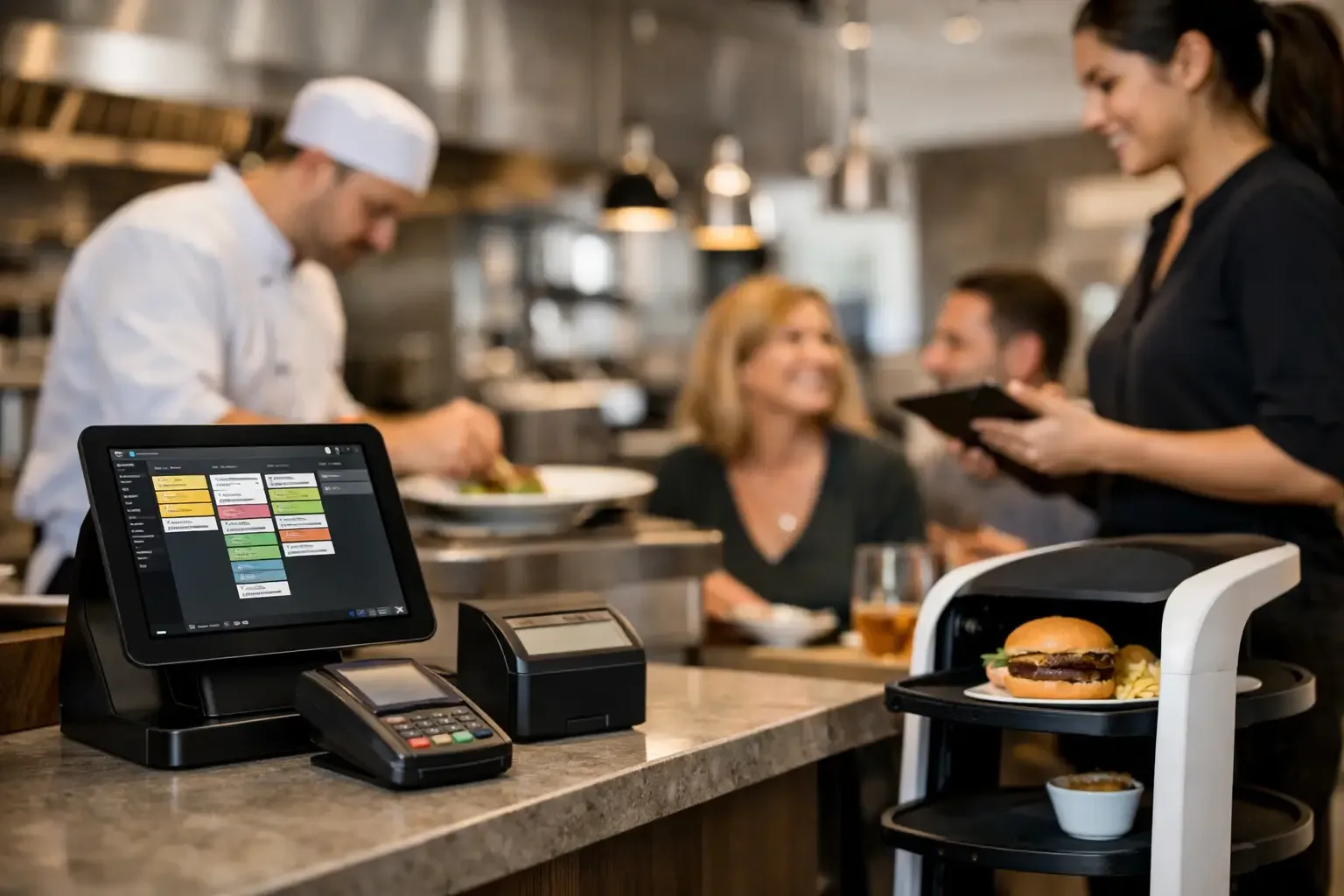
The question seems simple, but the answer varies considerably depending on where the business is starting from. When a manager tries to work out how much it costs to automate a restaurant, they are in fact assessing more than equipment: they are measuring operational impact, service capacity, till control and the reduction of manual tasks that currently eat into time and margin.
In a restaurant with a high volume of customers, automation is not a technological extra. It is an operational decision. And, as with any investment that directly affects day-to-day work, the real cost depends on the service model, the size of the premises, the number of points of sale, the share of cash in sales and the level of integration required between payment, service and management.
How much does it cost to automate a restaurant in Portugal
There is no single figure that applies to every restaurant. A small takeaway with one counter and a simple flow will have very different needs from a restaurant with a dining room, terrace, deliveries and several staff shifts.
In practice, the investment can range from a few thousand euros to considerably more when the project includes self-service kiosks, automated cash management, integration with POS software, payment terminals, printers, kitchen display screens or changes to the layout of the premises. The most common mistake is to look only at the price of the equipment and ignore the cost of current inefficiency.
If there are frequent queues today, errors in change, time lost closing the till, excessive reliance on staff for repetitive tasks or difficulty absorbing peaks in demand, the cost of not automating may be higher than the initial investment.
What makes the investment vary
The first factor is the type of automation. Automating a restaurant can mean several things at once or just an initial phase. Some operations start by automating cash payments, others move to self-ordering kiosks, and others combine both systems to gain speed and control.
Automated cash management reduces change errors, strengthens till security and limits staff’s direct contact with money. Where there is a high volume of cash payments, this type of solution has an immediate operational impact. Self-service kiosks, on the other hand, tend to generate more value in high-throughput operations, quick-service restaurants or venues where customer autonomy helps absorb queues and frees staff for higher-value tasks.
Another decisive factor is the number of stations. A restaurant with a single payment point has a very different investment design from an operation with several counters, separate service areas or integration between eat-in and takeaway.
Existing infrastructure also affects the budget. If the restaurant already works with compatible software, a suitable network and reasonably organised processes, implementation tends to be simpler. When the layout, electrics, connectivity or system integration need to be reviewed, the investment rises, but so, usually, does the potential for improvement.
Visible costs and costs that are often left out
When analysing how much it costs to automate a restaurant, it is worth separating the purchase cost from the total project cost. The equipment is only one part.
There is also installation, configuration, integration with the invoicing or POS system, staff training, technical support and any maintenance. In some cases, outright purchase is an option. In others, it makes more sense to consider flexible arrangements, especially when the aim is to protect cash flow and get up and running faster.
There is also a less obvious cost: the transition. During implementation, the operation needs adapting, testing and team alignment. If this phase is poorly prepared, the restaurant may face internal resistance and delays in adoption. If it is well managed, the transition is quick and the operational gain soon starts to show.
Where the return on investment lies
The right question is not only how much it costs to automate a restaurant. It is also how much it costs to keep operating without automation in a model where every minute of service counts.
The return comes on several fronts. The first is productivity. An automated payment process reduces time at the counter, speeds up service and lets the team focus more on the customer and less on mechanical tasks. The second is control. Less cash handling means fewer mistakes, fewer till discrepancies and more traceability.
The third is operational security. When cash is managed by an automated system, the risk associated with manual handling falls. For many operators, this point alone justifies the decision, especially in places with high staff turnover or a high daily cash volume.
The fourth is customer experience. In restaurants, long queues and slow processes have a direct impact on revenue. If customers can order or pay more quickly, the restaurant improves table turnover, reduces friction and protects sales at the busiest times.
Automate everything at once or in phases?
It depends on the type of operation and the maturity of the business. Not every restaurant needs a complete project from the outset. Often, the smartest decision is to start with the area that has the greatest measurable impact.
If the main problem is at the till, it makes sense to prioritise automated cash management. If the challenge is queues and service capacity, kiosks may be the first step. If the operation already has good demand but struggles to scale consistently, combining self-service with payment automation becomes more attractive.
A phased approach spreads the investment, tests team uptake and measures results more clearly. On the other hand, in larger operations, an integrated view from the start avoids duplicated decisions and ensures the systems are ready to grow.
How much it costs to automate a small, medium or high-volume restaurant
In a small restaurant, the investment usually focuses on point-of-sale efficiency and till control. The goal is simple: reduce the operational load without adding complexity. Here, well-chosen solutions can pay back quickly because they tackle very specific weaknesses.
In a medium-sized restaurant, with more staff, more shifts and a wider range of service, automation starts to have a structural effect. It is no longer just about saving a few minutes per transaction. It is about creating operational consistency throughout the day.
In high-volume operations, the entry cost is naturally higher, but so is the value generated. A common mistake in these settings is to under-size the solution and end up keeping bottlenecks at critical moments. When there are hundreds of transactions a day, small inefficiencies add up fast.
How to assess whether the investment makes sense
The best way to decide is to look at concrete indicators. How many cash payments are made per day? How much time does the team lose on change, checks and closing? How many sales are delayed at peak times? How many till errors occur each month? And how many manual tasks occupy staff who could be serving customers better?
If these answers point to wasted time, operational risk or capacity limits, automation stops being a technology expense and becomes a management tool.
It is also important to assess how well the solution suits the restaurant’s concept. A stand-alone piece of equipment, without integration or a place in the real service flow, may solve little. An implementation designed for the specific operation, by contrast, delivers measurable and more sustainable benefits.
This is where a consultative approach makes a difference. Instead of choosing technology generically, the restaurant benefits from solutions tailored to the sector, the volume of customers and the customer profile. That context is what turns equipment into operational results.
The right price is the one that improves the operation
On the ground, the question of price is rarely settled with a price list. It is settled with context. Two restaurants may invest similar amounts and get completely different results, because the difference lies not only in what they buy, but in how the solution fits into the service and payment process.
Automating does not mean dehumanising the service. It means removing friction where it adds no value. Less time on change, fewer manual errors, fewer avoidable queues and more capacity for the team to be where they really make a difference.
For a pragmatic manager, this is the key point: the right investment is not the lowest one, it is the one that creates more control, more efficiency and better conditions for the restaurant to grow consistently. When the decision is made on that basis, the cost of automation becomes easier to justify than the cost of carrying on as before.


