
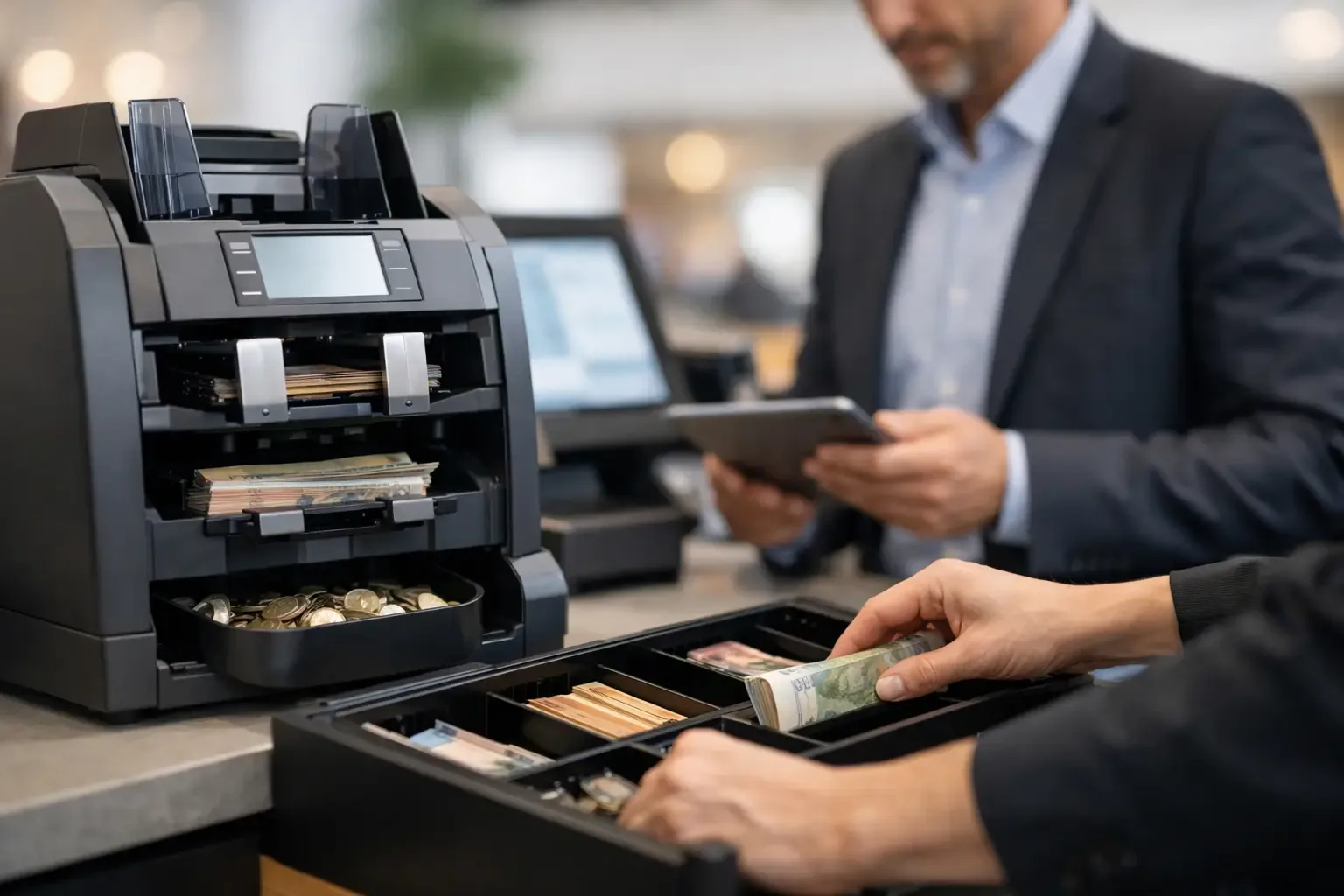
There is a critical moment in any operation with a till: the difference between what was sold and what is actually in the till. When that gap keeps recurring, the problem is no longer just an accounting one and starts to affect margins, management time and confidence in the process. This is precisely where automated cash control becomes relevant for businesses that handle face-to-face payments and need more rigour without slowing down service.
In many sectors, cash still carries real weight in daily transactions. In local retail, restaurants, self-service launderettes or hotels with multiple customer touchpoints, physical money requires continuous control. When that control relies solely on manual counts, change handed out by staff and cashing up prone to human error, the operation builds up friction where there should be flow.
What automated cash control means
Automated cash control involves using equipment and systems that accept, validate, store and dispense money in a controlled way, recording every till movement. In practice, staff no longer handle notes and coins directly during payment, while the system takes care of validating the cash, managing change and recording the transaction.
This changes the role of the till. Instead of focusing on counting money, checking amounts and correcting slips, the team can concentrate on serving customers. The impact is operational, but also financial. Less manual intervention means fewer change errors, fewer till shortfalls and a more predictable daily close.
It is not just about automating a single task. It is about turning a sensitive point in the operation into a more controlled, auditable and scalable process.
Why automated cash control is gaining ground
The pressure on points of sale is very clear today. Businesses want to serve faster, reduce overheads and have greater visibility over what happens in the operation. The traditional till copes poorly with this context because it depends on constant attention, ongoing staff training and frequent supervision.
In a restaurant with peak hours, for example, every second at payment counts. If staff have to take money, look for change, check coins and close the drawer, service time increases. In a retail shop, the problem may not be speed but consistency. Small errors repeated over the month create losses that are hard to trace. In a self-service launderette, the issue is even more sensitive, because the operating model requires autonomy and reliable payment collection.
Automated control responds to these scenarios with a simple logic: reduce reliance on human intervention in tasks where errors are costly and frequent.
Operational benefits with real impact
The first benefit is fewer errors. An automated system validates the money received and dispenses the exact change, eliminating discrepancies that are common in manual operations. This has a direct effect on till reconciliation and on management’s confidence in closing figures.
The second is security. When cash does not pass freely between hands, bags and drawers, the risk of internal theft or loss falls significantly. In addition, controlled storage of the money strengthens till protection during the shift.
The third is efficiency. Automating cash handling speeds up service, simplifies cashing up and reduces the time teams spend counting and checking. In operations with high staff turnover, this point is especially relevant, because it shortens the learning curve for sensitive tasks.
There is also a management advantage that is not always appreciated at first: traceability. Knowing how much came in, when it came in and at which station each movement took place gives the operation a new level of control. This makes it possible to detect patterns, correct deviations and make decisions based on more consistent data.
Where it makes the most difference
Restaurants
In restaurants, automated cash control helps protect margins in an environment where the pace is high and the pressure on the team is constant. Payment is no longer a bottleneck and becomes more predictable. In venues with counter service, the gain in speed is immediate. In takeaway operations, it also reduces exposure to errors at peak times.
Retail
In retail, the advantage lies in combining control and productivity. The system reduces till discrepancies, makes supervision easier and simplifies the management of multiple operators. For shops with long hours or high footfall, automation helps maintain consistency throughout the day, regardless of each employee’s experience.
Hospitality
In hospitality, especially in settings with automated reception or hybrid flows between face-to-face service and self-service, cash management needs to be aligned with an efficient experience. Automated control reduces friction in face-to-face payments and makes the process more reliable in operations with different shifts.
Self-service launderettes
In this sector, the central issue is operational autonomy. Whenever the business depends on cash payments with little human intervention, the ability to accept, validate and store money securely becomes essential. Automation reduces failures, simplifies service upkeep and brings greater stability to daily operations.
What to assess before implementing
Not every operation needs the same level of automation. The right choice depends on the volume of cash transactions, the number of payment points, the profile of the team and how much till discrepancies weigh on the monthly result.
If the share of cash payments is marginal, the return may take longer. But when cash still plays a significant role, the investment tends to pay off not only through reduced losses but also through time saved and tighter control.
Operational integration also matters. The equipment must fit the real workflow of the point of sale and not require a parallel process. An effective solution is one that improves daily work without adding unnecessary complexity.
Another decisive factor is suitability for the sector. A restaurant counter has different needs from a hotel reception or a launderette. That is why a specialist approach makes more sense than a generic offer. The design of the solution should respect the business context, the space available, usage peaks and the way customers pay.
Automated cash control and the customer experience
Some see this purely as an internal matter, but customers feel the difference. A faster payment, with no hesitation over change and no interruptions to service, conveys organisation. In a competitive market, that perception counts.
This does not mean automation replaces human contact. It means it takes a mechanical, error-prone task away from staff, freeing them for higher-value work. Instead of checking coins, they can answer questions better, sell more or deal with a request more attentively.
When properly implemented, the system does not make service colder. It makes it more efficient and more consistent.
Control does not end with the equipment
Automating cash greatly improves the process, but it does not replace a clear operational view. Access rules, closing procedures, levels of supervision and maintenance routines still need to be defined. Technology reduces risk, but the best results come when system, team and management are aligned.
It is also important to work with partners who understand the reality of the sector and can adapt the solution to conditions on the ground. In a commercial operation, implementation should not be treated as a mere equipment installation. It should be seen as a concrete change to the payment process.
So when a company decides to move to automated cash control, the right question is not just which machine. The more useful question is this: how can payment stop being a source of error and become a point of efficiency?
It is in that answer that automation starts to create real value. For businesses that want to reduce shortfalls, protect the till and speed up service, the most important step is not digitalising for its own sake. It is choosing a solution that improves the operation where it fails most, every day.