
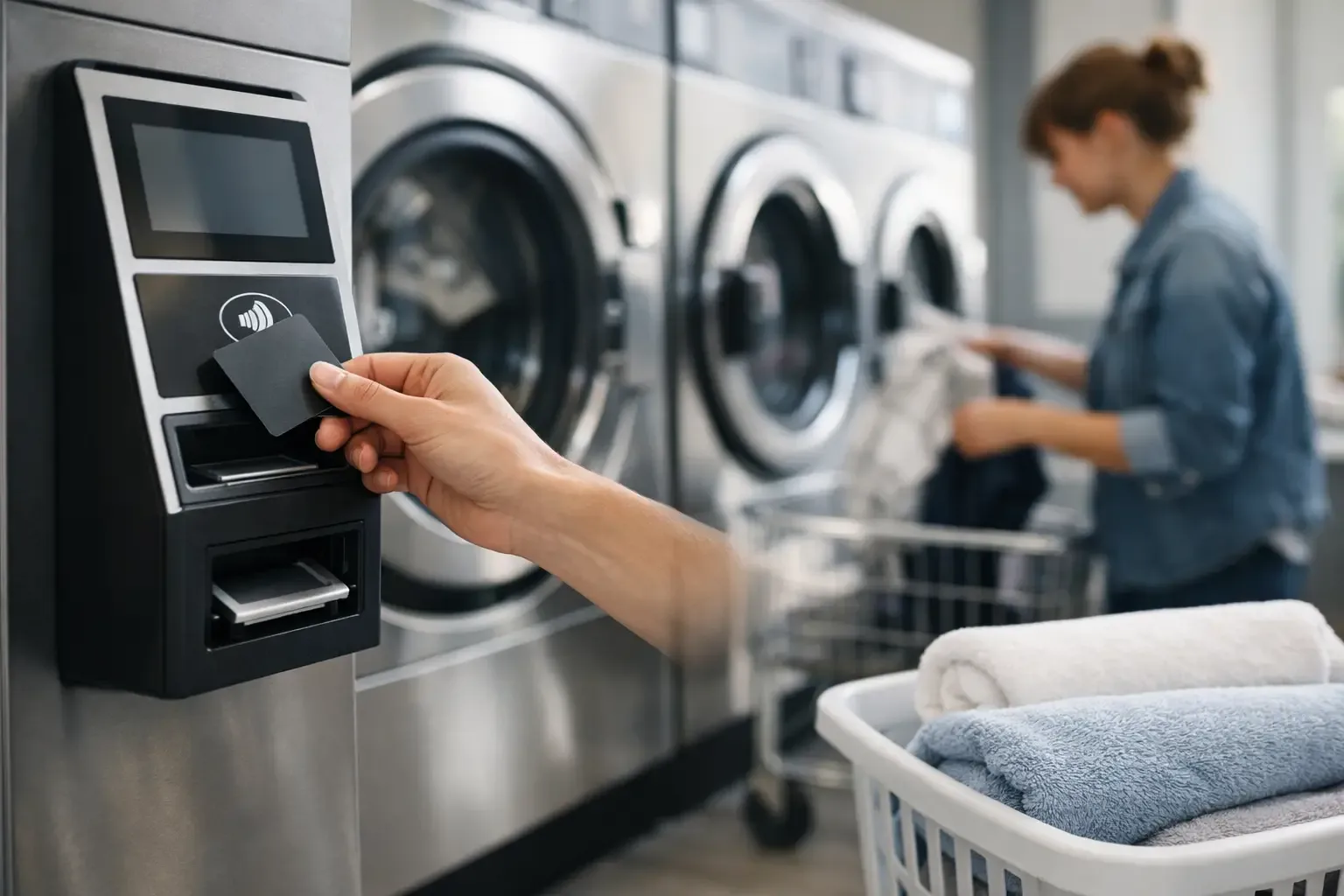
In a self-service laundrette, a few seconds at the moment of payment can shape the customer’s perception of the entire service. If the machine does not accept the customer’s preferred payment method, if there is no change available or if the operator wastes time on checks and refilling the till, the operation starts to build up avoidable friction. That is why automatic payments in self-service laundrettes are no longer just a convenience but a critical part of operations.
For anyone running this type of business, payment is not an isolated detail. It is linked to equipment turnover, revenue control, security in cash handling and the autonomy of the premises. A well-implemented payment solution is not only for taking money. It brings consistency to day-to-day operations.
Why automatic payments have become so important in self-service laundrettes
The self-service model rests on a simple promise: the customer comes in, chooses, pays and uses the service with minimal reliance on staff. When that sequence breaks down, the laundrette’s value proposition is compromised.
In many operations, business growth also brings new demands. More customers mean more transactions, greater exposure to till errors, more time spent refilling coins and more need for supervision. At the same time, consumers expect speed, flexibility and modern payment methods. If the laundrette still depends on a limited or overly manual system, it starts to lose competitiveness.
Payment automation responds to this scenario with very practical logic. It centralises processes, reduces operational intervention and makes the point of service more predictable. For operators with one or several shops, this gain in control makes a difference from the very first month.
What changes in practice with automatic payments in a self-service laundrette
The main change is the move from a reactive model to a controlled one. Instead of staff constantly sorting out small payment problems, the operation runs on defined rules, checks and flows.
This means a simpler experience for the customer. The user arrives, selects the service and completes payment with less friction. Depending on the solution implemented, they can pay by cash, card or other electronic means, without relying on constant on-site assistance.
On the management side, the impact is even clearer. Control over the cash in the till improves, exposure to human error falls and revenue reconciliation becomes clearer. In a business whose margins demand operational efficiency, these improvements are not extras. They are part of profitability.
Fewer operational failures, more consistent service
One of the most common problems in self-service laundrettes is a fragmented payment process. Machines with limited acceptance, equipment without integration and manual cash collection routines create unnecessary points of failure.
With an automated solution, the logic changes. The system organises payment more uniformly, with less reliance on improvised procedures. This reduces incidents, improves service availability and cuts the number of situations in which customers need help with something that should be instant.
Cash security and lower risk at the point of sale
In operations that still take cash, automation is also a direct answer to security concerns. Money no longer passes between customer, till and operator in the same way. There is less manual contact, less room for discrepancies at till closing and lower exposure to losses.
This point is especially relevant in laundrettes with long opening hours or few staff on site. Automation helps protect revenue and create a more controlled environment, without relying solely on human supervision.
Which solutions make sense for a self-service laundrette
Not all laundrettes have the same needs. An independent shop with moderate footfall may only need a reliable payment system that is easy to operate. A network with several service points, on the other hand, tends to value integration, reporting and standardised processes.
Choosing a solution should start with three objective questions: how customers pay today, where the main operational bottlenecks are and what level of control the manager wants over revenue. From there, the decision becomes more rational.
In some operations, cash still plays a significant role. In that case, it makes sense to consider automated cash managementtechnology, with validation, secure storage and less manual intervention. In others, the priority is offering fast electronic payment methods, especially in urban or tourist areas, or where convenience matters most.
It is also important to assess the customer interface. A payment kiosk or a centralised system can simplify the journey and make using the premises more intuitive. When payment is clear and quick on screen, use of the service tends to flow better.
The return lies not only in sales, but in operations
There is a common mistake when analysing investment in automation: looking only at the direct increase in turnover. In a self-service laundrette, the return also comes from less unproductive time, less need for intervention and the ability to manage the business better.
Fewer trips to the site to sort out payments, fewer till discrepancies and fewer calls about simple faults all have economic value. Although they do not always show up clearly in a first analysis, their impact builds up over time.
In addition, a more modern payment system improves the perception of the premises themselves. A customer who finds an organised, fast and up-to-date experience tends to trust the service more and come back more readily. In competitive local markets, this consistency counts.
When it pays to act sooner
If the laundrette already has enough volume to make manual management tiring, waiting too long can cost more than investing. The same applies when growth is planned, new shops are opening or there is a need to reduce operational dependence.
On the other hand, in very small operations with low turnover, the solution should be tailored to the context. The most complex model is not always the most suitable. What matters is ensuring the technology meets the needs of the real business, not a generic expectation of modernisation.
Decision criteria for choosing a technology partner
When selecting an automatic payment solution for a self-service laundrette, technology matters, but implementation capability matters just as much or more. Equipment may look good on paper and fail in practice if it is not adapted to the operation’s flow.
A credible partner should understand the sector, identify the business’s critical points and recommend a configuration that matches transaction volume, customer profile and the degree of autonomy wanted for the premises. This consultative view is decisive in avoiding misaligned investment.
It is also important to assess reliability, ease of use, maintenance and scalability. If the business grows, the solution should grow with it without having to start from scratch. This is where sector specialisation makes a difference. Those who know the specific demands of a self-service laundrette tend to propose systems that are more consistent and easier to integrate into daily operations.
Automating payment also means professionalising the operation
Many self-service laundrettes started with a simple structure, focused on getting to market quickly. That is natural. But as the business matures, operational demands increase. What used to work with hands-on management and improvisation is no longer enough.
Automating payment is a clear step in that evolution. Not only because it reduces manual tasks, but because it brings method, predictability and control. The business is better prepared to grow, to serve customers better and to operate with less margin for error.
In a market where customers value convenience and operators need real efficiency, automated payments are no longer an optional extra. They become part of the business infrastructure. For companies looking to modernise their operations wisely, it makes sense to work with a specialist partner such as SelfPay Portugal, able to align technology with the operational context.
The right decision is rarely the loudest one. It is the one that removes friction every day, improves control and creates a more solid operation without complicating what should be simple.


