
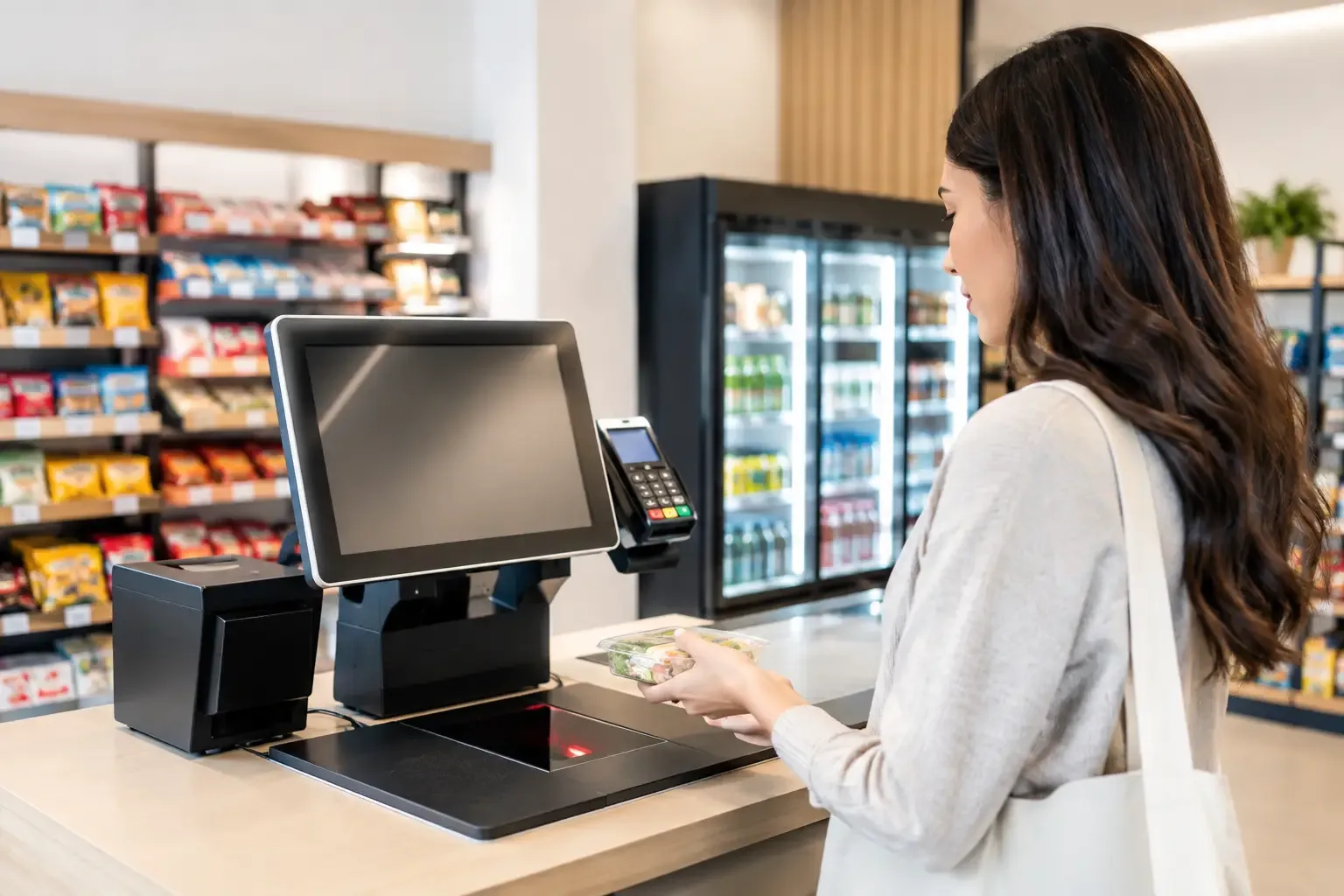
An autonomous shop is not defined simply by having a self-service checkout. It is defined by its ability to keep sales, payments, cash control and customer support running with less manual intervention, without compromising security or service quality. Choosing the right equipment for an autonomous shop therefore means looking at the entire purchase journey, not just the moment of payment.
For a retail manager, the gain lies in reducing queues, cash errors and repetitive tasks. For the customer, it lies in speed and independence. But these results only appear when the technology is sized to the sales volume, the type of products, the payment methods accepted and the real operation of the space.
What an autonomous shop needs to solve
An autonomous operation should allow customers to complete their purchase intuitively, while staff focus on higher-value tasks: restocking, advising, preparing orders, quality control or handling exceptional situations. The aim is not to remove people from the service, but to use the available resources more productively.
In practice, there are four areas the equipment must cover: identifying and scanning items, payment, secure cash management and supervision of the operation. If any of these areas fails, the experience stops being autonomous and starts generating bottlenecks, requests for help and lost efficiency.
It is also important to distinguish a shop with automated processes from a fully unattended one. A small point of sale open 24 hours a day will have different requirements from a convenience store, a specialist retail outlet or a space within a hotel. The level of autonomy should match the risk, the customer flow and the capacity for remote monitoring.
Equipment for an autonomous shop: the core elements
Self-service kiosks and terminals
The self-service kiosk is often the most visible point of the operation. It lets customers scan items, select options, look up information and pay without relying on a traditional counter. In shops with simple products, clear barcodes and high footfall, it can significantly reduce waiting times.
The choice of terminal should take into account screen size, ergonomics, scanning speed, the peripherals required and ease of use. A device with lots of on-screen options may seem comprehensive, but it will be counterproductive if customers have to ask for help at every step. The interface should be straightforward, legible and suited to the profile of the people who use the space.
In operations with weighed goods, items without barcodes or age-restricted products, additional procedures will need to be defined. Autonomy does not eliminate exceptions. It prepares for them so they can be resolved quickly, by a member of staff on site or through authorised approval.
Scanners, printers and supporting peripherals
The shopping experience depends on components that are less visible but decisive. Barcode scanners, integrated scales, receipt printers and alert systems must work together as a whole. A slow scanner or a failed print turns a simple operation into a point of friction.
These peripherals should be selected according to the shop environment. In a high-turnover space, durability and speed should take priority. In a shop with limited floor space, a compact configuration may be the priority. In both cases, it is essential to provide easy access for maintenance, replacing consumables and cleaning.
Electronic payment ready for different habits
Customers expect to pay by card, contactless and, increasingly, by mobile phone. A payment terminal should accept the methods most used by the shop’s customers and communicate correctly with the sales software.
Authorisation speed matters, but it is not the only criterion. Managers should assess the stability of the connection, the cash-up process, transaction reconciliation and the ability to identify faults. When there are discrepancies between recorded sales and payments received, the problem is not just technical: it consumes administrative time and makes financial control harder.
In many businesses, electronic payment will be enough. However, excluding cash may not suit every customer base or location. Neighbourhood shops, tourist areas and operations whose customers are used to paying in cash should base this decision on their own data, not on a generic trend.
Automated cash management
When the shop accepts cash, manual change handling is one of the most common sources of error, wasted time and exposure to risk. Automated cash management systems, such as Cashmatic solutions, accept, validate, store and dispense notes and coins, reducing staff’s direct contact with the till.
The operational effect is clear: the amount handed over by the customer is counted by the machine, change is calculated automatically and the money is kept secure inside the unit. Staff no longer have to check change under pressure, count the float several times a day or deal with as many discrepancies at closing.
This type of solution is particularly relevant in shops with constant footfall, extended opening hours or several staff members operating the same payment point. Even so, the size of the equipment and its note and coin capacity should be matched to the volume of cash. Installing an oversized configuration for a small operation can delay the return; installing insufficient capacity can require frequent interventions.
Access and space control systems
In models with unstaffed hours, access becomes an integral part of the experience. Depending on the concept, it can be granted by card, code, app, digital identification or another authorised method. The option chosen should balance simplicity for the customer with traceability for the operator.
Space control also includes CCTV, sensors, incident reporting and procedures for opening doors or providing assistance. These elements do not replace a loss prevention policy, but they provide the information needed to act quickly and analyse unusual situations.
It is wise to define from the outset what happens when there is a network failure, an unsuccessful payment attempt, an unscanned item or a customer who needs help. Credible autonomy is the kind that handles exceptions well, not just the kind that works when everything goes to plan.
Integration matters more than piling up technology
A shop can have good standalone equipment and still struggle to operate if the systems do not talk to each other. The point of sale, the payment terminal, cash management and stock control should share information consistently, avoiding duplicate records and manual interventions.
Before investing, it is worth mapping the complete flow: customer arrival, product selection, scanning, payment, receipt, stock update and cash-up. This exercise reveals where the delays are and helps decide which functions should be automated first.
Integration also makes the business easier to read. When sales and payment data are well organised, managers can track peak hours, payment types, till incidents and restocking needs. It is not about collecting data for its own sake, but about making decisions with a more objective view of the operation.
How to assess the investment by type of business
There is no single set of equipment for every autonomous shop. A convenience store will value fast checkout and cash acceptance. A point of sale in a hotel may prioritise controlled access and integration with reception services. A self-service launderette will have its own needs for activating machines and managing payments without a permanent staff presence.
In specialist retail, the presence of staff may remain essential for advising customers. In that context, kiosks or autonomous payment systems free staff from taking payments, allowing them to spend more time on assisted selling. Technology should support the shop’s commercial positioning, not undermine it.
When comparing proposals, assess the total cost of ownership, not just the initial price. Include installation, configuration, training, technical support, consumables, updates and maintenance. Also ask how support will be provided once the system is up and running, and what response time to expect in the event of downtime.
SelfPay Portugal approaches this decision based on the specific needs of each sector, combining automated payment solutions, service kiosks and cash management. This approach makes it possible to design a configuration suited to each business’s flow, rather than imposing a one-size-fits-all model.
Preparing the shop to work better from day one
Implementation should start with measurable goals: reducing average service time, cutting cash discrepancies, increasing service availability or allowing staff to focus on other tasks. Without these indicators, it will be difficult to assess the real impact of the investment.
Staff training is equally decisive. Employees must know how to guide customers, resolve simple blockages, replenish consumables and escalate incidents when necessary. A well-designed autonomous shop still needs well-prepared people to make sure the technology does its job.
The best equipment for an autonomous shop is the one that removes friction without creating complexity elsewhere in the process. Start where the operation loses the most time or control, and build automation from there. That way, every technology decision translates into an improvement that customers, staff and managers can recognise day to day.