
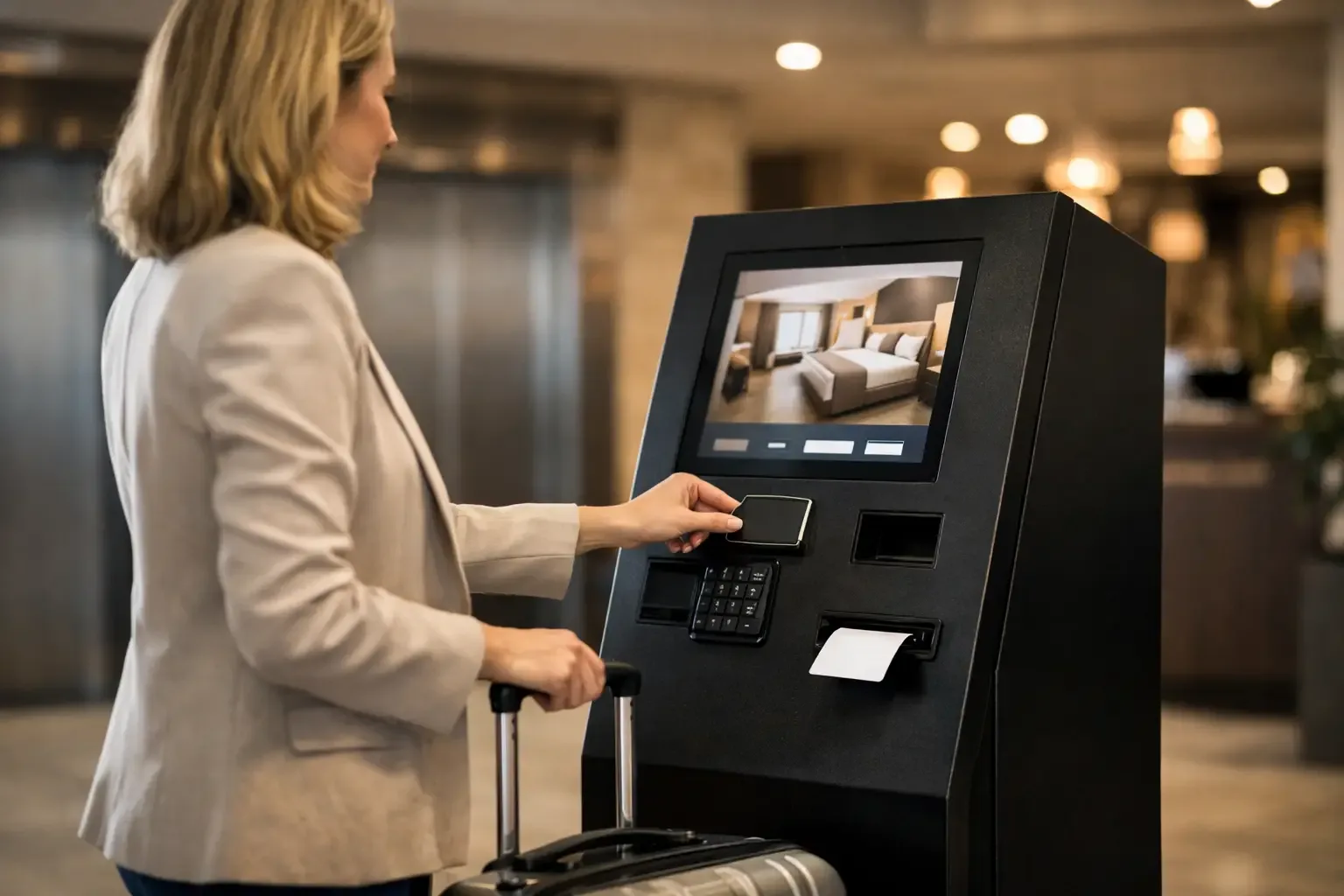
A late arrival, a queue at reception or a small team need not compromise the guest experience. A Roommatik Hotel system automates critical stages of check-in, providing a self-service point that works according to the rules set by the property. For hotels, hostels, holiday rentals and aparthotels, it is an operational answer to a specific need: welcoming guests better, with greater availability and less reliance on repetitive tasks.
What is a Roommatik Hotel system?
Roommatik is an automated check-in solution for the hospitality sector. Using a self-service kiosk, guests can identify their booking, confirm the required details, make payments where applicable and obtain access to their accommodation, depending on the property’s configuration and integrations.
In practice, the system moves to the kiosk a significant part of the process that traditionally requires a receptionist’s constant involvement. It does not necessarily replace reception or human contact. Instead, it allows staff to stop focusing on predictable admin tasks and spend more time welcoming guests, resolving exceptions and providing customer service.
The solution is particularly relevant for operations with out-of-hours arrivals, seasonal peaks or lean reception teams. Instead of limiting check-in to the physical presence of a member of staff, the property can offer extended service capacity, including 24 hours a day when the operating model justifies it.
Why check-in automation is becoming more important
Guests expect speed, clarity and independence, especially after a long journey or when arriving at unusual hours. Having to wait to complete a simple check-in creates friction at the very first contact with the property. On the other hand, keeping reception permanently staffed can be a significant cost, especially for smaller businesses or during low-occupancy periods.
Automation should not be seen merely as a way to cut costs. It is a way to organise the operation better. When the arrival flow is standardised, staff have fewer manual records to check, fewer payments to process at the desk and fewer waiting situations linked to repetitive tasks.
There is also a question of consistency. A process configured in the system always follows the same sequence of validation and information. This helps reduce operational slips and makes it easier to train new staff, without taking away the property’s ability to step in whenever a situation requires it.
Where the impact is felt day to day
The most visible benefit is shorter queues and waiting times at reception. However, the impact extends to staff management, payment control and service availability. In a property with many arrivals in short periods, allowing guests to start or complete the process independently avoids piling work onto a single desk.
In properties without night reception, the kiosk can make late arrivals possible without a member of staff having to be on site. In hotels with a staffed reception, it acts as a complementary channel, useful at busier times. The right model depends on the type of property, occupancy, guest profile and the security procedures set by management.
How Roommatik automated check-in works
The guest journey should be simple, but the implementation behind the screen requires planning. Usually, the process starts with the booking being identified using the details requested by the system. The guest then confirms or completes information, follows any registration requirements, settles outstanding amounts and receives the instructions or means of access provided for the accommodation.
The experience can include scanning ID documents, capturing a signature, issuing receipts and integrating with hotel management systems, payment methods and access control. The features available depend on the equipment chosen, the technical integrations and the specific needs of the operation.
This reliance on integration is essential. A kiosk should not be treated as a standalone device placed in the lobby. To deliver results, it has to fit into the property’s real processes: bookings, payment rules, issuing keys or codes, guest communication and handling exceptions.
Roommatik Hotel system: which operations benefit most?
There is no single hospitality model. That is why the decision should start from the service flow, not just the number of rooms. A property with few rooms but many late arrivals may gain more from automation than a larger hotel with a reception that is always open and arrivals spread throughout the day.
City hotels often benefit from fast service at peak times. Tourist properties with strong seasonality can boost reception capacity without proportionally increasing staffing. Hostels and holiday rentals, where guest independence is already valued, can create a more flexible and predictable arrival process.
The solution also makes sense for aparthotels, campsites, residences and other accommodation where out-of-hours access is a recurring requirement. In all cases, the deciding factor is repetition: the greater the volume of standardised check-in tasks, the greater the potential efficiency tends to be.
When human service remains essential
Automation has limits and should be designed realistically. Groups, bookings with special conditions, guests who need extra assistance, last-minute changes or communication failures require a clear support process. The aim is not to leave guests without an answer, but to make sure staff step in where they genuinely add value.
For this reason, it is advisable to define procedures for exceptions before installation. Who responds to a request for help? How is a booking that cannot be found handled? What happens if access is not issued? What information should be available to the guest? These questions determine the quality of service as much as the equipment itself.
What to assess before implementation
Acquiring a self-service check-in system should start with an analysis of how reception currently works. It is useful to measure arrival times, the average time spent on each check-in, the periods with the longest queues, the percentage of payments made on site and how often guests arrive outside staffed hours.
Next, it is important to confirm compatibility with the existing hotel management software and the property’s access systems. A well-defined integration avoids duplicated data and reduces the need for manual intervention. The kiosk’s location should also be assessed: the unit needs to be visible, accessible, protected and part of an intuitive route from the entrance.
Communication with guests is another key factor. Before arrival, guests should know what to expect, which documents to bring and how to ask for help if needed. On site, clear instructions and a simple interface reduce drop-offs and requests for assistance.
Finally, management should analyse the return using concrete indicators. Fewer hours spent on repetitive check-ins, shorter queues, greater capacity to handle late arrivals and improved guest satisfaction are more useful metrics than a generic promise of modernisation.
Implementation focused on the operation
Effective implementation means configuring the solution to suit the reality of the hotel, testing the various booking scenarios and training staff to support the new model. Technology should adapt to the business, not force the business to create artificial processes just to accommodate the equipment.
SelfPay works with specialised solutions for in-person and digital operations, supporting hotels that want to modernise guest service and payment flows. The choice of equipment and configuration should take into account the size of the property, the integrations required and the level of guest autonomy desired.
A well-integrated Roommatik system does more than transform the moment of arrival. It gives the property greater capacity to welcome guests at the times when availability matters most, while staff focus on the service no kiosk should replace: the kind that requires context, attention and human judgement.


