
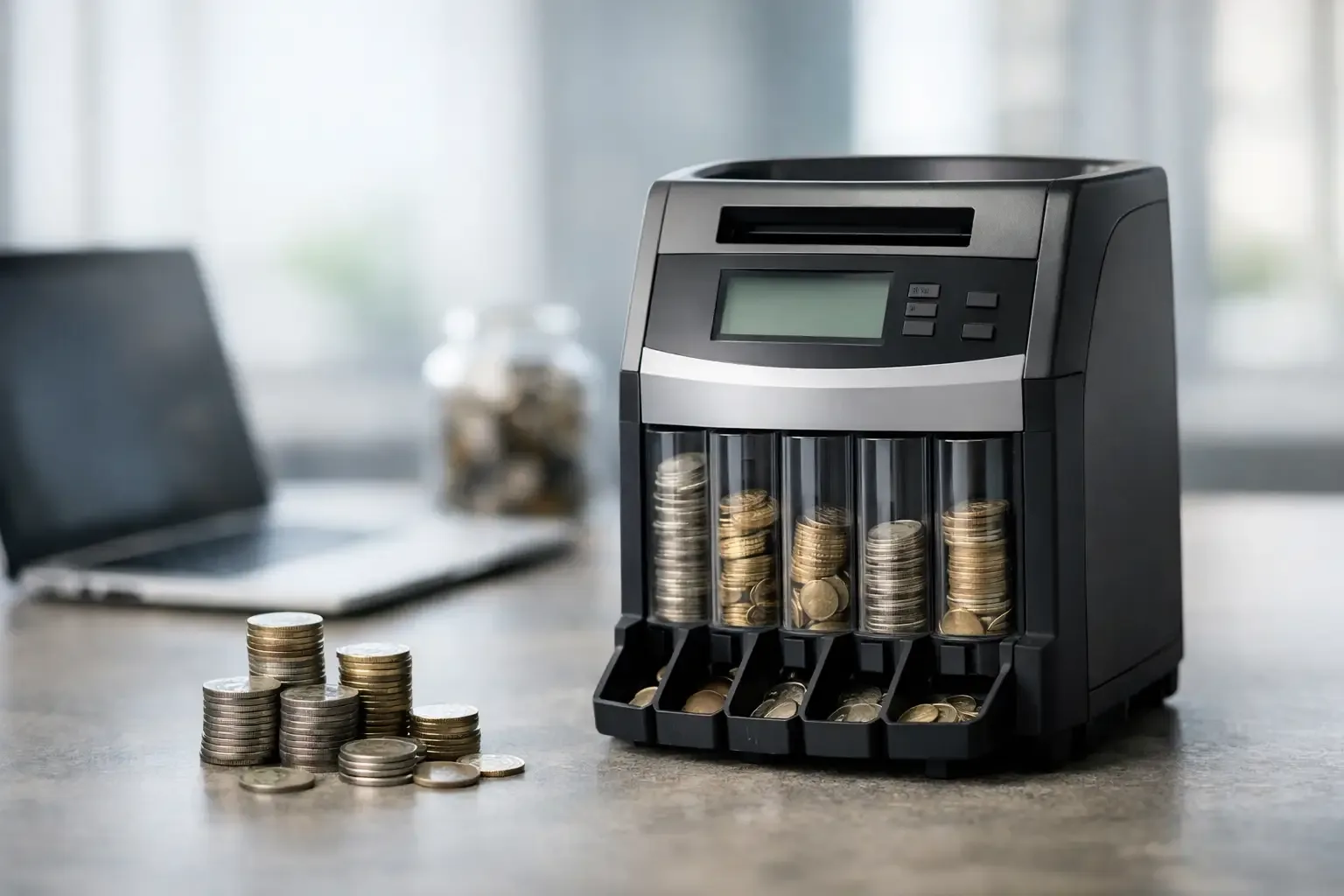
The question of how much a smart cash changer costs usually comes up too late: typically when the business is already losing time cashing up, making change errors or is overexposed to cash. By then, the price is no longer just the cost of the equipment but also includes the daily cost of the manual operation. To assess the investment properly, you need to look at the whole picture.
A smart cash changer is an automated cash management system that accepts coins and notes, validates the money, stores it securely and dispenses change automatically. In practice, it reduces staff’s direct contact with the till and creates a more controlled process at the point of payment. It is a particularly relevant solution for restaurants, retail, self-service launderettes and other settings where cash still accounts for a significant share of sales.
How much does a smart cash changer cost in practice?
There is no single price that applies to every business. The cost of a smart cash changer varies depending on the capacity of the equipment, the level of automation, integration with the invoicing or POS software, the brand, the installation configuration and the type of support included.
In market terms, equipment of this kind can represent an investment ranging from a few thousand euros to significantly higher amounts for more complete solutions. An entry-level model designed for moderate cash volumes and simple use will naturally cost less than a solution designed for intensive operations, with high till turnover and demanding technical integration.
That is why the right question is not always just how much a smart cash changer costs. In many cases, the more useful question for management is how much it costs to keep the current process without automation. If there are frequent till discrepancies, excessive time spent cashing up, reliance on staff to check change or a risk of internal theft, the hidden operating cost may be higher than it seems.
What makes the price vary
The first variable is cash-handling capacity. Equipment designed to accept and dispense large volumes of coins and notes throughout the day has a more demanding architecture and sturdier components. This is reflected in the price, but also in durability and operational stability.
The second is validation technology. Not all systems offer the same level of coin and note recognition, anomaly detection or processing speed. In businesses with a constant flow of customers, the speed at which cash is accepted and change dispensed is not a technical detail: it directly affects the service experience.
Integration with the point-of-sale ecosystem also weighs on the investment. When the smart cash changer communicates with the invoicing software, the POS or other self-service solutions, the operational result is better. But that integration may require specific configuration, testing and adaptation to the customer’s environment.
There are also factors that are often underestimated, such as physical installation, staff training, preventive maintenance and technical support. An apparently lower price can hide a limited implementation model, with less support and a greater risk of downtime. For operations where the till cannot fail, this point deserves attention.
Buy outright or choose a solution tailored to the project
In some companies, the analysis starts with the idea of buying the equipment outright. This makes sense when there is a clear long-term vision, a stable volume of operations and the ability to absorb the initial investment. In that scenario, the smart cash changer becomes part of the business’s operational infrastructure.
But that is not always the only sensible route. Depending on the project, it may be more advantageous to structure the solution around the reality of the operation, the number of payment points, seasonality and growth potential. A restaurant with heavy lunch and dinner trade has different needs from a local shop or a self-service launderette.
A consultative approach is decisive here. Rather than choosing equipment purely on its list price, it makes more sense to assess the operational fit. An oversized system is poorly used capital. An undersized one creates friction and limits the return.
When the investment pays off
The return tends to come faster in businesses with a significant volume of cash payments, high staff turnover or a strict need for control. In restaurants, for example, automated change speeds up service and reduces errors at the busiest moments. In retail, it improves till control and reduces discrepancies at close. In self-service operations, it allows greater autonomy without a proportional increase in staff.
It also pays off when security is a priority. By restricting direct access to money, the smart cash changer reduces the risk of misappropriation and lowers staff exposure to sensitive tasks. This operational change affects not only financial control but also internal organisation and confidence in the process.
Another relevant point is productivity. When the team no longer wastes time on manual counting, checking change and investigating discrepancies, it has more time for customer service, restocking or supervision. This efficiency, accumulated over the month, is one of the strongest arguments in favour of automation.
Price alone can be misleading
Comparing equipment solely on its initial cost is usually an incomplete reading. Two smart cash changers can have fairly similar prices and deliver very different results. The difference may lie in reliability, ease of use, integration with the point of sale or the technical support available in Portugal.
For an operations manager, the key point is not buying the cheapest equipment. It is implementing a solution that reduces failures, stabilises the payment process and keeps pace with the real operation. When this analysis is done well, the price is seen in the context of the impact the system has on the business.
That is also why the most successful projects start with a diagnosis rather than a catalogue. Before discussing final figures, it is worth understanding how many transactions are made each day, what percentage are in cash, what kind of change is needed, how the current software works and what constraints affect service.
How to assess proposals without losing sight of the essentials
When requesting a proposal, it is worth looking beyond the equipment itself. Ideally, you should understand what the project includes: installation, configuration, training, support, maintenance and compatibility with existing systems. A more complete quote may be financially more advantageous than an apparently cheaper option that later requires additional costs.
Another important criterion is suitability for the sector. A smart cash changer for hotels, integrated into a check-in or reception process, does not perform in the same way as a solution for quick-service restaurants. Automation is most effective when it is designed for the specific flow of the business, not as generic technology applied to any context.
At this point, working with a specialist partner makes a difference. Companies such as SelfPay Portugal take exactly this approach: not just presenting equipment, but designing an automated payment solution aligned with the sector, the operation and the customer’s goals.
So how much should you expect to invest?
Without prior analysis, any figure would be an oversimplification. Even so, it is reasonable to expect the investment in a smart cash changer to vary with the complexity of the project and the operational demands. For simple operations, the cost will be more contained. For environments with higher throughput, integration needs and stricter security requirements, the cost rises, and with good reason.
A good decision is not about finding the lowest price. It is about understanding whether the system reduces errors, protects cash, speeds up service and frees the team for higher-value work. When these gains are real and measurable, the equipment stops being a technology expense and becomes a management tool.
If your operation still relies on manual till processes, it is worth asking the full question. Not just how much a smart cash changer costs, but how much it costs to keep working without one. That is often where the answer starts to make sense.


