
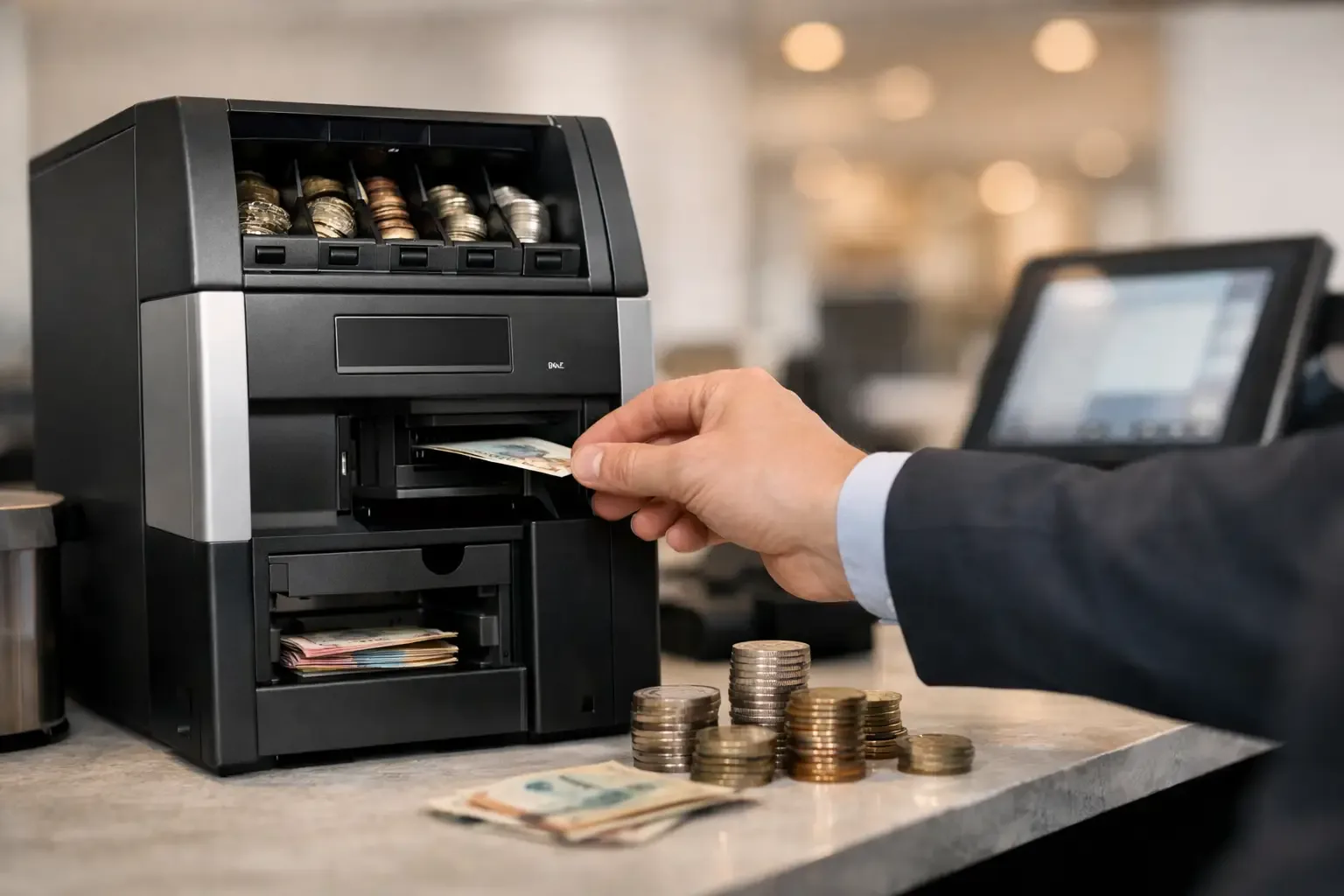
When the till slows down at the busiest times, the problem is rarely just the staff. Often, it is the process. An automated cash recycler solves one of the most sensitive points in face-to-face operations: handling coins and notes quickly, with control and security, without relying solely on manual counting for every transaction.
For businesses that serve the public, this detail has a direct impact on productivity, operational losses and customer experience. In retail, it avoids unnecessary queues. In restaurants, it eases pressure on the counter. In hotels and other settings with frequent payments, it helps standardise procedures and limit human error. The issue is not just technological. It is operational.
What an automated cash recycler is
An automated cash recycler is a device integrated into the point of sale that accepts, validates, stores and dispenses cash automatically. In practice, the operator enters the purchase amount in the system, the customer inserts the money and the machine handles validation and change.
This means staff no longer handle coins and notes directly during service. The till still exists as an operational function, but with less exposure to error, less time lost on checks and greater traceability of the cash in circulation.
It is worth distinguishing this type of solution from a simple change dispenser. An automated cash recycler works with till control logic, software integration and validation mechanisms that make the operation more reliable. For businesses with a significant volume of cash transactions, this difference matters.
Why automated cash recyclers have become more important
For years, many businesses accepted small inefficiencies at the till as a normal cost of operating. Change discrepancies, idle time when opening and closing the till, the need for frequent supervision and the risk of handling money were seen as unavoidable. Today, there is less tolerance for this.
Pressure on margins, difficulty recruiting and training staff and the need to serve more customers in the same space are forcing businesses to review their processes. It is in this context that the automated cash recycler stops being just a piece of equipment and becomes an operational management tool.
There is also a consistency factor. An automated process follows the same pattern regardless of the shift, the operator’s experience or how busy it is. For managers, this means greater predictability. For staff, less pressure at the till. For customers, a faster and more reliable experience.
Operational benefits with real impact
The most immediate benefit is fewer change errors. Even experienced staff can slip up at peak times, especially when they are juggling service, restocking, customer queries and other tasks at once. By automating the receipt and dispensing of cash, the risk of error falls significantly.
Security is another key point. When staff do not touch the money, there is less exposure to internal theft, shortfalls and till discrepancies that are hard to explain. In addition, the cash is kept secure inside the machine, which improves control and reduces vulnerability at the service point.
There is also a time saving that is not always valued in the initial analysis. Opening the till, counting the float, checking change, closing the shift and investigating discrepancies are repetitive tasks that consume resources every day. With an automated cash recycler, a large part of that work becomes systematised.
In many businesses, efficiency comes not only from the speed of each payment but from the sum of small time savings throughout the day. Fewer seconds per transaction, fewer minutes at closing, fewer corrections. It is this cumulative effect that improves profitability.
Where it makes most sense to implement
Retail
In retail, an automated cash recycler is particularly useful in shops with constant footfall, several operators and a need for tight till control. Local supermarkets, specialist shops, convenience stores and high-turnover outlets benefit from a more stable operation that depends less on each employee’s individual experience.
It also helps where service involves advising customers at the same time. If the salesperson is not focused on counting coins and notes, they can pay more attention to selling and improve the interaction at the point of sale.
Restaurants
In restaurants, speed is decisive. At counters, cafés, takeaways and quick-service concepts, payment delays create queues almost immediately. An automated cash recycler reduces friction at the final moment of purchase and improves the flow of service.
In other formats, such as bakeries or restaurants that are very busy at certain times of day, the machine helps stabilise the operation at peak times. It does not solve every constraint on its own, but it eliminates one of the most common: a slow and inaccurate till.
Hotels and reception
In hotels, the share of cash may vary, but it still exists in many properties, especially in tourist settings, for extra charges and for additional services. An automated system strengthens control at reception and reduces staff exposure to repetitive administrative tasks.
In settings where a professional image matters a great deal, automating payment also helps convey a modern, well-organised service.
Self-service launderettes and other unattended spaces
In self-service operations, cash handling needs to be secure and simple. Here, the automated cash recycler plays an even more critical role, because it is part of what makes the service autonomous. The machine’s reliability directly affects business continuity and customer satisfaction.
What to assess before investing
Not every business has the same need, and this should be approached pragmatically. If cash payments are only a small share, the return may take longer. If the operation handles a lot of cash, runs several shifts and has a history of till discrepancies, the decision tends to be more obvious.
The first criterion is the real volume of transactions. The second is the hidden cost of the current process: lost time, errors, reconciliations, supervision, risk and the impact on service. Many businesses look only at the price of the equipment and ignore the ongoing cost of handling cash manually.
It is also important to assess integration with the invoicing software and with the design of the counter or till point. A good project is not just about installing technology. It is about adapting the workflow so that automation simplifies the operation rather than complicating it.
Another relevant aspect is scalability. If the business plans to open new shops, standardise procedures or reduce its reliance on very specific profiles at the till, it makes sense to choose a solution that can keep pace with that growth.
Automated cash recyclers and the customer experience
Cash automation is not always seen as part of the customer experience, but it has a direct impact. Customers value speed, accuracy and predictability. When payment goes through without hesitation, lengthy checks or change errors, the perception of the service improves.
There are, however, nuances. In some highly personalised service settings, technology should be integrated without making the interaction cold or overly mechanical. The aim is not to remove the personal touch. It is to free staff from repetitive tasks so they can focus on the customer.
That is why implementation should be planned around the type of business. In a premium concept, automation can be discreet and built in. In a high-turnover environment, it can play a more visible and functional role. The right criterion is not aesthetic. It is operational.
An investment best seen as a process transformation
Buying an automated cash recycler just to modernise the counter is a narrow view of the subject. The real value lies in transforming the cash process: less manual handling, more control, more security and greater operational consistency.
For decision-makers who manage teams, margins and service, this type of solution should be judged on its effect on the operation as a whole. If it reduces errors, speeds up service and improves cash control, then it is not just a piece of equipment. It is a management decision.
SelfPay Portugal works precisely on this basis of operational specialisation, aligning automated payment solutions with the specific requirements of each sector. And it is this fit with the real context of the business that makes the difference between having technology installed and having an operation that is genuinely better prepared to grow.
Before going ahead, it is worth asking a simple question: how much does it cost to keep handling cash the same way? In many cases, that answer makes the investment clearer.