
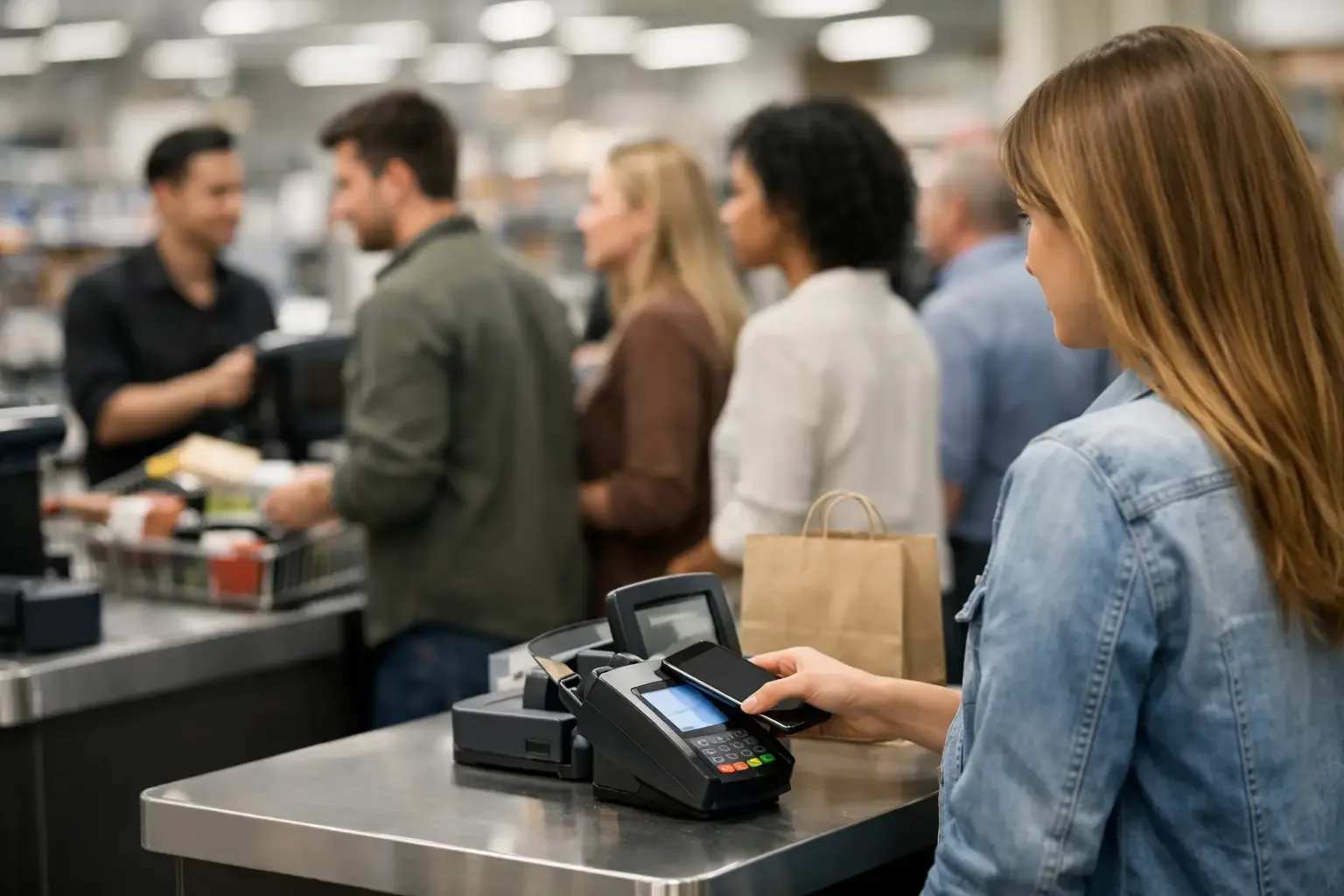
When the queue grows at the till, the problem rarely lies only in the moment of payment. In practice, understanding how to reduce queues at checkout means looking at the entire service flow, from choosing the product to the final validation of the purchase. For anyone running in-person operations, a queue is a clear sign of operational friction, lost capacity and a real risk of customers walking away.
In restaurants, retail, hotels or self-service laundrettes, the impact is felt quickly. Some customers give up, teams are under pressure, errors appear at till closing and the experience falls short of expectations. Reducing queues is not only about gaining speed. It is about creating a payment process that is more predictable, more secure and more scalable.
Why queues build up at payment
Many businesses assume that queues only appear at peak times. That is one factor, but not the only one. In many cases, congestion results from processes that rely too heavily on manual intervention, equipment that does not match the volume of the business or too many payments concentrated at a single point.
When the operator has to take cash, give change, validate orders, answer questions and also deal with exceptions, each transaction takes longer than it should. The problem gets worse when the pace of service preparation and the pace of payment do not match. In a quick-service restaurant, for example, production may be finely tuned, but if ordering and payment are still centralised at a single till, the queue remains.
There is also a common mistake in operational analysis: measuring only the average waiting time. What most affects the customer’s perception is variability. If some payments take 20 seconds and others 2 minutes, the queue becomes unpredictable and harder to absorb.
How to reduce queues at checkout with an operational view
The effective answer lies in redesigning the point of service, not simply asking the team to work faster. When the operation is well designed, payment stops being a bottleneck and becomes an integrated part of the service.
The first step is to identify where the queue really forms. It is not always at the physical till. Sometimes the blockage happens when taking orders, managing change, issuing invoices or because customers constantly need assistance. This diagnosis is essential because two operations with similar queues may need completely different solutions.
Next, it is important to decide whether the goal is to increase payment capacity, spread the flow or automate critical tasks. In many cases, the best solution combines all three approaches. A business that handles a large volume of cash faces different challenges from a hotel that needs faster check-ins or a laundrette that wants to offer unattended payments for longer hours.
Payment automation: where the gain is most immediate
Automation delivers fast results because it reduces manual dependencies in the tasks that slow the operation down the most. Where cash is still relevant, automated cash management systems have a direct impact on service time. Staff no longer count coins, check notes or calculate change by hand. This reduces errors, speeds up every transaction and strengthens till control.
Beyond speed, there is a less visible but very important benefit: process stability. When payment always follows the same logic, regardless of who is on duty, the operation becomes more consistent. For managers, this means less exposure to till discrepancies, less time spent on reconciliation and more predictable closing routines.
There is, however, an important point. Automating without adjusting the layout or customer flow can limit the return. If the equipment is poorly positioned, if customers do not understand the route or if they still depend on several intermediate checks, the technology improves part of the process but does not remove the main cause of the queue.
Self-service: less concentration, more flow
When demand is concentrated in short time windows, self-service becomes a very effective lever. Ordering and payment kiosks spread service across several points at once, easing pressure on the counter and cutting waiting times.
In restaurants, this approach works particularly well in operations with structured menus and highly repetitive orders. Customers browse the options on screen, customise their order, pay and send it to the kitchen without tying up a member of staff for the whole process. The team can then focus more on preparation, delivery and occasional support.
In retail, the logic is similar, though with nuances. Not every shop benefits from the same self-checkout model. In stores with small baskets and high turnover, the gain tends to be immediate. Where the sales process requires advice or tight control of specific items, the model may need assisted support. The criterion should not be following a trend, but understanding where customer autonomy speeds up the operation without compromising the experience.
Sectors where reducing queues has a direct impact on revenue
In hotels, a queue at reception is more than an inconvenience. It is often the guest’s first operational contact with the property. Automated check-in solutions help reduce idle time, especially at busy periods, for late arrivals or in operations with a strong tourist component. The gain is not only speed. It also frees reception staff for welcoming and support duties instead of absorbing repetitive administrative tasks.
In self-service laundrettes, the issue is even more practical. If payment depends on human intervention or on systems that are not intuitive, the autonomy of the space is compromised. Solutions designed for this model make it easy to take payments, reduce failures and increase service availability.
In food retail and restaurants, queues have an immediate effect on conversion. When customers realise they will wait too long to pay, they tend to buy less or give up altogether. In urban and convenience operations, where time weighs heavily on the decision, a few minutes make a difference.
The role of layout and signage
Not everything depends on technology. The way the space guides the customer has a direct influence on the queue. If the payment area is poorly marked, if routes cross or if customers only realise at the end where they should pay, friction increases.
A well-designed layout reduces uncertainty and spreads the flow better. In operations with kiosks, for example, signage should clearly explain where to order, where to pay and where to collect. In shops with both assisted and self-service payment, separating the routes prevents customers with different needs from joining the same queue.
Small physical adjustments can bring significant gains. Separating those who only want to pay from those who need information, placing equipment at natural decision points and creating clear waiting areas helps absorb peaks better without adding to the sense of confusion.
Measure before investing, adjust after implementing
Anyone looking at how to reduce queues at checkout needs to resist a hasty decision based only on perceptions. You can see the queue, but its cause must be measured. Average time per transaction, payments per hour, share of cash, abandonment rate and peak periods are simple indicators that help choose the right solution.
It is also worth assessing the weight of exceptions. If a large share of delays comes from special requests, returns or administrative interventions, the solution may be to separate flows rather than automate everything in the same way.
The work does not end after implementation. Technology often creates additional capacity but requires fine-tuning of the operation in the first few weeks. Adjusting on-screen instructions, reviewing equipment placement or providing temporary extra support for customers is part of the process. The difference between a project that works and one that merely exists often lies in this follow-up.
Reducing queues without losing control
Some businesses are reluctant to automate because they associate speed with less control. In practice, the opposite is often true. When payment is automated and integrated into the operational flow, the business gains visibility, reduces vulnerabilities in cash handling and cuts manual errors.
The critical point is choosing solutions suited to the sector, the transaction volume and customer behaviour. A generic approach rarely responds efficiently to situations as different as a high-traffic restaurant, a local shop or a hotel reception. This is where a specialist perspective makes a difference, because the goal is not just to install equipment, but to design a more efficient operation.
Reducing queues at checkout is, ultimately, a management decision. It means treating the moment of payment as a strategic part of the experience and of business productivity. When the process is well set up, customers wait less, the team works with more control and the operation gains the capacity to grow without repeating the same bottlenecks.


