
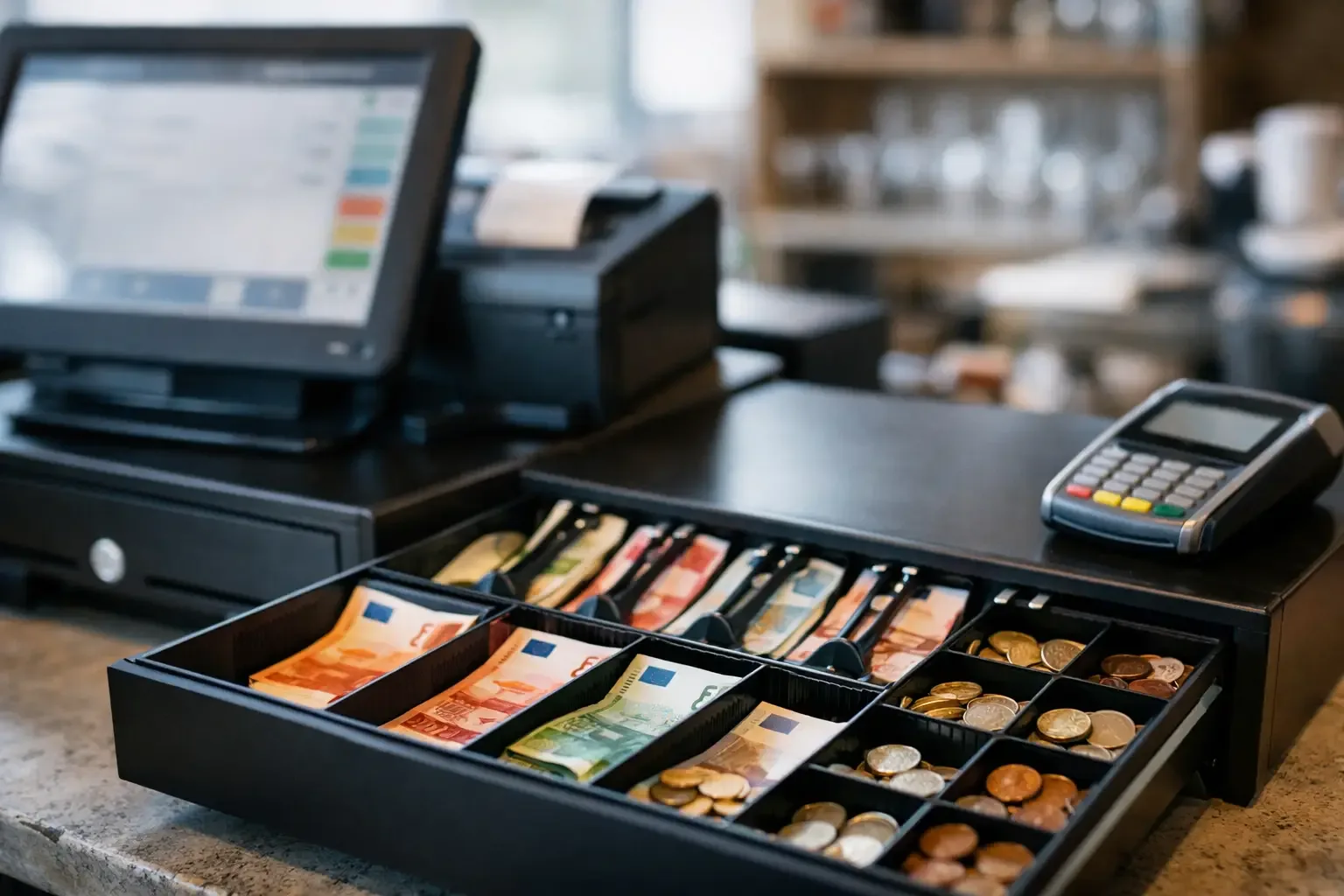
Closing the till should not depend on manual counts, improvised change or discrepancies that are hard to explain at the end of a shift. When looking for the best cash management systems, the goal is not just to accept notes and coins: it is to control cash from payment through to reconciliation, cut administrative tasks and keep service moving.
For a restaurant with lunchtime peaks, a retail shop handling many transactions an hour or a self-service launderette with no permanent staff, the right solution can be quite different. The choice should start with how the business actually operates, not with a generic list of features.
What sets a good cash management system apart
A conventional cash drawer stores money. An automated cash management system accepts, validates, gives change and records every transaction. This difference has a direct impact on security, productivity and the quality of internal control.
In a manual process, the employee takes the payment, checks the amount, works out the change, puts the notes in the drawer and later helps reconcile the till. Each step leaves room for errors, lost time or discrepancies. With an automated payment machine, cash is inserted directly by the customer or operator and is kept secure inside the machine, with amounts recorded consistently.
The best systems are not judged only on their ability to accept cash. They should integrate with the point of sale, communicate with the invoicing software and provide useful management information. When the solution is well implemented, staff stop wasting time counting coins and can focus on serving customers, restocking or preparing orders.
Best cash management systems: selection criteria
Before comparing models, it is important to define what the operation requires every day. Transaction volume, peak hours, average spend and the number of service points matter more than the price of the equipment on its own.
Capacity suited to payment volume
A small convenience shop and a supermarket have very different storage and speed requirements. If the equipment has too little capacity for notes or coins relative to daily flow, it will need frequent emptying and refilling, reducing the benefit of automation. On the other hand, installing an oversized solution in a low-volume operation can delay the return on investment.
Capacity should be assessed on the busiest days, not just the monthly average. Restaurants in tourist areas, for example, can see very different demand between low season, weekends and the summer months.
Speed of acceptance and change dispensing
Speed is decisive when there is a queue. A slow system creates friction at exactly the moment it should make things easier. It is essential to assess how long it takes to accept notes and coins, how quickly change is calculated and how the equipment responds during periods of continuous use.
In convenience retail or quick-service restaurants, seconds repeated hundreds of times a day turn into minutes of waiting and pressure on staff. In businesses with a more consultative service, such as specialist shops, the priority may lie more in control and security than in maximum speed.
Integration with the point of sale
A standalone cash system only solves part of the problem. Integration with the POS links each payment to the recorded sale, reduces keying errors and simplifies end-of-day reconciliation.
Before buying, it is worth confirming how the devices will communicate, what information will be available and who will handle installation. It is also important to know whether the solution can keep up with future changes to the invoicing software or the layout of the premises.
Physical security and operational control
Security is not just about having the money inside a machine. It should include note validation, protection against unauthorised access, traceability of transactions and less cash exposed at the counter.
This is especially relevant in premises with several shifts or high staff turnover. By limiting direct handling of cash, the business reduces uncertainty over responsibility and makes the cash process more transparent for both management and staff.
Ease of use and technical support
A technically advanced solution loses value if it is hard to use day to day. The screen, alerts, refill procedures and incident handling should be clear to anyone working at the point of sale.
Support also deserves scrutiny. Payment equipment is critical to business continuity, so the availability of technical support, spare parts and maintenance in Portugal should be part of the decision. The upfront cost matters, but downtime during a busy period can cost more than the price difference between two solutions.
Which type of system suits each sector
There is no single answer for every business. Cash automation should be sized according to the type of service and the role the till plays in the customer experience.
Restaurants and cafés
In restaurants, bakeries and quick-service outlets, the main challenge is balancing speed with accuracy. There are low-value payments, orders concentrated into short periods and staff moving between counter, dining room and kitchen. An automated system cuts the time spent giving change and stops cash moving between operational areas.
When combined with ordering kiosks, the impact can be greater. The customer places the order, chooses how to pay and staff receive the details for preparation, with shorter queues at the counter. Even so, it is essential to keep an accessible route for customers who prefer to pay in cash or need assistance.
Retail
In retail, cash management has to cope with footfall peaks, shift changes and the need for control at each till. A cash system can minimise till discrepancies, simplify opening and closing and reduce daily reconciliation time.
For shops with several counters, it may make sense to consider whether each till needs its own unit or whether the operation would benefit from a centralised solution. The choice depends on the store layout, the number of staff and the autonomy needed at each payment point.
Hotels and accommodation
In hospitality, cash can come up at check-in, when paying for extras, for additional services or outside normal reception hours. The priority is to keep service professional without adding to the team’s administrative workload.
An automation strategy can combine check-in solutions with payment systems suited to reception. The aim is not to remove hospitality, but to take repetitive tasks out of the process so staff can step in where human contact adds value.
Self-service launderettes
In a self-service launderette, service availability is crucial. Customers expect to select a programme, pay and start the machine without relying on an attendant. The system must withstand heavy use, be simple for the user and be able to handle payments securely over long opening hours.
Here, preventive maintenance and monitoring are as important as accepting coins and notes. Any equipment downtime translates directly into idle machines and lost sales.
How to assess the return on investment
The return should not be measured only by fewer till discrepancies. There are less visible but significant gains: less time spent on the daily close, smaller change floats, fewer interruptions to service and more predictable reconciliation.
Start by measuring how much time staff currently spend counting, checking and organising cash. Add up the errors, the cost of losses, the impact of queues and the need to move money between tills and secure areas. Then compare these figures with the investment, the maintenance and the changes needed to the existing process.
Growth should also be considered. The right solution should keep pace with the business, whether through more payment points, integration with new equipment or longer opening hours. Choosing only to solve today’s problem may mean replacing the system too soon.
Implementation: the detail that determines the outcome
Technology delivers better results when implementation is treated as an operational change. You need to look at the installation site, the POS connection, opening and closing procedures, staff training and the maintenance plan.
SelfPay works with specialist solutions, such as Cashmatic automated cash management systems, assessing the most suitable application for each operational context. This approach matters because a restaurant, a shop and a launderette do not use the till in the same way, even when they share the need for greater control.
Before going ahead, involve the people who work at the counter every day. Staff can spot friction points that never show up in a sales report: lack of space, specific peaks, frequent customer questions or procedures that slow down giving change. This insight helps define a set-up that works beyond the sales demo.
The best choice is the one that turns payment into a predictable, secure and fast process, without complicating the work of those serving or the experience of those buying.


