
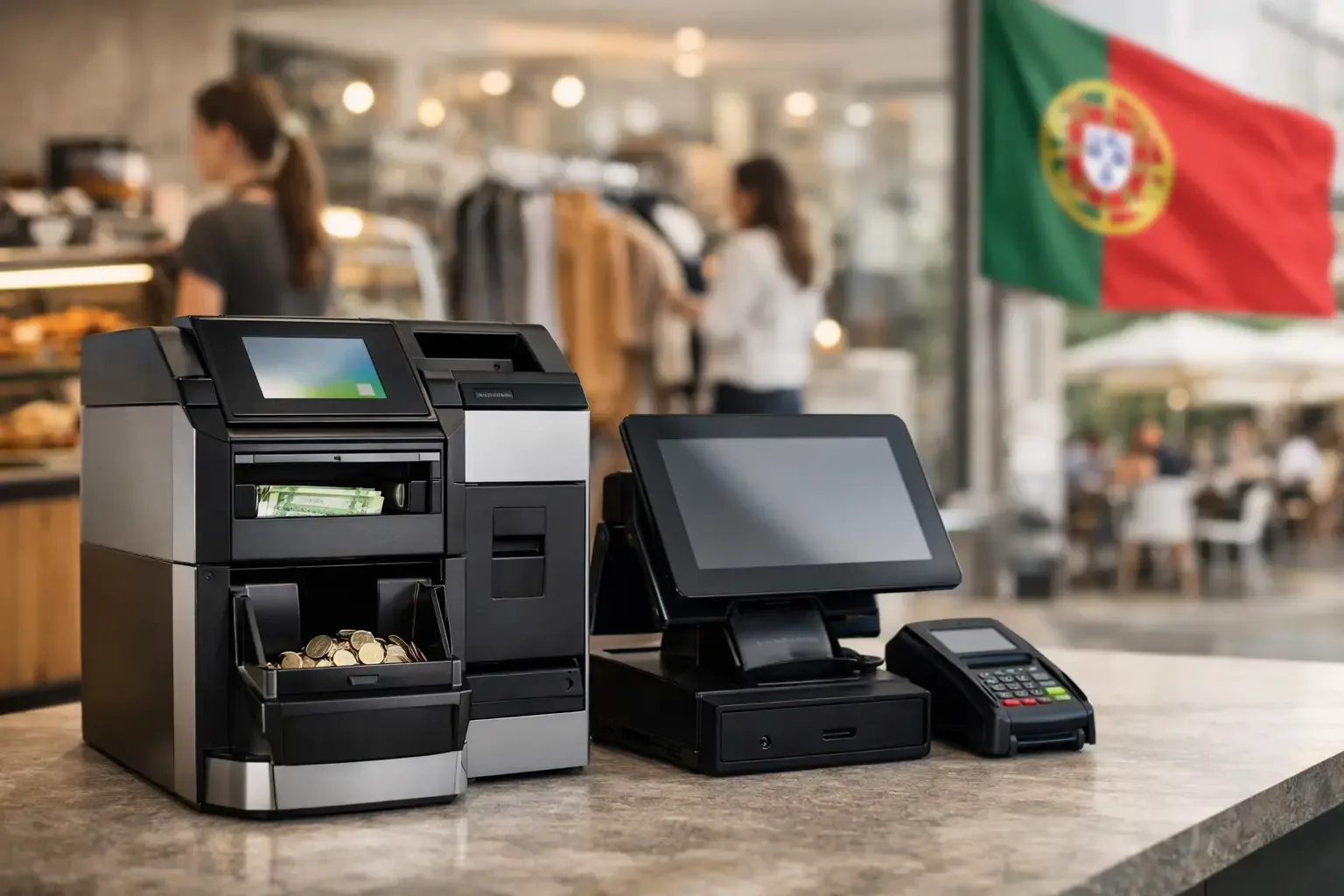
When a till keeps closing with discrepancies, the problem is rarely just the change. Staff time is spent counting, people are exposed to cash handling, queues move more slowly and there is less visibility over the money coming into the business. This is the context in which it is worth understanding which businesses benefit from Cashmatic and under what conditions this technology delivers real operational gains.
Cashmatic systems automate the acceptance, validation, storage and dispensing of notes and coins at the point of payment. Staff no longer have to count change or keep money in a drawer, while customers pay in cash more independently and quickly. This is not just about replacing a cash register: it is about reorganising a critical process, where small, repeated errors can affect the operation every day.
Which businesses benefit from Cashmatic?
The most direct answer is: businesses with till activity, frequent cash payments and a need for tight control. But the decision should not be based solely on sales volume. A venue with fewer transactions may benefit more than a very busy one if it has limited staff availability, long opening hours, high staff turnover or persistent difficulties reconciling the till.
Cashmatic is especially suited to face-to-face operations where service requires speed, trust and control at the same time. The solution reduces manual intervention in the cash cycle, while preserving the role of staff in advising customers, providing service and dealing with situations that genuinely need human attention.
Retail with counter service
In retail, the pressure is constant: serve quickly, keep the space tidy and make sure every payment is recorded correctly. Convenience stores, mini-markets, tobacconists, specialist shops, pharmacies, perfumeries and other businesses selling directly to the public can gain immediate value from automated cash management.
The main benefit is fewer change errors and discrepancies when cashing up. Instead of the team starting and ending each shift with manual counts, the machine keeps cash secure and accounted for. This improves traceability and reduces the time spent on admin at the end of the day.
There is also a significant advantage for the customer experience. At busy times, cash payments no longer depend on hunting for coins, confirming the amount and counting by hand. Service becomes more predictable, which is particularly important for shops in shopping, tourist or high-footfall areas.
Restaurants, cafés and patisseries
In quick-service restaurants, cafés, patisseries and food outlets with a high number of orders, seconds make a difference. The team has to take orders, prepare products, serve meals and process payments without creating queues. Whenever staff interrupt these tasks to count money or correct change, the operation loses pace.
A Cashmatic system can be integrated into the service counter to automate cash payments, reducing direct contact between staff and money. As well as speeding up service, this set-up reinforces good hygiene practice and lets the team focus on preparation, delivery and quality of service.
The benefit is most obvious at peak times, such as breakfast, lunch and early evening. Even so, you do not need a restaurant chain to justify the investment. An independent venue with steady footfall and a small team can increase its service capacity without adding operational complexity.
Shops with shifts, long opening hours or rotating teams
In some businesses, the challenge is not only taking money but ensuring every shift follows the same process. When several people use the same till, the likelihood of errors and miscommunication rises, and it becomes harder to establish responsibility for a till discrepancy.
Automation helps create a common operating rule. Money goes straight into the machine, change is dispensed automatically and information on each movement is linked to the sales process. For managers of several shops or service points, this standardisation makes it possible to compare operations and spot situations that need looking into before they become a recurring cost.
This is a significant advantage for businesses with extended opening hours, high staff turnover or a need to reduce reliance on informal procedures. Technology does not remove the need for training, but it makes the procedure simpler to carry out and supervise.
Businesses in tourist and high-footfall areas
Portugal receives significant tourist flows, especially in city centres, coastal areas and seasonal destinations. In these settings, businesses face demand peaks that are hard to predict, customers of many nationalities and the need to keep service clear, fast and secure.
An automated cash management solution reduces friction at a sensitive moment in the sale. The customer inserts the money, the system validates the notes and coins and dispenses the exact change. For the team, this means less need to check amounts under pressure and a lower risk of accepting unsuitable cash.
This model can suit souvenir shops, food outlets, local shops and face-to-face services in busy areas. The key criterion is whether demand concentrated at certain times or seasons creates enough queues, admin effort and risk of error to justify automation.
Self-service launderettes and customer-operated businesses
Self-service launderettes work on their own logic: long availability, minimal staff involvement and payments that must be simple for any user. When the business accepts cash, manual handling can become a weak point, especially if the operator is not permanently on site.
In this sector, integrating automated payment solutions makes it possible to collect cash more securely and reduce trips to check coins and notes. Customer autonomy is strengthened, while the operator gains greater control over the venue’s cash flow.
The choice of equipment should take into account the type of service, the space available, the number of machines and the payment methods already in place. In some cases, a solution integrated into a payment kiosk will be more suitable than equipment designed for a traditional counter.
When Cashmatic may not be the priority
Automating cash is not a mandatory answer for every business. If most payments are digital, the amount of cash in the till is very small and there are no control or service problems, the return may be slower. It may also not be the first priority for operations that do not yet have basic point-of-sale processes in order.
On the other hand, looking only at the number of cash payments can lead to an incomplete assessment. A shop with moderate volume but slow cashing up and frequent discrepancies may have a more urgent need than one with higher turnover but well-established processes. The analysis should include the cost of staff time, the risk of losses, the impact of queues, physical space and growth objectives.
How to assess the right solution for your operation
Before going ahead, it is worth mapping the path cash takes from payment to cashing up. How many people handle cash? How much time is spent counting and checking each day? Are there till discrepancies? When do queues form? These answers help define the most suitable configuration.
Integration with the point-of-sale software is another decisive point. The equipment must fit the venue’s workflow, not force the team to create parallel procedures. It is equally important to consider storage capacity, note and coin acceptance speed, the position of the machine on the counter and the technical support plan.
SelfPay approaches this decision sector by sector, because the challenges of a café are not the same as those of a retail shop or a launderette. Technology has the greatest impact when it is implemented as part of the service and control process, with a configuration tailored to the real pace of the business.
Automating cash makes most sense when it lets the team stop managing money and start managing customers better. For many face-to-face businesses, this change begins at the counter, but it shows every day in control, security and the time that becomes available again to sell and serve better.