
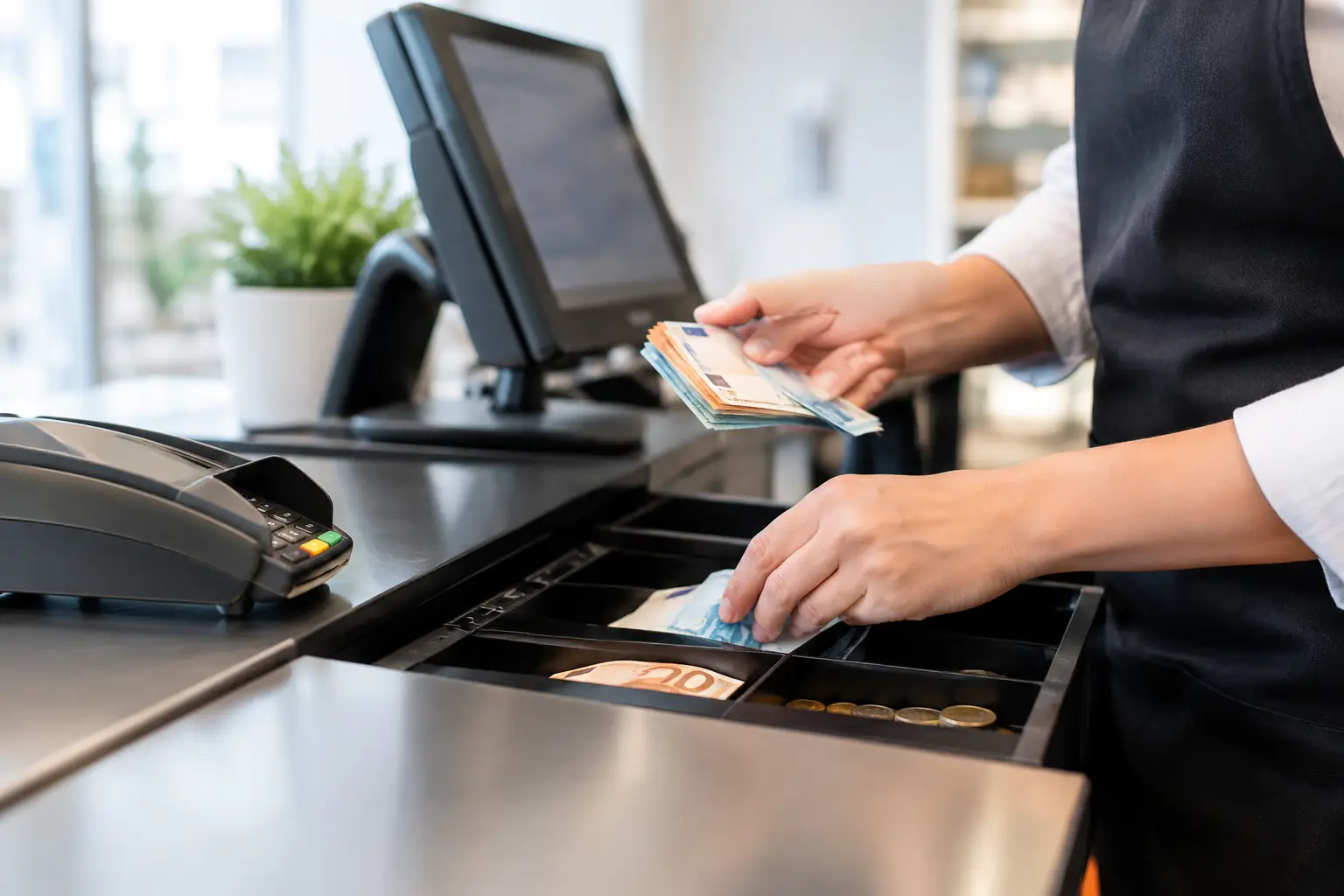
When things get busy, the checkout becomes one of the most exposed points of the operation. A restaurant at peak time, a shop serving several customers at once or a hotel front desk with arrivals bunched together all face the same challenge: taking cash payments quickly without losing control. Cash handling security does not depend only on the attention of whoever is serving. It depends on processes designed to reduce contact, manual decisions and opportunities for error.
For many businesses, cash is still a relevant payment method. Ignoring it is not an option, but keeping it in a manual loop creates operating costs that rarely appear on their own: cash discrepancies, time spent counting, exposure to suspicious notes, the need for change and difficulty assigning responsibility. The answer is not to slow the team down or to add more checks. It is to organise the payment flow so that it is safer and more predictable.
Why cash handling security requires a process
The risk associated with cash starts before the till is closed. Every time a note changes hands, there is a chance of giving the wrong change, accepting unsuitable cash, losing it, having it stolen or recording the sale incorrectly. At a high-turnover point of sale, even small repeated discrepancies can affect margins and management’s confidence.
The problem gets worse when the same employee takes the payment, checks the note, gives change, stores the money, counts it and prepares the deposit. This concentration of tasks makes control harder, especially across shift changes or with high staff turnover. It does not mean the team is not competent. It means the process relies too heavily on human intervention at a moment of pressure.
A secure operation should make it possible to know how much was received, when, at which terminal and how much is available for collection. This traceability transforms cash management. Instead of trying to explain a discrepancy at the end of the day, the business starts preventing the conditions that make that discrepancy likely.
Reducing direct contact with cash
Automating cash payments creates a practical separation between serving the customer and physically handling notes and coins. The customer inserts the cash into the machine, the system validates the amount, calculates the change and dispenses it in a controlled way. The employee stays focused on service, the order or welcoming the guest, without having to handle money in every transaction.
This model reduces errors, but it does not remove the need for an operating policy. You need to define who can open the machine, who manages collections, how incidents are handled and how often reconciliations are carried out. Technology is most effective when it is part of a clear cash control method.
There is also a significant benefit in settings with heavy public contact. In food service, for example, an employee can take orders, serve food and look after the customer without constantly switching between products and money. In retail shops, queues can move more steadily because validating payment and calculating change no longer depend on manual counting.
Four risks that automation helps to control
The need to automate varies with transaction volume and type of business, but there are cross-cutting risks that justify an objective assessment:
- Change errors: automatic calculation reduces mistakes caused by haste, distraction or similar-looking notes.
- Cash discrepancies: by limiting access to cash during the shift, it becomes easier to reconcile sales with the amounts received.
- Unsuitable notes and coins: machines equipped for validation can reject cash that does not meet the defined criteria.
- Staff exposure: less money accessible at the counter means less vulnerability to attempted theft or tense situations.
These gains should not be seen only as a security measure. They are also a way of protecting the pace of service. A payment process that forces staff to stop to count, look for change or confirm amounts creates friction for both the team and the customer.
Balancing security and customer experience
A control measure only works if it is easy to use day to day. Machines that are unintuitive, poorly positioned or unsuited to the space can shift the complexity onto the customer and generate constant requests for help. That is why choosing a solution should start from the real payment journey: where the customer decides to pay, how long they stay at the counter and what support they expect.
In a quick-service restaurant, the goal may be to speed up payment while keeping an employee available to guide the order. In a self-service laundromat, the priority may be to ensure autonomy during periods without permanent staff. In hospitality, the flow may require integration with check-in processes and a discreet experience for guests arriving outside the busiest hours.
There is no one-size-fits-all setup. A small shop with low cash volumes may benefit from a simple control system and consistent closing rules. A restaurant chain or a busy shop will see a bigger return from a solution that automates acceptance, change and reporting. The decision should take into account cash volume, peak hours, the cost of errors and the level of autonomy you want.
Operational security beyond the machine
Technology reduces exposure, but it does not replace procedures. A well-prepared operation defines access by role, limits the opening of compartments, logs technical interventions and creates routines for cash collection. There should also be a clear response to power failures, fraud attempts or occasional machine jams.
Staff training is just as decisive. Employees do not need to be technical experts, but they should know how to guide the customer, spot an unusual situation and follow the correct procedure without improvising. When the rules are simple, adoption is higher and security stops being seen as an extra task.
It is advisable to track concrete indicators after implementation: number of cash discrepancies, daily time spent counting, requests for help with payment and average service times. This data makes it possible to confirm whether the solution is meeting its operational goal and to adjust processes when needed.
From a manual till to integrated control
Modernising the point of payment should be treated as an operational decision, not just the purchase of a machine. Automated cash management systems, such as those SelfPay provides for different sectors, make it possible to keep cash in a closed, controlled loop, from accepting the payment through to collection.
The impact can be particularly visible in businesses where the counter combines several roles. When staff no longer count notes and coins, they gain time to confirm orders, answer questions and give more attentive service. For management, cash information becomes more reliable and available with less administrative effort.
Cash handling security is, ultimately, a choice about how the business wants to operate at its busiest moments. By reducing reliance on manual handling, the business protects its team, controls cash better and creates the conditions for service to keep moving, even when demand does not let up.