
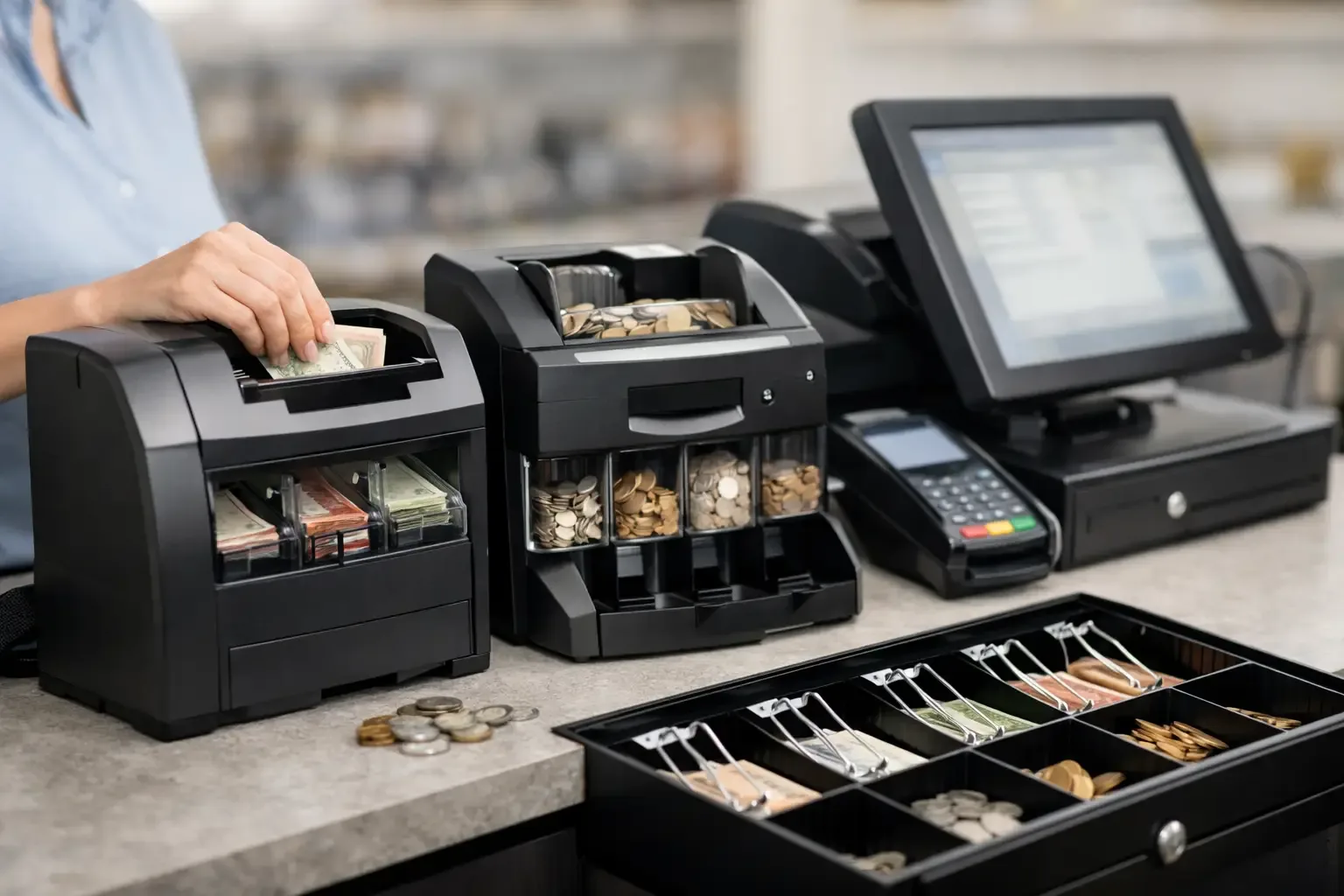
A miscounted note, incorrect change or a till discrepancy at the end of a shift seem like minor problems until they happen every day. Cash management systems are designed to eliminate these failures at the point of sale by automating the receipt, validation, storage and dispensing of cash. For businesses with constant footfall, this change has a direct impact on productivity, security and the customer experience.
In a restaurant at lunchtime, a retail shop during the sales or a self-service launderette open until late, cash demands time and attention. The employee has to take notes and coins, check the amount, work out the change, store the cash and make sure the recorded amount matches the payment made. When this process is done by hand, any interruption or distraction can lead to errors.
What cash management systems are
Cash management systems are automated cash handling devices installed next to the service point or built into a payment counter. The customer hands notes and coins directly to the machine, which validates each one, detects possible counterfeits, calculates the change and dispenses it automatically. The employee stays in control of the sale but no longer handles money.
The solution usually communicates with the point-of-sale software, so each payment is linked to the correct transaction. At the end of the day, the manager can check the amounts received, the transactions carried out and the cash held in the machine, cutting the time needed for till checks and shift closes.
The principle is simple, but the operational result is significant: money no longer passes between customer, employee and cash drawer. It stays secure inside the machine from the moment it is handed over until it is collected by an authorised person.
How an automated payment works
After ringing up the items or service at the point of sale, the operator enters the amount due. The customer inserts the cash into the system and the machine checks the authenticity and denomination of the notes and coins. If the payment exceeds the purchase amount, the system calculates and dispenses the exact change.
The employee does not need to count money or open the cash drawer. Cutting these repetitive tasks is particularly useful at peak times, when speed of service and accuracy are decisive. It also reduces direct contact with cash, a practical concern in restaurants and high-volume service businesses.
Why automate cash handling
The main advantage is not just counting money faster. It is creating a more controlled cash process. In a manual model, till discrepancies can result from mistakes with change, mixed-up notes, incorrectly recorded payments or procedures that vary between employees. With automation, every payment is recorded and the cash is stored without manual intervention.
For management, this means fewer operational losses and clearer control of the cash available. Till reconciliation no longer depends solely on the physical count at the end of each shift. Managers can access structured information, spot discrepancies more quickly and spend less time on administrative tasks.
There is also a significant security gain. Less cash exposed at the counter means less risk of unauthorised access and less vulnerability to theft. Of course, no machine replaces internal security procedures such as controlled access, proper cash collection and staff training. However, it creates a physical and operational barrier that a conventional drawer does not offer.
Speed is another decisive factor. Customers do not judge a business only on its product or service. They judge the wait, the clarity of payment and the confidence of receiving the right change. When service is faster at peak times, the operation can serve more people without putting excessive pressure on staff.
Cash management systems by business sector
The choice of system should start from the real flow of each business. No single configuration suits every point of sale. Daily cash payment volume, available space, the number of tills and the connection to existing software are the factors that should guide the decision.
Retail
In retail, the priority is usually to keep queues short and make sure every sale is recorded without errors. Convenience stores, local supermarkets, pharmacies, kiosks and specialist shops face demand peaks that are hard to absorb when the employee has to manage customers, products and money at the same time.
A cash management machine lets the operator focus on serving customers, restocking or validating the sale. In shops with several shifts, automation also simplifies the till handover between teams, because the cash remains secure and accounted for in the system.
Restaurants
In restaurants, orders pile up at very specific times. Lunch and dinner demand speed, especially in counter-service concepts, cafés, bakeries, shopping-centre restaurants and venues with heavy tourist traffic. A change error at a busy moment hurts the margin and holds up the next customer in the queue.
Integration between the point of sale and the cash management system helps standardise the process. Payment becomes more self-directed for the customer and more predictable for the employee. It can complement ordering kiosks, automating not only payment but a significant part of face-to-face service.
Hospitality
In hospitality, reception handles payments, deposits, additional services and guest requests throughout the day. Cash automation can support operations looking to reduce waiting times, keep tighter control of cash and stay available at times when fewer staff are on duty.
In properties with automated check-in processes, efficient handling of in-person payment completes a broader strategy of guest autonomy. Even so, the configuration should reflect the type of property, the guest profile and existing reception procedures.
Self-service launderettes
Self-service launderettes tend to operate with few or no staff on site. The cash management machine accepts cash payments in a controlled way, with note validation and automatic change management. For the operator, this reduces the need for frequent call-outs and makes cash collection more organised.
In this context, the machine’s robustness, ease of use and monitoring capability are especially important. The system has to suit an unattended operation, with transactions spread throughout the day and a need for high reliability.
What to assess before implementation
The decision should not be based on the price of the equipment alone. An undersized system may require frequent call-outs to refill or collect cash. A model that is too complex for a low-volume point of sale may not justify the investment. The balance depends on how intensively it will be used and on the current costs of the manual process.
It is advisable to assess the average number of cash transactions, the most commonly used denominations, peak hours and the capacity needed for notes and coins. It is also important to confirm compatibility with the invoicing or point-of-sale software, the physical layout of the counter and the electrical and network installation requirements.
Technical support is another essential criterion. A till system is part of daily operations and downtime can directly affect service. Implementation should therefore include planning, proper configuration, staff training and a support model aligned with the needs of the business.
Measuring the return on automation
The return on a cash management system is not limited to the till discrepancies avoided. It should take into account the time saved on counting, closes and shift changes, fewer change errors, less cash exposure and the ability to serve more customers at peak times.
A practical way to assess results is to compare the periods before and after installation. How much time was spent counting money each day? How many till discrepancies were recorded each month? When did queues form? How many employees had to stop other tasks to help at the till? These answers turn an operational need into a measurable investment.
Automation does not remove the need for an attentive team, nor does it fix poorly defined service processes on its own. Its value grows when it is part of a well-organised operation, with clear rules and technology suited to the sector. That is why analysing the payment flow first is more useful than choosing a machine on capacity or looks alone.
For businesses looking to modernise cash management, SelfPay works with specialist solutions that can be tailored to each point of sale. The goal should be concrete: make payment faster for the customer, more secure for the business and simpler for those who run the operation every day.