
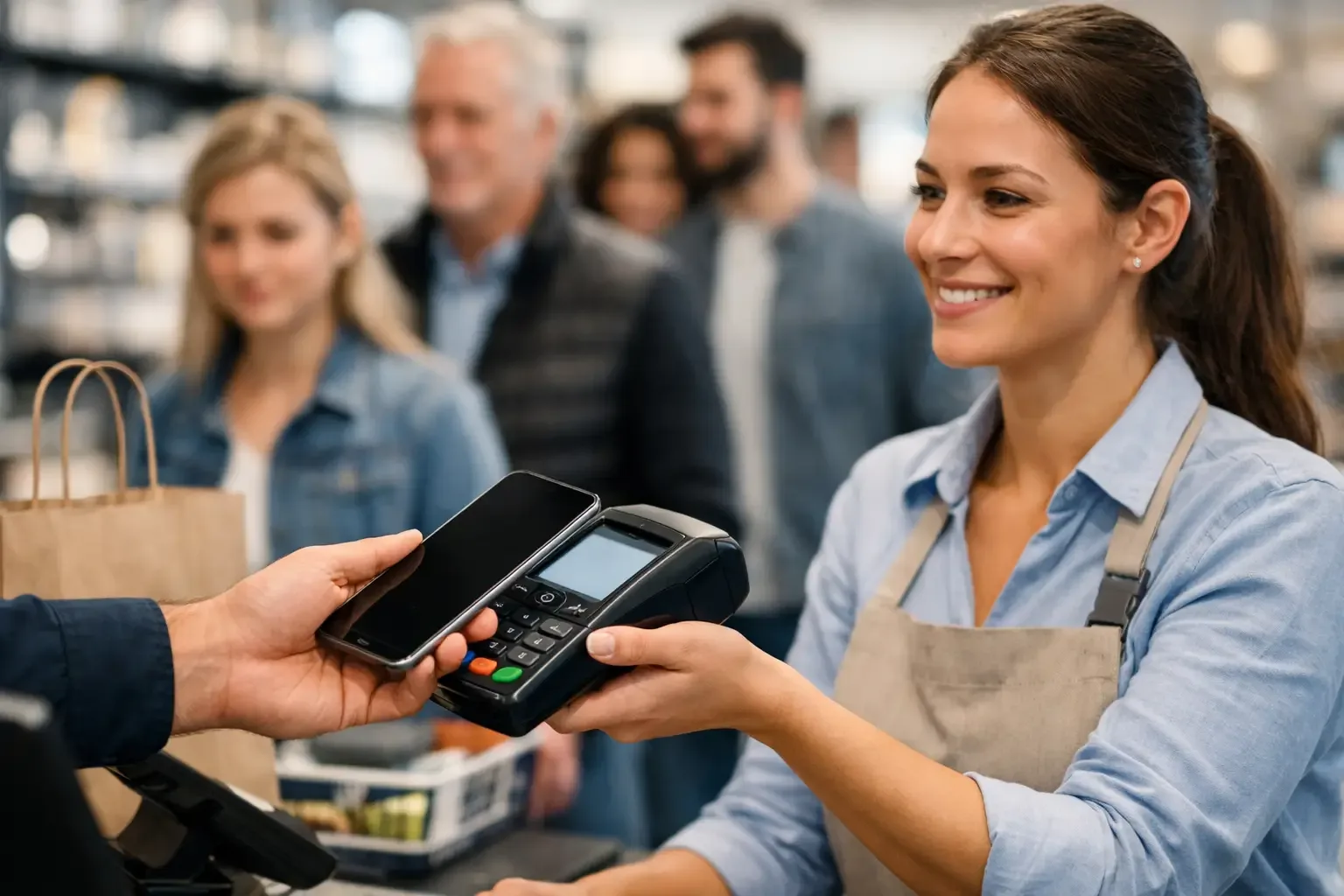
A slow-moving queue is not just a customer service problem. It means lost selling time, pressure on the team, a greater likelihood of change errors and an experience that may stop the customer coming back. Knowing how to optimise in-store payment starts with treating the checkout moment as a complete operational process, not as an isolated task at the end of the purchase.
In retail, restaurants, hotels, self-service launderettes or face-to-face services, every business has its own requirements. Even so, the goal is shared: to take payments quickly, securely and with control, without creating friction for the customer or overloading staff.
Where time is lost in face-to-face payment
Many operations still rely on manual procedures that seem small but add up over the day. Counting notes and coins, checking change, validating amounts entered on the terminal, correcting till errors or cashing up by hand are all tasks that take time away from serving customers.
The problem gets worse at busy times. In a restaurant, the peak may come at lunchtime. In a retail shop, it happens at weekends or during promotions. In a hotel, it is concentrated at check-in and check-out. When the payment process cannot keep up with these moments, queues, delays and a sense of disorganisation follow, which customers link directly to the brand.
There is also a less visible cost: the team’s attention. A member of staff busy resolving till discrepancies or looking for change is no longer available to advise, sell or provide a more attentive service. Optimising payment means giving that time back to the operation.
How to optimise in-store payment with automation
Automation is not just about accepting more payment methods. It is about organising the flow from the moment the amount is recorded through to the end of the transaction and cash management. The right solution depends on the sector, customer volume and the level of autonomy the business wants to offer.
Automate cash management
Cash still matters in many face-to-face businesses. However, handling it manually is associated with change errors, losses, discrepancies at cashing up and greater exposure to the risk of internal or external theft.
Automated cash management systems accept, validate, store and dispense the correct change. As a result, staff no longer count notes and coins during each sale. The process becomes faster, the amount returned to the customer is precisely calculated and the money is secured inside the machine.
This solution makes particular sense in venues with a large flow of cash, such as local supermarkets, bakeries, pharmacies, quick-service restaurants or shops open all day. The investment should be assessed against transaction volume, time spent on manual tasks and the losses or till discrepancies currently recorded.
Give customers autonomy where it makes sense
Not every payment needs to go through a traditional counter. Self-service kiosks can take on repetitive tasks such as placing orders, paying for meals, issuing queue tickets or settling services. In settings where customers already know the offer and want speed, this autonomy shortens the queue and frees the team for situations that need human intervention.
In restaurants, for example, a kiosk can take the order and payment before preparation. The team concentrates on production, delivery and handling special requests. In retail, the same logic can apply to simple transactions, provided there is a clear plan for supporting customers who need help.
Autonomy should not be imposed on everyone. A good operation keeps alternatives for people less familiar with technology, customers with specific needs or purchases that require advice. The aim is to create choice, not to shift complexity onto the customer.
Integrate payment with front-of-house operations
When systems do not talk to each other, duplication and failures arise: amounts entered by hand, inconsistent receipts or the need to confirm transactions on different platforms. Integration between point of sale, terminals, cash management and self-service equipment cuts out these steps and improves traceability.
In hotels, this integration is especially relevant. Automated check-in makes it possible to validate guest details, manage access and process payments outside reception’s busiest hours. In properties with a strong tourist profile, this capability helps welcome guests who arrive late, without the team having to be permanently tied up with admin tasks.
The point is not to have more technology. It is to make sure each piece of equipment solves a specific step in the customer journey and shares useful information with the rest of the operation’s systems.
Reduce errors without losing control
An efficient payment operation must be fast, but never at the expense of control. Automation adds value when it reduces errors and, at the same time, makes management more predictable.
The first step is to identify where discrepancies occur. They may lie in change, voids, discounts applied at the counter, refunds or shift close. Without this insight, it is easy to invest in a solution that improves how service looks but does not tackle the cause of the waste.
With automated processes, every movement is recorded consistently. This makes till reconciliation easier, reduces reliance on manual counts and allows exceptions to be spotted sooner. For a manager, the benefit is not only operational: it is the ability to make decisions based on more reliable data.
Responsibilities also need defining. Even with automated equipment, the team must know what to do when a note is rejected, a transaction is interrupted or the system flags a discrepancy. Technology reduces the margin for error, but training ensures that unusual cases do not interrupt service.
Measure the impact before and after implementation
The decision to modernise payment should be based on simple indicators that matter to the business. Average time per transaction, customers served per hour, till discrepancies, time spent cashing up and queue abandonment are useful metrics for assessing results.
Not every indicator needs to improve in the same way. In a shop with little cash, the priority may be speeding up service at peak times. In a self-service launderette, it may be round-the-clock availability and less need for on-site staff. In a hotel, it may be guest autonomy at check-in.
Before choosing a solution, it is worth observing the operation over several days, including the busiest periods. How many transactions are made per hour? How long does cashing up take? How often does change run out? Which tasks take up most of the team’s time? These answers make it possible to size the equipment correctly and avoid unsuitable solutions.
Choose technology suited to your sector
An effective payment system is not necessarily the most complex one. It is the one that fits the venue’s real workflow, the space available, the payment methods customers use and the level of support needed during implementation.
In retail, the priority may be protecting cash and keeping the counter free for assisted selling. In restaurants, it may be reducing queues at ordering and payment. In hotels, it may lie in automating check-in. In launderettes, the need tends to be for an autonomous, robust and easy-to-use operation.
That is why a specialist, sector-by-sector approach is more effective than a generic solution. SelfPay works with automated payment and self-service technologies geared to specific operational contexts, helping each business align equipment, service and control.
The best starting point is simple: identify the moment when payment holds up the operation. When that bottleneck is solved with the right technology, the till stops being a pressure point and starts contributing to a service that is faster, safer and ready to grow.


