
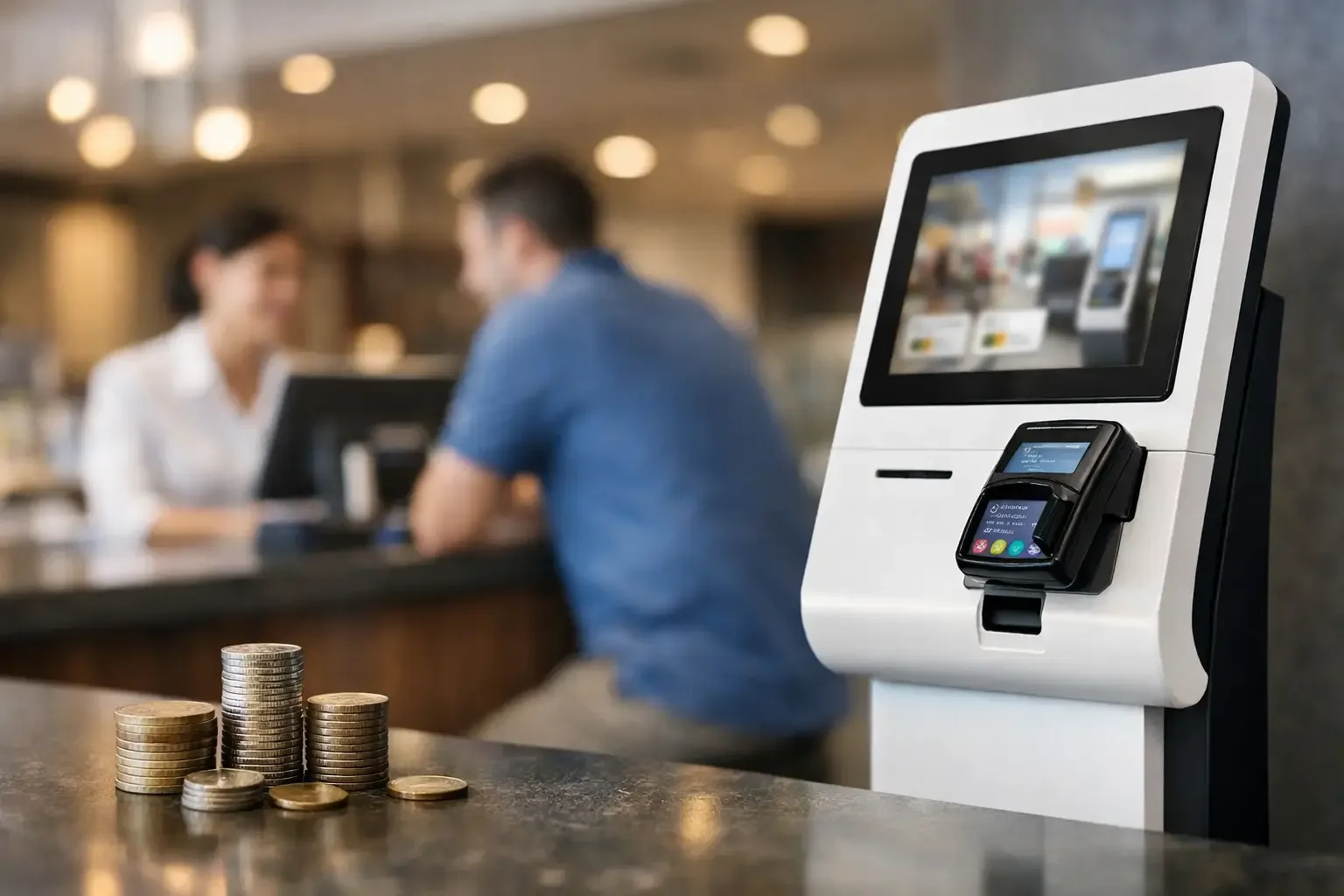
A kiosk does not cut costs just because it takes payments without constant staff involvement. Real cost reduction with kiosks happens when the operation no longer depends on repetitive tasks, manual corrections and queues that limit service capacity. For restaurants, shops, hotels and laundrettes, it is about reorganising the customer touchpoint to work with more control, speed and predictability.
The analysis should start with the real cost of the current process. Comparing the price of the equipment with a cashier’s salary is not enough. You need to consider the time staff spend taking orders, validating payments, issuing documents, answering simple questions, correcting recording errors and managing busy periods. When these tasks take up a significant part of a shift, the kiosk can become an operational asset with a direct impact on profitability.
Where kiosks reduce operating costs
The first gain lies in the capacity to handle more customers without increasing staff in the same proportion. In a quick-service restaurant, for example, a kiosk lets customers browse the menu, customise their order and pay on their own. The team can then focus on preparation, delivery and situations that need human attention.
This does not mean technology replaces people indiscriminately. In operations with personalised service, complex recommendations or customers with specific needs, face-to-face service remains decisive. The benefit lies in taking low-value transactional steps away from staff and putting them where they can genuinely improve the customer experience and service quality.
The savings are also visible at peak times. Long queues do not just mean dissatisfaction: they lead to walkouts, rushed orders, errors and pressure on staff. With well-placed kiosks, a site can create several ordering and payment points without installing a traditional till for each one. Capacity increases and the operation becomes less vulnerable to occasional staff shortages.
Fewer errors, less waste and fewer cancellations
Miscommunication between customer, operator and kitchen has a cost that many businesses underestimate. A wrongly selected product, a forgotten change or an incorrectly entered order creates waste, delays and sometimes a second preparation with no extra revenue. At a kiosk, customers visually confirm items, extras, quantities and price before paying.
The interface should be clear, with images, categories and options organised according to the natural purchase flow. A confusing screen can shift the problem elsewhere in the operation, creating requests for help and abandoned orders. That is why the configuration of the software, menu and product rules is as important as the physical equipment.
When integrated with the point-of-sale and production systems, the kiosk reduces the need to enter the same order more than once. This continuity reduces discrepancies between sale, preparation and delivery, makes reconciliation easier and cuts cancellations caused by operational errors. In retail, the same logic applies to price checks, self-service payment and receipt issuing.
Better use of staff
Labour cost is not managed only through the number of people on duty. It is managed by how each working hour contributes to the operation. If a member of staff spends much of a shift taking payments or entering repetitive orders, there is a clear opportunity to reassign tasks.
With a self-service solution, staff can help customers less familiar with the process during the initial roll-out, keep the space tidy, maintain service quality and speed up delivery. In hospitality, a check-in kiosk frees reception from predictable administrative tasks, especially outside the hours when most staff are on duty.
Savings depend on the size and model of each business. A small site with low footfall may not justify several terminals. An operation with intense peak hours, highly repetitive orders or recruitment difficulties, on the other hand, can see a faster return, even with a limited number of kiosks.
Cost reduction with kiosks requires integration
Buying a kiosk without reviewing the process can create a technology island. For cost reduction with kiosks to be consistent, the solution must communicate with the systems that support the operation: point of sale, payment methods, order management, kitchen, stock or hotel software, depending on the sector.
Integration avoids duplicated work and improves the quality of management information. If orders placed at the kiosk go straight into the production flow, the operation gains speed. If payments are recorded accurately in the central system, it becomes easier to track sales by period, product or service channel.
The choice of equipment should also reflect the reality of the space. There are significant differences between a kiosk in a shopping-centre restaurant, a countertop solution in a shop, a check-in terminal in a hotel and a machine for a self-service laundrette. Usage volume, required durability, location, payment methods and accessibility requirements all influence the decision.
At SelfPay, the approach is precisely to match automated payment and self-service solutions to the context of each operation. Sector specialisation helps avoid generic implementations that work technically but do not address the business’s day-to-day constraints.
How to assess the return before implementing
The return should not be calculated solely on the basis of fewer till points. A useful assessment compares indicators before and after implementation, including average service time, transactions per hour, order error rate, cancellations, cost of consumables, hours spent on administrative tasks and sales volume at peak times.
It is also worth measuring the commercial impact. A kiosk can present extras, meal deals, add-ons or additional services consistently, without relying on the operator being free to suggest each option. This is not about pushing sales, but about making relevant choices visible at the moment the customer decides. In restaurants, this effect can raise the average order value and help pay back the investment faster.
Before installation, it helps to answer three practical questions: where do queues form, which tasks take up most of the team’s time and where do most errors occur? The answers show whether the kiosk should be used for ordering, payment, check-in, ticket collection or a combination of functions.
The implementation phase deserves close follow-up. It is advisable to test the most frequent flows, train staff to give practical support and tell customers clearly how to use the new channel. In the first few days, having a member of staff next to the machine can speed up adoption and allow navigation or configuration details to be corrected quickly.
Security and control beyond direct cost
In operations that handle cash, payment automation adds an important dimension to loss reduction. Less manual handling means fewer change errors, fewer cash discrepancies and greater control over the daily close. When the solution includes automated cash management, the process can become even more secure and traceable.
With electronic payments, the benefit lies in fast validation and immediate recording of the transaction. However, the business must ensure maintenance, updates and clear procedures for exceptional situations, such as communication failures or orders that require a refund. Effective technology does not remove the need for operating rules, but it makes those rules easier to apply.
The most sustainable cost reduction does not come from cutting service for its own sake. It comes from designing an operation in which every resource, whether staff, space, equipment or time, is used for a clear purpose. When the kiosk is chosen to suit the business flow and integrated with the right systems, it stops being just a payment terminal and becomes a tool for controlled growth.