
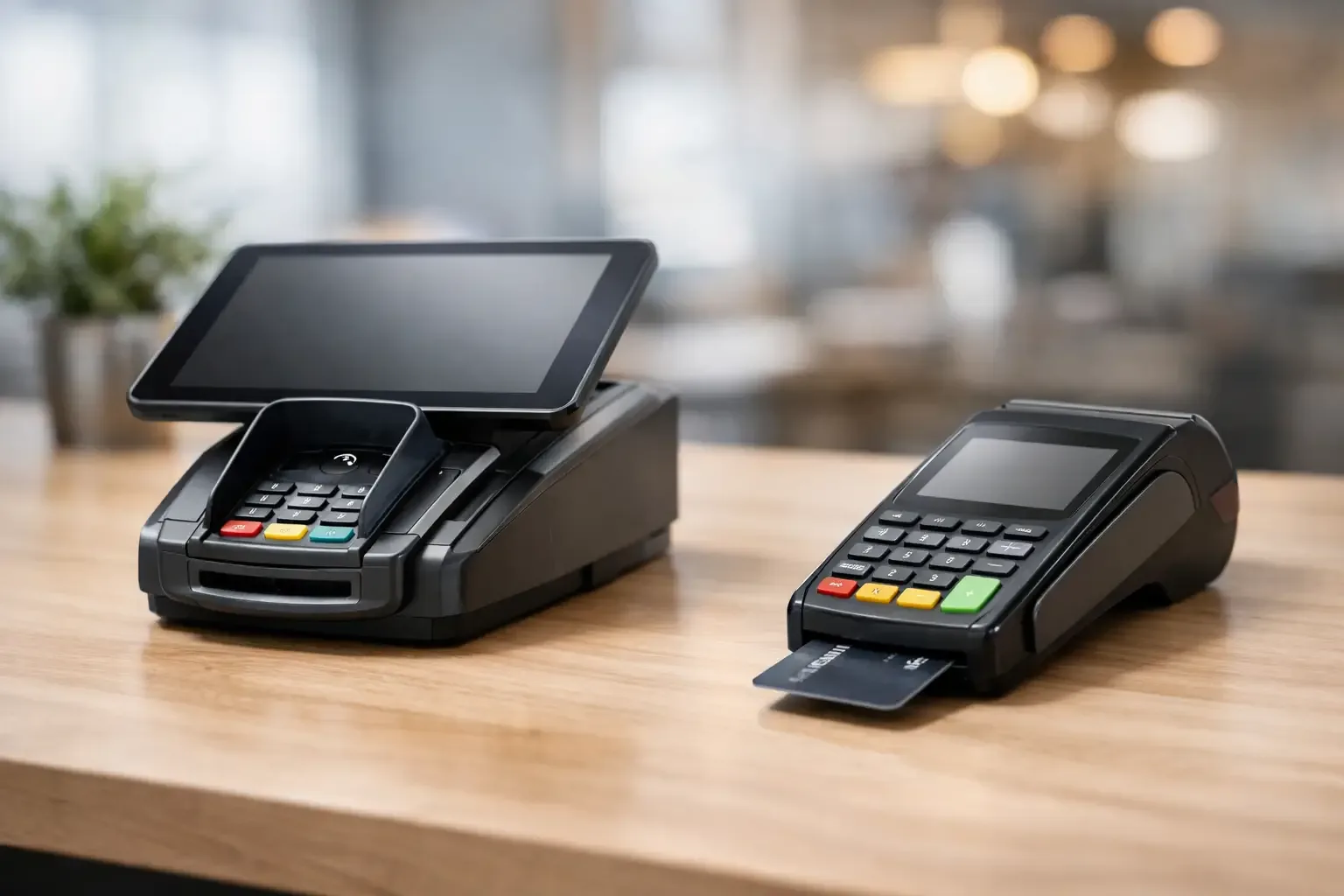
A payment terminal may seem like just another piece of equipment on the counter. But the decision between an integrated versus stand-alone terminal affects service speed, till control, team autonomy and the ability to reduce errors in daily operations. For a restaurant at peak time, a shop with several tills or a hotel with check-in peaks, this choice has a direct impact on service and profitability.
The point is not to identify a universally superior solution. It is to understand how each model works, where operational friction arises and which configuration best suits your volume, payment types and desired level of automation.
What sets an integrated terminal apart from a stand-alone one?
A stand-alone terminal works independently. The operator keys the purchase amount into the device manually, the customer pays and the result is then confirmed in the point-of-sale system. It is a familiar solution, simple to install and suited to less complex operations or those that need frequent mobility.
With an integrated terminal, the point-of-sale system communicates directly with the payment terminal. When the sale is recorded, the amount is sent automatically for payment, with no need to key it in again. After the transaction, the information can return to the management software, allowing the sale to be closed more consistently.
The difference seems small, but it removes a task repeated in every transaction. Over hundreds of payments a day, this translates into fewer keying errors, faster service and simpler financial reconciliation.
Integrated versus stand-alone terminal: the impact on operations
The comparison should start where the payment takes place. A retail shop with queues at the counter has different needs from a restaurant with table service. Likewise, a self-service launderette or a hotel with automated reception requires specific payment flows, often without constant staff involvement.
Speed at the point of sale
With a stand-alone terminal, staff need to confirm the total, key in the amount, wait for authorisation and check that the payment matches the sale. This process can be efficient in quieter operations, but it becomes more prone to mistakes under pressure, with interruptions and several customers waiting.
Integration cuts manual steps. The amount passes automatically from the point of sale to the terminal, making the process smoother and helping keep service moving. In quick-service restaurants, convenience retail or receptions with busy periods, a few seconds per transaction add up significantly.
Even so, speed does not depend on the terminal alone. Network quality, software configuration, counter ergonomics and team training also shape the final experience. Integration should be implemented as part of a well-designed process, not as an isolated solution.
Fewer errors and better till control
Keying in amounts manually leaves room for error. An amount can be typed incorrectly, a sale can be left pending in the software or a payment can be linked to the wrong item. Even when these incidents are occasional, they take time to check, require corrections when cashing up and need explaining to the team.
In an integrated model, matching the sale to the payment is more automatic. This strengthens the traceability of the operation and makes it easier to spot discrepancies. For managers overseeing several points of sale or shifts, this visibility is especially valuable.
A stand-alone terminal can still work well when the business has few transactions, a simple offer or a clear need for mobility. However, as payment volume grows, the operational cost of manual processes tends to rise.
Autonomy, mobility and service continuity
The main advantage of a stand-alone terminal is flexibility. It can be taken to the table, used at a temporary counter, moved between service areas or added to a seasonal operation with little reliance on the point-of-sale system.
This autonomy is useful on terraces, at events, for table service and in businesses that do not always work from a fixed point. It can also act as back-up equipment when payments need to keep running during technical work on the main system.
On the other hand, autonomy requires operational discipline. The team must make sure the amounts entered match the sale, that receipts are handled correctly and that the terminal’s end-of-day report is reconciled with the till. The device handles the payment, but it does not remove the associated admin tasks.
Costs: look beyond the price of the equipment
Comparing only the initial investment can lead to an incomplete decision. A stand-alone terminal tends to be more straightforward to implement, especially when it does not need connecting to the invoicing software or point of sale. For a small business or occasional use, that simplicity can justify the choice.
An integrated terminal may involve compatibility checks, technical configuration and support during installation. However, the return should be assessed in terms of time saved on each transaction, fewer discrepancies and a lighter admin load at daily close.
There are less visible costs that deserve attention: input errors, staff time spent on reconciliation, delays at peak times, training new staff and the impact of a slow payment experience. The right solution is the one that reduces these costs in the real context of the operation, not simply the one with the lowest purchase price.
When does a stand-alone terminal make sense?
A stand-alone terminal is a sensible option when the business needs mobility, has a low volume of transactions or wants a solution that complements an established process. It can suit table service, sales at trade fairs, temporary service points or venues where connection to the till system is not a priority.
It is also a valid choice for companies that want to start by digitalising payment acceptance without immediately changing their whole service infrastructure. In this case, it is advisable to set clear procedures for recording amounts, issuing documents and closing shifts.
Independence of the device should not be confused with lack of control. The more manual the process, the greater the need for consistent operating rules.
When is investing in an integrated terminal worthwhile?
Integration becomes more relevant when payment is part of a repetitive flow, with several operators, high footfall or a need for tight control. Retail shops, quick-service restaurants, cafés, hotels and operations with several tills benefit particularly from communication between systems.
It is also a strong choice for businesses looking to move towards self-service models. In an ordering kiosk, a reception with automated check-in or an unattended payment system, integration between service selection, payment and recording of the transaction is essential. It is not just about accepting cards or digital payments: it is about creating a complete, reliable and easy-to-use service journey.
Specialist solutions, such as automated cash management systems, restaurant kiosks or check-in equipment, call for an even broader analysis. The terminal must communicate correctly with the rest of the ecosystem to avoid bottlenecks between ordering, payment, receipt printing and updating the management system.
Questions to consider before deciding
Before choosing, it is worth observing a real week of operation. How many payments are made each day? At what times do queues build up? How many people use the till? Are there errors in entering amounts or recurring discrepancies at close? Is payment made at the counter, at the table, at a kiosk or unattended?
It is also essential to confirm compatibility with existing software and the payment methods your customers use most. An integration that is technically possible is not always the most suitable one if it does not fit the team’s workflow.
SelfPay analyses these scenarios based on the reality of each sector, linking payment technology to concrete goals: reducing waiting times, strengthening till control, automating service or giving customers more autonomy.
The best choice comes from a simple question: where do you currently lose the most time and control in the payment process? If the answer lies in manual repetition, reconciliation or queues, integration deserves to be treated as an operational decision. If it lies in mobility and flexibility of service, a stand-alone terminal may be the right tool. The value lies in building a process that keeps pace with your business, without forcing the team or customers to work around the technology.


