
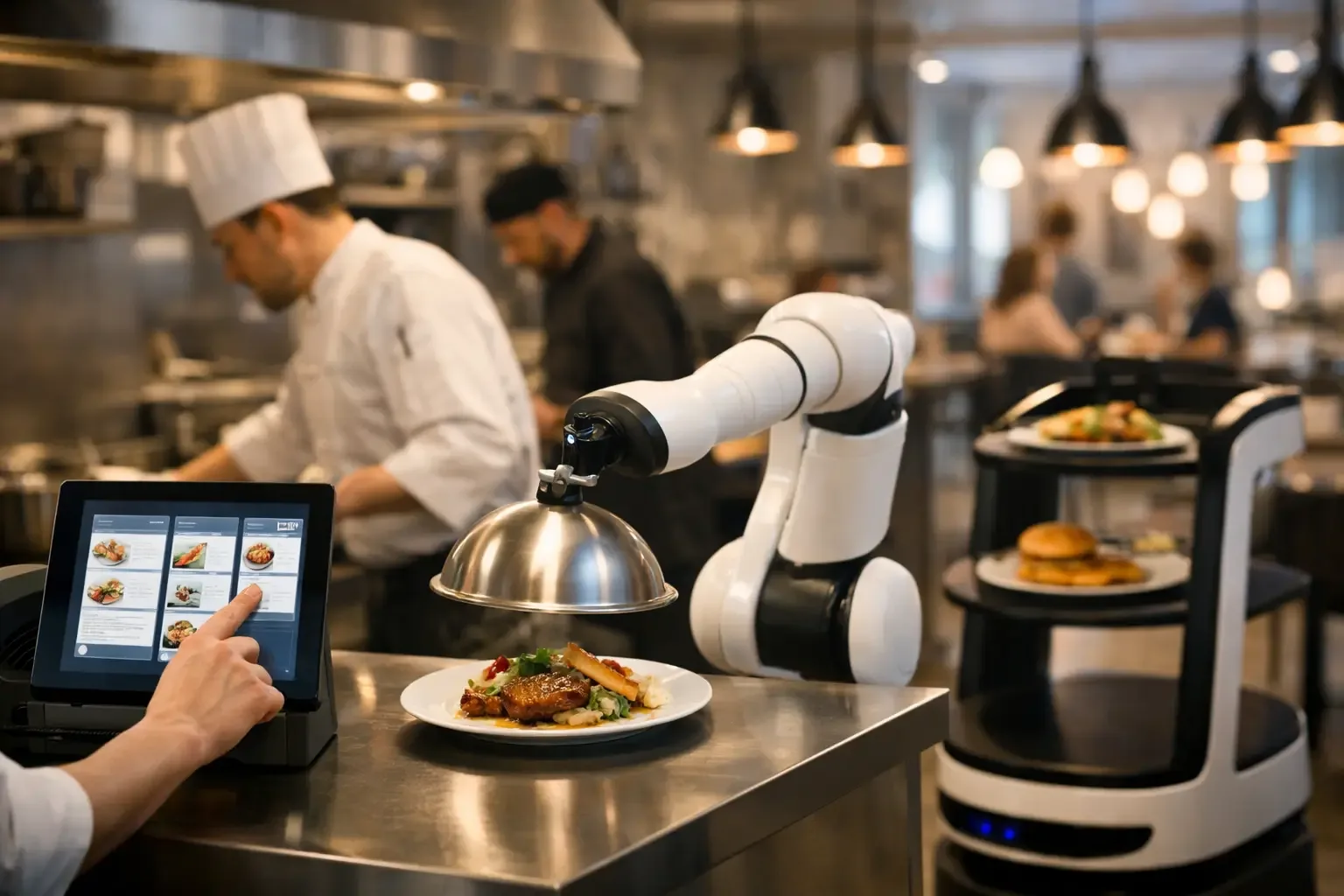
In a restaurant with peaks in demand, a few seconds lost on each order quickly turn into queues, till errors and pressure on the team. That is why a guide to restaurant automation should start with a practical question: where is the biggest operational bottleneck in your service today: ordering, payment or delivery?
The answer is rarely the same for everyone. In a quick-service concept, the problem usually lies in service speed and the ability to handle high volumes without a proportional rise in costs. In a traditional restaurant, the challenge may be cash control, consistent cashing up or managing the customer experience at busy times. In both cases, automation is not there to replace service. It is there to remove friction from the processes that slow the business down.
What automation means in the restaurant sector
Automation in this sector is not just about installing technology at the point of sale. It is about reorganising service, payment and control flows to reduce reliance on repetitive tasks, limit human error and make the operation more predictable.
In practice, automation can include ordering kiosks, automated cash management systems, integration between payment and POS, or hybrid models in which the customer takes part in placing the order and the team focuses on production and support. The value is not in a single piece of equipment. It is in the combined impact on time, control and profitability.
Guide to restaurant automation: where to start
The most common mistake is to see automation as an equipment purchase. The right decision starts earlier, with a clear operational diagnosis. If a manager does not know where time, margin or control is being lost, they risk automating a non-critical step and leaving the main problem untouched.
The first step is to analyse the full customer journey, from arrival to payment. How many minutes do customers wait to order? How many manual steps are there before the bill is settled? How many change errors, till discrepancies or voids occur per shift? These indicators provide an objective basis for setting priorities.
Next, you need to understand which type of automation suits the business model. A quick-service restaurant often benefits from self-order kiosks because they can handle more orders at once and ease pressure at the counter. An operation with a high flow of cash, on the other hand, may gain more from an automated cash management system, which strengthens security, speeds up payments and eliminates discrepancies at cashing up.
The physical context also matters. Available space, customer circulation, counter layout and the relationship between the dining area and the kitchen all shape the implementation. The most technically advanced solution is not always the most effective. In many cases, a simple set-up that fits well into the restaurant’s real workflow delivers better results than a more ambitious but poorly adapted installation.
Service and ordering kiosks
Restaurant kiosks have become increasingly relevant because they tackle one of the most sensitive points of the operation: serving more customers without creating congestion at the counter. They let customers browse options, customise their order and confirm the purchase more independently, freeing staff for support, preparation and delivery tasks.
This model is particularly useful in settings with highly repetitive orders, a visual menu and a need for speed. It also helps standardise the ordering process, reducing miscommunication and making it easier to run promotions such as meal deals, extras or add-on suggestions shown on screen.
There is, however, one point that deserves attention. A kiosk does not solve internal organisation problems on its own. If the kitchen is not ready to receive a larger volume of orders in quick succession, the experience may get worse rather than better. Front-of-house automation must be matched by operational capacity in the back of house.
Automated payment and cash control
In a sector with high turnover and intense shifts, manual cash handling remains a frequent source of failures. Change errors, discrepancies at close, the risk of shortfalls and time spent on checks are operational costs that often go unnoticed because they are spread across the day.
Automated cash management systems bring a clear advantage: staff no longer handle notes and coins directly. The machine accepts, validates, stores and dispenses the correct change, which increases security, reduces discrepancies and improves the traceability of each transaction.
For many restaurants, this gain is as important as speed itself. Till control no longer depends solely on manual routines and is supported by technology designed for continuous service environments. In businesses with multiple shifts or large teams, this has a direct impact on management and on confidence in the operation.
The customer experience changes too
Talking about automation only in terms of efficiency is seeing half the picture. Customers also feel the difference when service is more predictable, payment is faster and waiting time is shorter.
In an urban or tourist setting, this dimension is especially relevant. Consumers are used to fast, intuitive, low-friction experiences. When they encounter long queues, unclear processes or payment delays, their perception of the service suffers, even if the quality of the food is good.
This does not mean every customer prefers a fully self-service model. In many concepts, the best result comes from a hybrid approach: technology to speed up repetitive tasks and a team available to advise, handle exceptions and stay close to customers. Well-implemented automation does not remove human contact. It makes it more useful.
Integration, training and return
The decision to automate should be treated as an operational project, not a simple technology upgrade. This means integrating with existing systems, adapting internal processes and training teams properly.
Without this preparation, the investment loses effectiveness. A solution can be technically sound and still fail if staff do not understand the new workflow or if there is friction between equipment and management software. This is where a specialist approach makes a difference: choosing technology suited to the sector, with an implementation designed around the reality of the point of sale.
The return should also be assessed realistically. In some restaurants, the quickest benefit is shorter service times. In others, it shows mainly in till control, fewer errors or the ability to operate more steadily at peak times. There is no single formula, but there is a consistent logic: the greater the repetition, operational pressure and need for control, the greater the impact of automation tends to be.
When it makes sense to go ahead
There are clear signs that an operation is ready to automate. Recurring queues at certain times, difficulty keeping service consistent, cash control problems, excessive reliance on manual tasks and the need to scale without adding structure are some of the most obvious.
It also makes sense to go ahead when the business wants to prepare for growth. Opening new sites, standardising processes or adding capacity in high-footfall areas requires more predictable operating models. Automation helps with exactly that: it creates a more stable basis for replicating service, measuring performance and reducing variation between teams and shifts.
In a market increasingly squeezed by costs, time and customer expectations, modernising the point of sale is no longer a side issue. For many operators, it is already a question of competitiveness.
Guide to restaurant automation with a focus on operations
A good guide to restaurant automation does not end with choosing a kiosk or a payment system. The real test is understanding which operational problem is being solved and what concrete result is expected. Fewer errors, more speed, more control or a better customer experience are all legitimate goals, but they should be clearly defined from the outset.
That framework is what makes it possible to take decisions that pay off. Specialist solutions, such as those offered by companies focused on automating service and payment, make most sense when they are assessed in light of the business’s real workflow and not just as stand-alone technology.
Restaurants will continue to depend on pace, consistency and responsiveness. The difference lies in whether those results still rest on manual effort or are supported by an operation that is smarter, safer and better prepared to grow.


