
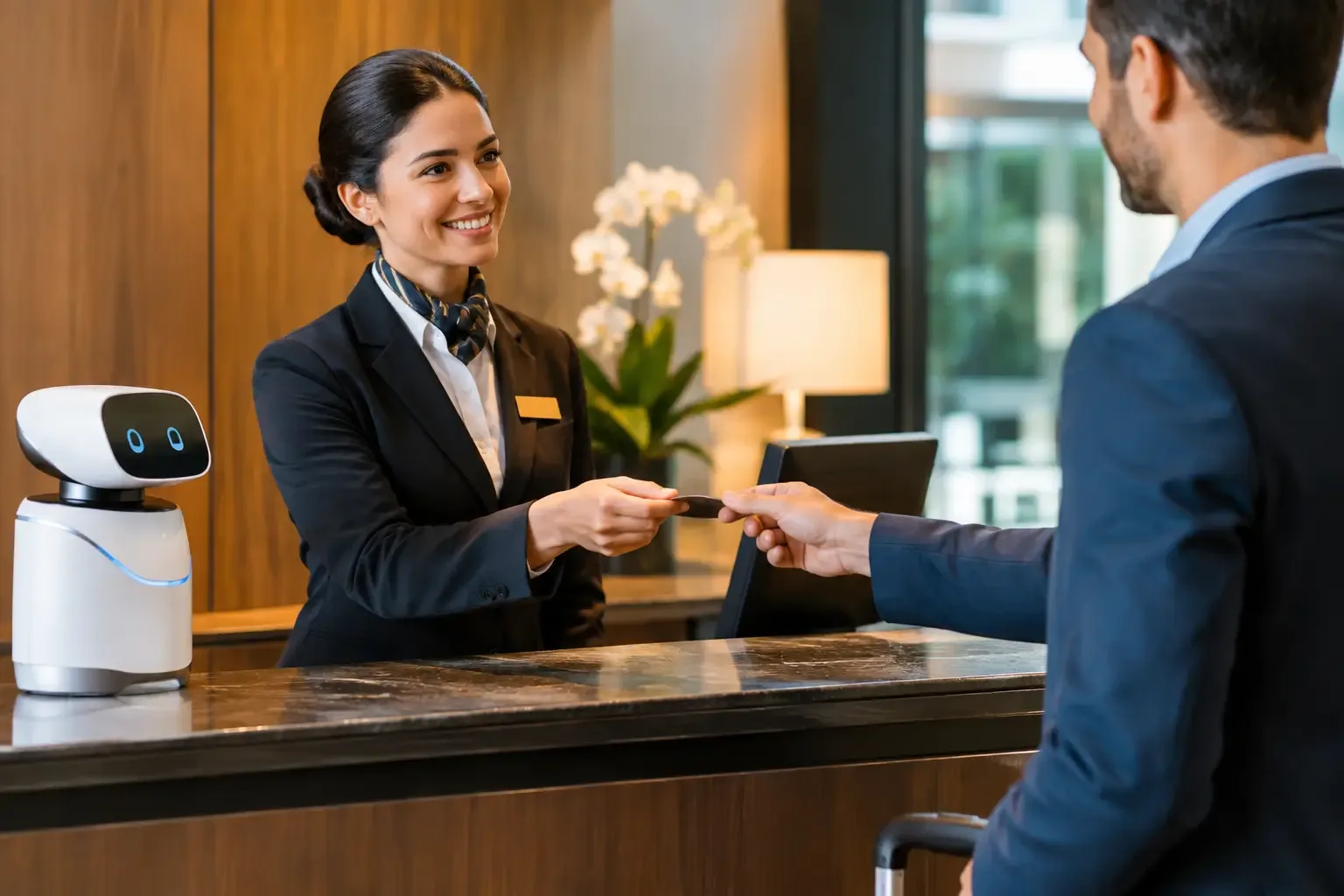
At 3 pm, a reception desk can go from calm to congested in a matter of minutes. Arrivals bunch up, guests wait for keys, there are requests for information and payments, and staff switch between the desk, the phone and the management system. Operational automation in hospitality responds precisely to this pressure: it organises repetitive tasks, reduces manual dependencies and lets the team be available where they add most value.
This is not about replacing hospitality with machines. It is about removing friction from processes so that human service is reserved for situations that need context, attention and judgement. For city hotels, tourist properties, professionally run holiday rentals and hotel groups, this distinction has a direct impact on productivity and on how the service is perceived.
Where hotel operations lose time every day
Many inefficiencies are not caused by a serious failure. They come from dozens of small tasks carried out manually, shift after shift. Confirming booking details, collecting documents, issuing key cards, taking payments, checking cash, answering the same questions and updating information in several systems are common examples.
When these processes depend entirely on reception, demand peaks become harder to manage. A late arrival may require a member of staff to be present at all times. A group arriving at once can create queues. An error when posting a payment or cashing up takes administrative time and makes financial control harder.
The consequence is not only operational. Guests judge the property from the first face-to-face contact. If check-in takes longer because staff are sorting out a cash discrepancy or looking for information already given in the booking, the experience begins with a wait that could have been avoided.
Operational automation in hospitality: start with the critical flows
The decision to automate should not start with buying technology. It should start with an objective look at the operation. When are queues longest? Which tasks do staff repeat without any real need for intervention? Where do most errors, communication failures or time losses occur?
In a hotel, priority flows tend to centre on arrival, payment, access handover, service outside the best-staffed hours and handling simple requests. Priorities vary with the business model. A property with high turnover and short stays benefits greatly from fast check-in and check-out. A larger hotel may place more weight on serving several guests at once and on controlling payments at different service points.
The aim is to define a concrete problem before choosing the solution. “We want to modernise reception” is a valid intention, but too broad. “We want to cut average check-in time and ensure self-service arrivals after 11 pm” already allows an implementation to be designed with clear criteria.
Automated check-in without losing the personal touch
Automated check-in kiosks let guests handle a significant part of the arrival process on their own. They can confirm their details, pay where applicable, receive instructions and collect their key or access card, depending on how the property is set up and integrated with existing systems.
This model is particularly effective in three scenarios: arrivals outside normal reception hours, periods when many guests arrive at once and operations with small teams. Solutions such as Roommatik machines provide a structure for this self-service with logic developed specifically for hospitality.
However, automation should not be imposed on every guest in the same way. Some prefer to be welcomed by a person, have questions about their stay or need special assistance. The best operation combines channels: the kiosk quickly handles the standard process and reception remains available to welcome, guide and resolve exceptions.
Payments and cash with greater control
Payment is another area where operations can gain speed and security. At receptions that accept cash, manual handling means counting amounts, giving change, checking discrepancies and moving money for closing and banking procedures. Every manual step increases exposure to errors and reduces the time available for guests.
Automated cash management systems accept, validate, store and dispense change in a controlled way. For the property, this means better traceability of transactions, fewer cash discrepancies and stronger security in handling money. For the team, it means less time spent on checking tasks and less direct responsibility for cash.
Not all hotels have the same payment profile. A property almost entirely geared to card payments may have different priorities from a hotel with a strong food and beverage offer, additional services or an international tourist market. The assessment should therefore consider the payment methods actually used, the transaction volume and the points where cash enters the operation.
Integration: the factor that determines the result
A standalone machine can solve a task, but a well-integrated solution transforms the process. Automated check-in must communicate reliably with the property management system, with access control and with the payment methods chosen by the property. If staff have to re-enter data manually between platforms, part of the gain disappears.
Before implementation, it is essential to validate compatibility, booking rules, key card management, prepayment handling, document issuing and procedures for exceptional situations. It is also important to decide who looks after the guest when something does not go to plan, whether an unvalidated document, a booking with incomplete details or a request to change rooms.
Effective automation does not eliminate exceptions. It makes them more visible and stops them from taking over the operation. Instead of a team carrying out hundreds of identical steps, you have a team ready to step in on the cases that really need attention.
Indicators to measure before and after
Modernisation should come with observable results. Measuring kiosk usage alone is not enough. What matters is whether the property is operating better, with less pressure and greater responsiveness.
Useful indicators include average check-in time, the share of self-service arrivals, the number of arrivals handled outside normal hours, cash discrepancies, time spent on the daily close and the number of staff interventions for repetitive faults. Guest satisfaction also deserves monitoring, especially through feedback about arrival, speed and ease of the process.
The figures should be read in context. Less involvement from reception is positive if guests complete the process without difficulty. It is not a good result if it simply shifts questions to phone calls or leads to abandoned transactions at the kiosk. The quality of automation is measured by the reduction in effort for both staff and guests.
A phased implementation reduces risk
An operational transformation does not necessarily mean changing everything at once. In many cases it makes more sense to start with the main bottleneck, test the flow in real conditions and adjust procedures before expanding.
A first phase might focus on late arrivals or a kiosk next to reception. Once the process is stable, the property can review pre-arrival communications, on-site signage, staff training and support escalation rules. This approach lets you fix details that do not come up in a technical demonstration but do affect guest uptake.
Training is just as decisive. Staff do not need to compete with the technology. They need to understand when to direct a guest to the self-service process, how to monitor the equipment and how to resolve an exception quickly. When staff see concrete benefits, such as shorter queues and fewer cash tasks, adoption comes more naturally.
A reception with more time to welcome guests
The right technology does not make a hotel impersonal. On the contrary, it can create the conditions for a more attentive reception. By automating predictable processes, the property has more capacity to welcome tired arrivals properly, respond to specific requests, recommend services and resolve problems before they turn into complaints.
SelfPay works with specialist solutions for automating payments and in-person service, including Roommatik check-in systems and automated cash management. The choice should always start from the reality of each property: guest volume, opening hours, reception organisation, payment methods and growth objectives.
A useful next step is to observe a full shift, identify where staff stop serving guests to carry out administrative tasks and calculate the impact of that interruption. It is at that specific point that automation stops being a technological idea and becomes an operational decision with a return.


