A slow-moving queue is not just minutes of waiting. In a restaurant, it can delay table turnover; in a shop, it can lead to an abandoned purchase; in a hotel, it can shape the guest’s first impression. Payment terminals are therefore a central part of any face-to-face operation, but their impact depends on how they fit into the till, customer service and the day-to-day control of the business.
Choosing equipment on purchase price alone may meet an immediate need, but it rarely addresses medium-term operational requirements. The right terminal should speed up payment, accept the methods customers use, simplify reconciliation and work reliably at the busiest times.
What to expect from today’s payment terminals
A payment terminal is no longer just a device for accepting cards. It is a point of contact between the customer, staff, invoicing software and, in many cases, cash management. When this connection is well thought out, payment becomes a quick, clear and secure step. When it is not, you get wrong amounts, duplicates, discrepancies when cashing up and unnecessary queues.
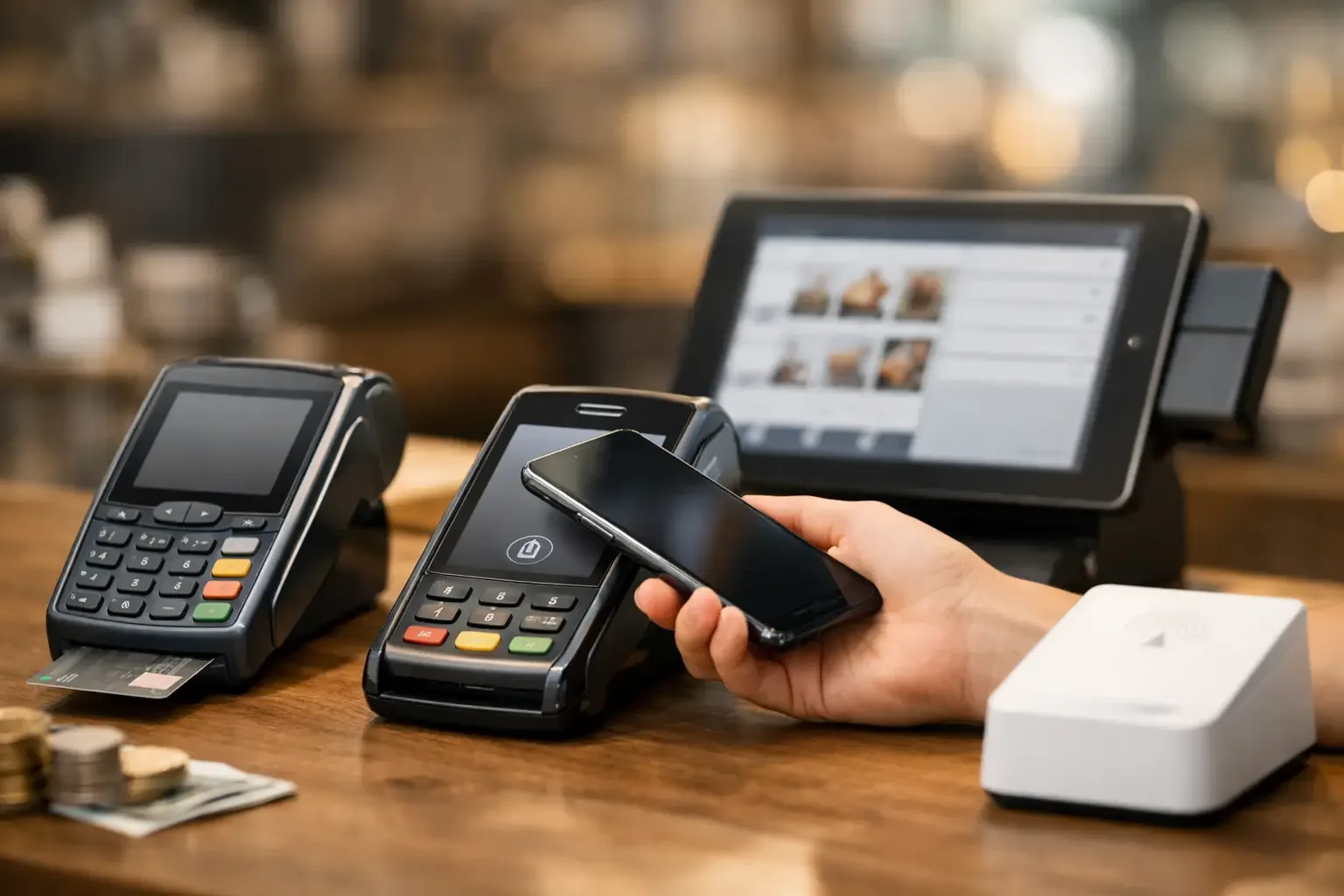
For physical businesses, the most relevant requirements tend to be simple: acceptance of chip cards, contactless and mobile payments; fast processing; battery life when the device is mobile; and a stable network connection. But other factors gain weight as the operation grows, such as integration with the point of sale, correct receipt printing, managing several service points and centralised monitoring of transactions.
The choice should start with a practical question: where and how does the customer pay? The answer is different at a supermarket till, on a terrace, at a quick-service counter, at a hotel reception desk or in a self-service launderette.
Choosing payment terminals to suit the operation
There is no single model that suits every business. The decision should be based on the service flow, transaction volume, the mobility required and the level of automation sought.
Fixed counter and high transaction volume
In traditional retail, pharmacies or service counters with a set position, a fixed terminal can be the most consistent option. It is always available in the same place, can be connected to the point-of-sale infrastructure and allows a clear routine to be established for the team.
Here, integration is especially important. If the amount due passes automatically from the sales system to the terminal, the need for manual entry falls, and with it the risk of error. This difference seems small in a single transaction but becomes significant across hundreds of payments a day.
Mobility for restaurants and on-site service
In a restaurant, taking the terminal to the table reduces walking back and forth and saves the customer from going to the counter just to pay. The experience is smoother, especially during lunch, dinner or busy events.
In this context, it is important to check the quality of the wireless connection, battery life and how easy the device is for staff to use. A mobile device that loses connection at peak times or needs frequent charging becomes an operational constraint. It should also be comfortable to carry and robust enough for intensive use.
Self-service and unstaffed operations
In launderettes, car parks, automated services or outlets with long opening hours, terminals built into kiosks and self-service machines follow a different logic. The aim is not just to accept payment, but to let customers complete the whole transaction on their own.
The screen, the instructions and the layout of the payment methods matter as much as the terminal itself. If the process is confusing, requests for help increase and the advantage of automation diminishes. A good system should guide the user at every step, confirm payment clearly and automatically pass the transaction on to the next service.
Hospitality and automated check-in
In hospitality, payments can take place at booking, check-in, during the stay or at check-out. Payment terminals linked to reception kiosks help reduce waiting times and make it possible to serve guests outside normal desk hours.
Even so, automation does not remove the need to design the guest journey well. Some cases require human intervention, such as booking changes, special requests or incomplete payments. The most effective solution automates repetitive tasks and keeps the team available for moments that need personal attention.
Card payment does not solve the whole till process
Many businesses still accept cash. Ignoring this creates two parallel operations: a modern, recorded one for electronic payments and a manual one for notes and coins. It is often in the second that till discrepancies, change errors and time spent counting are concentrated.
Integrating payment terminals with automated cash management systems makes it possible to handle card and cash within a more controlled operation. Solutions such as Cashmatic systems automate the acceptance, validation, storage and dispensing of change, limiting staff’s direct contact with cash.
The benefit is not limited to security. By reducing manual handling, the business gains consistency when cashing up and frees staff to serve customers, prepare orders or handle other higher-value tasks. For a high-turnover shop or a restaurant with several shifts, this organisation can have a direct impact on daily productivity.
Criteria that should inform the decision
Before buying or replacing equipment, it is worth analysing the operation with concrete data. The number of transactions per day, peak times, average spend, the most used payment methods and till incidents all help set priorities.
Compatibility with existing software should be validated from the start. A technologically advanced terminal that is isolated from the point of sale can force tasks to be duplicated. Likewise, a self-service solution must communicate correctly with the ordering, booking, invoicing or access control systems that support the service.
Security also calls for a broad perspective. You need to consider payment data protection, user permissions, closing procedures and the physical security of the equipment. In environments without constant supervision, such as a launderette or a kiosk, hardware robustness and monitoring capability become particularly important.
Finally, assess support and scalability. A business may start with one payment point and later need additional mobile terminals, an ordering kiosk or cash automation. Working with a sector-specialist partner makes this evolution easier, because implementation is designed around the operational reality rather than as a one-off installation.
How to measure the return on the solution
The return on payment terminals and related equipment should not be calculated solely on transaction fees or the monthly service charge. The assessment should include the time the team no longer spends keying in amounts, counting the till, correcting errors and managing queues.
It is also useful to track indicators before and after implementation: average payment time, number of till discrepancies, daily closing time, customers served per hour and the need for staff intervention. This data shows whether the solution is fulfilling its main purpose: removing friction from the operation.
In businesses with significant cash volumes, add to the analysis the cost of change errors, till shortages or surpluses and time spent moving cash internally. In self-service operations, also look at the self-completion rate and the reasons customers abandon the process.
SelfPay addresses this reality with specialised solutions for retail, food service, hospitality and launderettes, because the gains from automation always depend on the context in which payment takes place.
An operational decision, not just a technological one
The best choice is not necessarily the terminal with the most features. It is the one that adapts to the pace of the business, reduces manual tasks and offers customers a simple way to pay. In a small counter business, that may mean an integrated, easy-to-use terminal. In a high-volume operation, it may justify combining electronic payment, automated cash management and self-service.
When payment no longer interrupts service, the team works with more control and customers feel the business respects their time. That is the starting point for modernising the till with results you can see every day.