
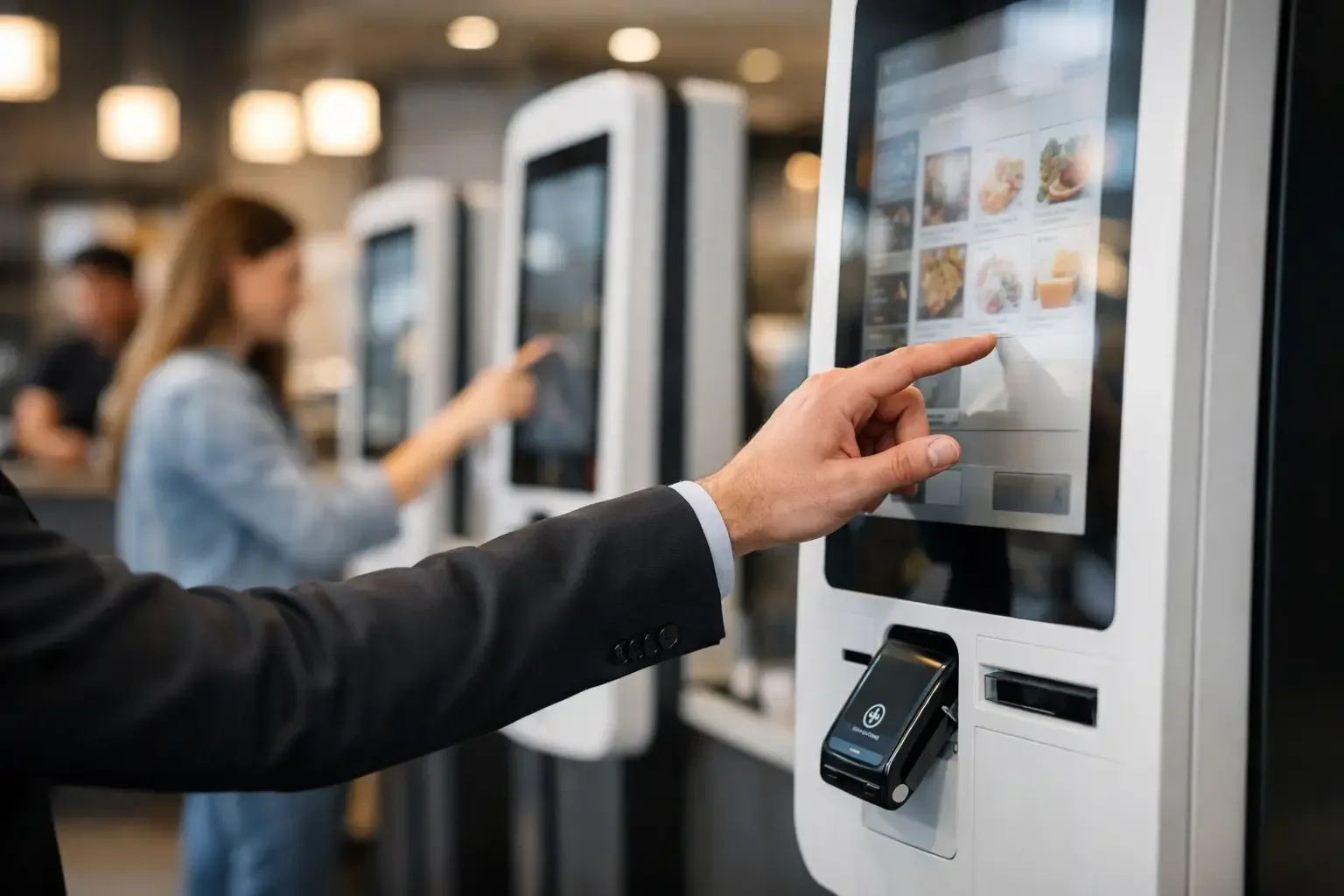
When a customer leaves the queue before completing a purchase, the problem rarely lies in demand alone. Often it lies in the process. Self-service kiosks address exactly this critical point: cutting waiting times, giving customers autonomy and easing pressure on the operation without compromising control, security or service quality.
For businesses with in-person service, the decision to automate is no longer about following a trend. It is about solving concrete bottlenecks. Restaurants with intense peaks, hotels with late-night arrivals, laundrettes with extended hours and retail shops with small teams all face the same basic challenge: serving more, with less friction and greater operational predictability.
What self-service kiosks solve in practice
A self-service kiosk is not just a device with a touchscreen. It is an interaction point that moves repetitive tasks from the counter to a customer-facing interface. In practice, this means less reliance on manual service for simple operations, greater process consistency and more capacity for staff to focus on situations that need human intervention.
In many businesses, the gain starts with how the flow is organised. Instead of concentrating orders, payments or check-in at a single service point, the operation spreads these moments across several points. The result is visible: shorter queues, less strain on staff and a better perception of speed among customers.
But there is an even more relevant point for anyone running operations: automation reduces variability. An experienced member of staff can be fast and effective, but performance changes with pressure, volume and staff turnover. At a kiosk, the process is always presented in the same way, with the same steps and defined rules.
Which sectors benefit most from the investment
The short answer is simple: wherever there is repetition, pressure on service and a need for speed. Even so, the return is not the same in every context. It depends on the type of interaction, the customer profile and how the business is organised.
Restaurants
In restaurants, self-service kiosks have a direct impact on order-taking speed and queue management. In high-turnover settings such as quick-service restaurants, food courts or outlets in shopping areas, automation helps absorb peaks without a proportional increase in extra staff.
In addition, customers browse the menu at their own pace, choose extras, confirm the order and pay at the same point. This tends to reduce miscommunication and can increase the average order value, especially when the interface presents add-ons or suggestions in a structured way. Even so, not every concept benefits equally. In more consultative or premium dining, the kiosk should complement service rather than replace it entirely.
Hospitality
In hospitality, the value lies less in sales and more in reception. Automated check-in makes sense when a property wants to cut waiting times, offer service outside normal hours or reduce the administrative load on reception.
This is especially relevant for city hotels, professionally run holiday rentals and properties with a large number of arrivals in a short space of time. The kiosk can speed up data collection, document validation and the delivery of useful information to guests. Even so, at properties positioned around a highly personalised reception, automation should be introduced carefully so as not to change the character of the experience.
Retail and services
In retail, self-service kiosks can take on several roles: product lookup, purchase support, ticket issuing, self-service payment or integration with loyalty programmes. Interest grows when there is a need to serve more people without expanding the traditional till area.
In in-person services such as self-service laundrettes, the rationale is even clearer. When the business model depends on customer autonomy and extended hours, automating payment and interaction becomes a central part of the operation, not just an add-on.
The operational impact goes beyond speed
Speed is the most visible benefit, but it is not the only one and, in many cases, not the most valuable. Those who decide to invest in self-service kiosks are usually looking for a broader effect on the operation.
The first is control. Automated processes make it possible to set clear rules, limit recording errors, standardise data collection and improve transaction traceability. When the system is well implemented, there is less reliance on informal procedures and less room for repeated mistakes.
The second is team efficiency. Automating does not mean removing people from the process. It means putting human resources where they create most value. Instead of being busy with transactional tasks, staff can focus on customer support, resolving exceptions, operational restocking or service quality.
The third is security, especially when the kiosk includes automated payment solutions. Reducing direct cash handling lowers cash discrepancies, simplifies cashing up and strengthens internal control. For many managers, this factor carries as much weight as improving the customer experience.
What to assess before going ahead
Not all self-service projects produce the same result. Technology on its own does not fix poorly designed processes. Before installing a kiosk, it is worth analysing three key points.
The first is demand volume and pattern. If the business has highly concentrated service peaks, automation tends to pay back more quickly. If footfall is low and spread out, there may still be a benefit, but it will be less significant.
The second is the type of interaction. The simpler, more repetitive and more standardised the task, the greater the chance of success. Frequent orders, direct payments, check-in with defined steps and self-service operations are typical examples. Processes with a lot of customisation, negotiation or need for human explanation, on the other hand, require a hybrid model.
The third is integration with the existing operation. The kiosk should not work in isolation. It needs to communicate with payment, order management, reception or point-of-sale systems, depending on the sector. This is where many projects succeed or fail. A modern-looking device that is disconnected from the rest of the operation creates friction instead of removing it.
Self-service kiosks and the customer experience
There is also a recurring question: do customers really want to use this kind of solution? In many cases, yes, as long as the experience is simple. Customers value autonomy when they feel they save time, avoid waiting and stay in control of the process.
Adoption increases when the interface is intuitive, the screen shows clear options and the path to payment or confirmation is short. If the kiosk complicates what would be instant at the counter, uptake falls. That is why user experience is not a technical detail. It is a commercial factor.
The demographic context and the setting also need to be considered. In urban, tourist or high-traffic areas, people tend to be more willing to use self-service. Where customers expect close advice, the model should include visible staff support, especially in the early stages of implementation.
Automating with a sector-specific approach
A generic approach is rarely the most effective. The real value of self-service kiosks emerges when the solution is designed for the realities of the sector, the type of customer and the specific process to be improved.
That is why a consultative approach makes a difference. A restaurant does not need the same operational design as a hotel. A laundrette does not face the same integration requirements as a retail shop. Choosing technology without this prior analysis can lead to an under-used investment.
In a market where operational efficiency has become a competitive factor, businesses that automate wisely can respond better to demand, control their operation more closely and grow with less friction. Companies such as SelfPay Portugal work precisely with this vertical specialisation, which makes it possible to align equipment, payment and service flow with real needs on the ground.
More than adding a digital point to the premises, implementing self-service means redesigning how the business welcomes, serves and charges its customers. When that decision is made with a focus on the process and not just the equipment, the result tends to be more solid, more measurable and far more useful day to day.