
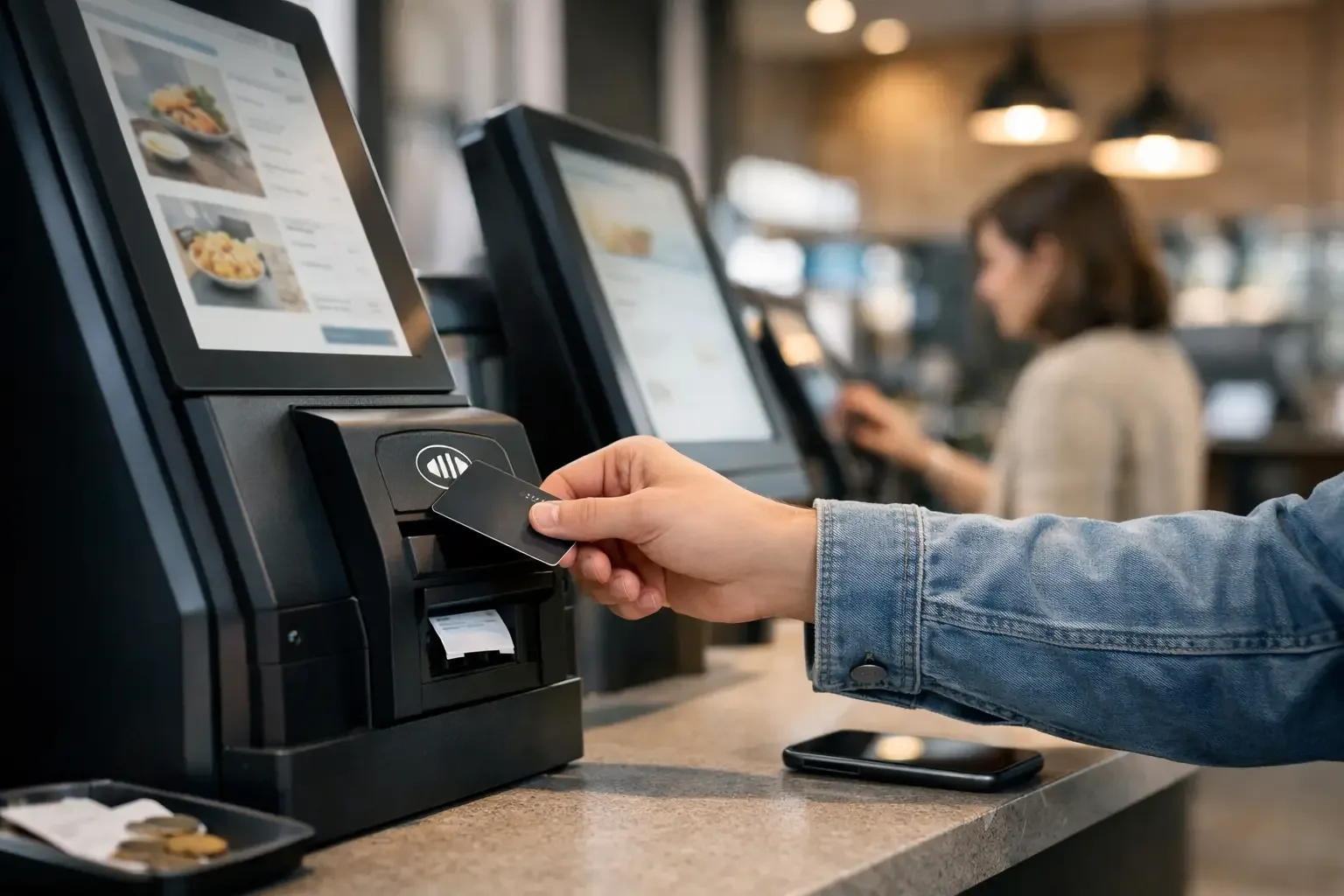
When a customer is waiting to pay, the problem rarely lies only in the moment of the transaction. In most cases, an entire process is losing efficiency. This is where a self-service payment system stops being just a piece of equipment and becomes an operational decision: less waiting time, fewer till errors and greater service capacity without adding pressure on the team.
For in-person businesses, this change has a direct impact on productivity and customer experience. Restaurants with busy peaks, retail shops with small teams, hotels with out-of-hours arrivals and unattended laundries all share the same basic challenge: serving more, with more control and less friction. Payment automation addresses exactly that point.
What is a self-service payment system
A self-service payment system is a solution that lets customers start, validate and complete a payment with minimal or no staff involvement. Depending on the sector, it can take the form of ordering and payment kiosks, check-in terminals, unattended payment machines or systems integrated with automatic cash management.
The difference between installing a standalone terminal and implementing a true system lies in its integration with the operation. The goal is not just to accept payments. It is to reorganise the service flow, reduce repetitive tasks and ensure greater consistency in cash-up, reconciliation and cash control.
In a business context, this means less dependence on manual processes and greater predictability at the point of sale. Technology is no longer just on the counter; it becomes part of how the business operates.
Where this solution makes the most sense
Not every operation has the same needs, but there are sectors where the return tends to be particularly visible.
Restaurants
In restaurants, self-service helps absorb volume at the busiest times. An ordering and payment kiosk cuts queues at the counter, improves the organisation of the production line and frees the team for higher-value tasks, such as customer support or managing the dining room.
There is also a significant effect on order accuracy. When customers select items directly on screen, miscommunication drops and orders go to preparation more clearly. In quick-service operations, this detail has a daily impact.
Retail
In retail, the main advantage lies in faster checkout and better till control. Self-service solutions can speed up payment in high-traffic shops and reduce the operational burden of handling money.
When integrated with automatic cash systems, the gain is even clearer. Staff no longer count change by hand, the risk of error falls and security at the point of sale increases. For many shops, this combination is more valuable than faster payment alone.
Hospitality
In hospitality, automation solves a different problem: round-the-clock availability and guest independence. A check-in and payment terminal makes it possible to handle late arrivals, reduce waiting times at the front desk and keep the service running 24 hours a day.
This does not remove the importance of the traditional front desk. In many properties, the most effective model is hybrid. Self-service handles standard processes and the team focuses on situations that need personal attention, local information or resolving exceptions.
Self-service laundries and unattended services
In these settings, the payment system is often the heart of the operation. The reliability of the solution, ease of use and the ability to run with little intervention are decisive. When the equipment fails or makes things complicated, the business feels the impact immediately.
That is why, more than an attractive interface, what matters is stability, ease of maintenance and a fit with how the service really works.
Operational benefits of a self-service payment system
The most visible benefit is shorter queues, but that is only the surface. The real value lies in the efficiency accumulated over the day.
First, there is a clear reduction in repetitive tasks. Taking payments, giving change, validating simple transactions or printing receipts are actions that consume time and take the team away from work that is more useful for the business. Automating these moments improves the distribution of work.
Second, there is more control. Well-implemented systems help reduce till discrepancies, reconciliation failures and the risks of handling money manually. For operations managers, this point often carries as much weight as the time saved.
Third, the customer experience improves. Not every consumer prefers assisted service. Many value speed, independence and less waiting. Especially in urban, high-turnover settings, being able to complete a purchase or check-in without immediately depending on a member of staff is seen as genuine convenience.
What to assess before investing
Not every self-service project delivers the same result. The difference lies less in the concept and more in how well the solution fits the process.
The first criterion is the business flow. How many people come in, at what times, with what kind of interaction and at what point does payment take place? A quick-service restaurant has very different needs from a specialist shop with consultative selling. The technology must adapt to the process, not the other way round.
The second point is the type of payment. If the operation handles a lot of cash, it makes sense to look at solutions with automatic cash management. If most transactions are electronic, the priority may be interface speed, integration with the invoicing software and the robustness of the equipment.
The third factor is integration. A self-service payment system only creates consistent operational gains when it communicates with the other elements of the operation: POS, invoicing, order management, access control or check-in. When the solution works in isolation, duplication, manual exceptions and loss of visibility follow.
Customer adoption also matters. If the process is confusing, slow or visually unclear, automation loses its strength. The on-screen experience should be simple, intuitive and suited to the profile of the people using the service.
Self-service does not mean no service
A common mistake is to see this technology as a direct replacement for people. In practice, the most effective projects use automation to improve the operation, not to dehumanise it.
When payment and other transactional tasks move to a self-service channel, the team has more time for more meaningful interactions. Staff can help customers with questions, handle exceptions, manage busy periods or raise the quality of service. Instead of being tied to the till, they play a more useful role on the floor.
This is particularly important in sectors where the experience still counts for a great deal, such as hospitality or restaurants. Self-service removes friction. Human service continues to build trust, support and differentiation.
The return depends on the implementation
Is it worth it? In many cases, yes. But the return does not depend solely on buying the equipment. It depends on the right configuration, integration with existing systems, staff training and choosing a solution suited to the sector.
A poorly placed kiosk, an unintuitive interface or an internal process that has not been rethought can limit the expected impact. On the other hand, when technology and operation are aligned, the gains are concrete: more speed, more till security, fewer errors and a greater ability to scale service.
That is why vertical specialisation makes a difference. A hotel should not be treated like a shop, and a laundry should not get the same implementation logic as a restaurant. The right technology always starts with a correct reading of the context.
In a market where service time, operational control and customer experience matter more and more, investing in a self-service payment system is above all a decision about efficiency. For businesses that want to modernise their point of sale without losing control of the operation, it makes sense to see this automation as part of growth and not just as another piece of equipment.